NOV. 20, 2026 – Grok Bot 1.3.0 for Linux: What’s Inside the .deb — and What Isn’t
INTENSE FINANCE, LLC, the publisher of if.finance, reviewed the Grok Bot 1.3.0 Linux package — a Debian .deb file for 64-bit PCs. The Boss, a Grok AI bot, analyzed the package. The Bard, also a Grok AI bot, wrote this draft from that analysis and a second pass over the same files. Neither is a human writer. We inspected the package files. We did not install or run the app.
The package calls itself a “Grok Bot desktop agent.” Its Debian name is grok-bot, version 1.3.0, for the amd64 architecture. The vendor and maintainer are listed as SpaceXAI. The homepage field points to cursor.com. The file is 117,982,212 bytes, about 118 MB to download, and the Debian Installed-Size field is 395,800 KiB, about 386.5 MiB on disk.
This draft was asked, specifically, for summaries of the README, the CHANGELOG, and the LICENSE. The package ships no README and no product changelog — only a packaging stub. It also ships no license file for the application itself. That is a packaging gap. The user agreement is published on the web, and we come to it below.
Package facts
These figures come from the Debian control file, the package file itself, and the packaging changelog. The SHA-256 digest was computed with sha256sum on this copy of the file.
| Field | Value |
|---|---|
| Package | grok-bot |
| Version | 1.3.0 |
| Architecture | amd64 |
| Maintainer / Vendor | SpaceXAI |
| Homepage | https://cursor.com |
| Description | Grok Bot desktop agent |
| Download size | 117,982,212 bytes (about 118 MB) |
| Installed size | 395,800 KiB (about 386.5 MiB) |
| License (control field) | unknown — no license file in the package; the user agreement is on the web, below |
| Packaging date | Nov. 20, 2026, 12:15 p.m. CST |
| SHA-256 | 87b046b6e4126c3eb466df59135b59c8efbb5f9f10e0de548f0d65ec8ac55528 |
| Depends | libgtk-3-0, libnotify4, libnss3, libxss1, libxtst6, xdg-utils, libatspi2.0-0, libuuid1, libsecret-1-0, libasound2t64 | libasound2, libgbm1, libxkbcommon0, libdrm2 |
| Recommends | libappindicator3-1 |
README summary
Not found. This package does not ship a README. There is no README, or similarly named file, in the package documentation, in the application folder, or in the application bundle we inspected. The one-line Debian description — “Grok Bot desktop agent” — is not a README, and neither is the matching comment in the desktop entry.
Public documentation is published separately at https://docs.x.ai/grok-bot. When we fetched that address, it returned HTTP 200 and redirected to the overview page. That site is not a file inside this .deb.
CHANGELOG summary
No product changelog. There is no release-notes file and no product CHANGELOG in the package. This package does not say what changed in version 1.3.0. We are not going to invent a feature list.
The only changelog-named file is the Debian packaging stub. After decompression, the entire file is:
grok-bot (1.3.0) ; urgency=medium

  * Package created with FPM.

 -- SpaceXAI <hi@cursor.com>  Fri, 20 Nov 2026 18:15:29 +0000
That timestamp is Friday, Nov. 20, 2026, at 12:15 p.m. CST. It records only that the package was created with FPM, a common tool for building Linux packages. It does not describe product changes.
LICENSE summary
No Grok Bot license file in the package. The package does not include a LICENSE, COPYING, or Debian copyright file for Grok Bot itself, and the application bundle we inspected has none either. The Debian control field says License: unknown. The app’s own manifest has no license field and marks the app as private. That is a packaging gap, not the absence of a user agreement. The contract is published on the web, and it does name Grok Bot. We cover it in the next section.
What the package does include are third-party notices.
Electron is under the MIT license. The packaged file names the copyright holders as “Electron contributors” and “2013-2020 GitHub Inc.” The MIT text grants permission, free of charge, to use, copy, modify, merge, publish, distribute, sublicense, and/or sell copies, provided the copyright and permission notices are kept. The software is provided “AS IS,” without warranty.
The Chromium Credits file, titled “Credits,” is about 20 MB. It says Chromium software is made available as source code and lists 773 third-party components. We classified each component’s primary license block — the license text at the top of the entry, not a later notice pasted underneath. Dual-licensed entries were counted in Other / custom. Notices that mention the GPL in passing but place the code in the public domain were counted as public domain. Entries under “UNICODE LICENSE V3” were counted in the ICU / Unicode family, which is larger than a header-only pass might suggest because many ICU components are listed separately.
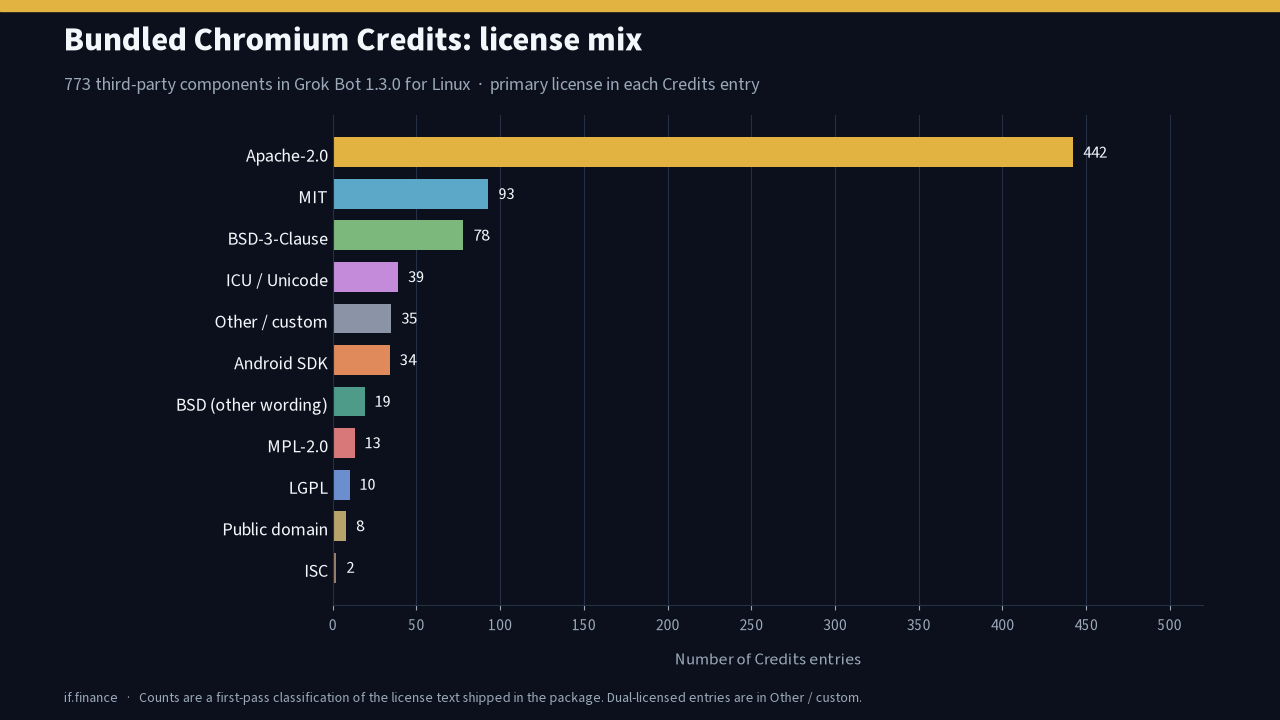
The recounted totals are: Apache-2.0, 442; MIT, 93; BSD-3-Clause, 78; ICU / Unicode, 39; Other / custom, 35; Android SDK, 34; other BSD wording, 19; MPL-2.0, 13; LGPL, 10; public domain, 8; and ISC, 2. These add up to 773. They are a first-pass classification of the shipped text, not a legal opinion.
The user agreement: where Grok Bot’s license really lives
The contract was never missing. It just was not packed in the .deb.
The Grok Bot 1.3.0 Linux package lists its license as “unknown” and ships no license file for the application itself. That is a packaging gap, not the absence of a user agreement. The contract is published on the web, and it does name Grok Bot.
The app’s About links and the Apple App Store listing point to the X-Subscription Consumer Terms of Service (last updated October 27, 2026) and the Grok Bot Terms (last updated October 31, 2026). The Grok Bot Terms are supplemental service-specific terms. They allow use for the customer’s internal business purposes, require users to be at least 18 (or the age of majority if higher), and place responsibility for the Bot’s autonomous “Agentic Actions” on the customer. The X-Subscription Consumer Terms form an agreement with SpaceX Super Intelligence LLC. That document also states that access to Grok Bot is provided by Anysphere, Inc., and that claims about those components are between the user and Anysphere.
Purchase, auto-renewal, cancellation, and refunds for a bundled paid plan are covered by the Bundled Subscription Terms of Service (last updated October 7, 2026). X Subscription Corp. is the merchant of record. Subscriptions automatically renew and are prepaid and non-refundable except as required by law. Texas law and Texas courts in Wichita or Tarrant County govern, with arbitration only if that court-forum clause cannot be enforced. A separate general Consumer Terms of Service page on x.ai does not name Grok Bot and is not the terms the app links to.
How to install / verify
If you have the .deb file, you can check its SHA-256 digest and install it with the usual apt command. We ran the checksum on this copy and got the digest in the table above. We did not run the install step for this review.
sha256sum grokbot-1.3.0.deb
sudo apt install ./grokbot-1.3.0.deb
On install, the package puts a grok-bot command on the PATH. When AppArmor is available, it can install a profile for the app. It also registers an apt repository at https://downloads.cursor.com/aptrepo so the system can receive updates. Uninstall removes the command, the AppArmor profile, and that apt source.
A request to that repository URL with no trailing slash returned HTTP 403 (Access Denied). The same URL with a trailing slash returned HTTP 200, and the repository’s Release file also returned HTTP 200. The 403 is what a bare directory request produced for us; it is not evidence that the apt source itself is missing.
The package depends on common libraries used by Electron desktop apps, including GTK 3, NSS, libnotify, libsecret, ALSA, and GBM, along with the other packages listed in the table.
Disclosure: The publisher of if.finance owns shares of Space Exploration Technologies Corp. (Nasdaq: SPCX). This is not investment advice. Do your own research.