🚪🔒 Washington Slams the AI-Chip Back Door, and Brazil Is on the List 🇧🇷
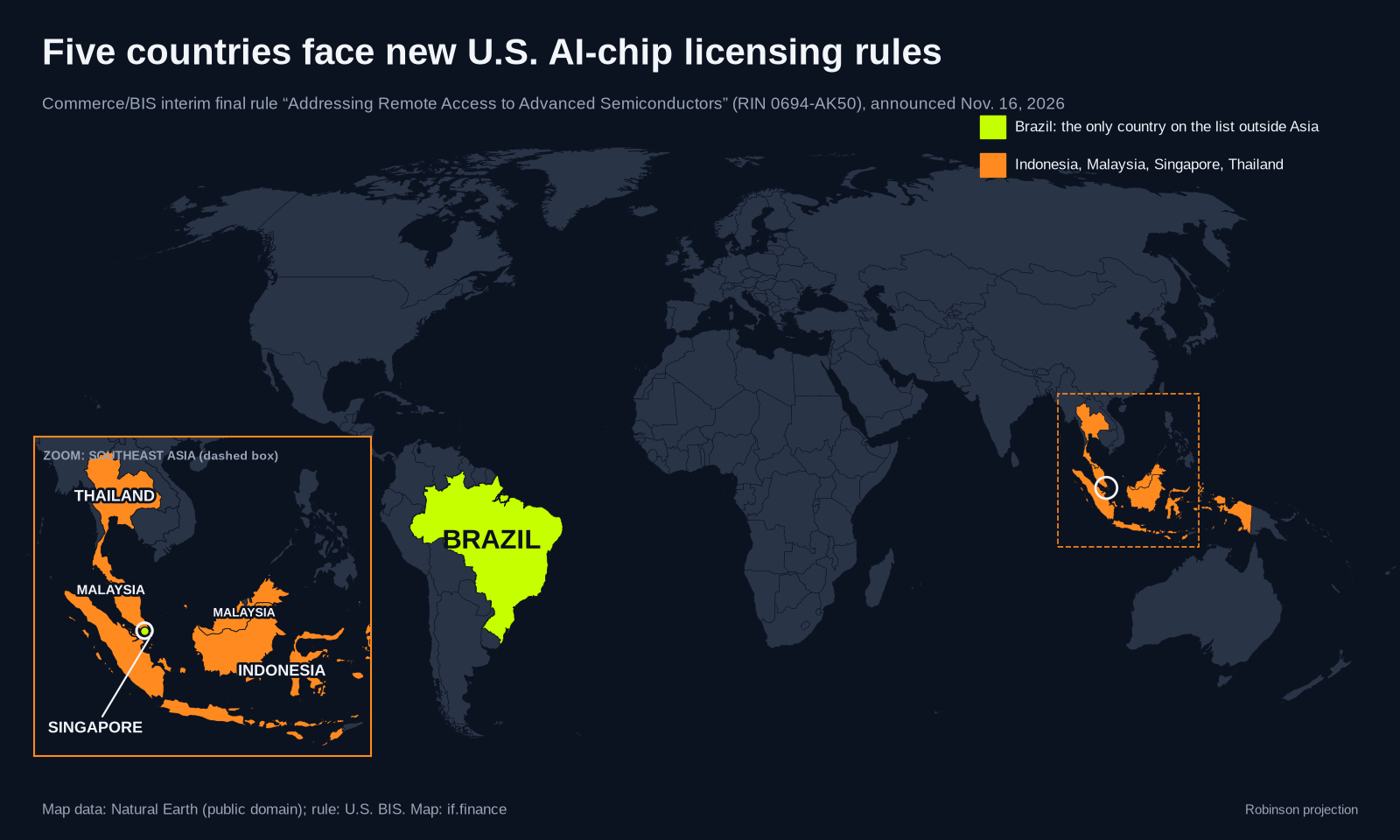
The Commerce Department on Monday moved to close the rent-a-GPU loophole, and it put Brazil, Indonesia, Malaysia, Singapore and Thailand on a new license list for advanced AI chips. For Brazil, which just signed a data-center tax break into law and is courting a R$200 billion-plus TikTok campus, the Brazil AI chip license is the story.
What Washington just changed
On November 16, the Commerce Department’s Bureau of Industry and Security (BIS) released an interim final rule, “Addressing Remote Access to Advanced Semiconductors.” An interim final rule takes effect first and takes public comments afterward. BIS said the rule was “written by and at the direction of” the Treasury Department and the National Security Council. Its goal: stop companies from getting around existing chip restrictions through “remote computing arrangements involving data centers in third countries.” [1][2]
The rule takes effect on Federal Register publication, scheduled for November 19, 2026. Comments are due 60 days after publication. [2][3]
It does four things: [2]
- It closes the remote-access back door. A new section, § 744.24, bars shipping covered chips and servers without a license to any data center, anywhere in the world, that you know provides more than 12,000,000 “aggregate TPP” to companies headquartered in Macau or Country Group D:5, or whose ultimate parent company is. TPP (total processing performance) is BIS’s measure of a chip’s computing power, and “aggregate” means the TPP of every chip in the group added together. Capacity across linked data centers counts together, including ones linked only digitally. [2]
- It adds a license requirement for five countries. A license will be required to export, reexport or transfer covered advanced chips “to or within Indonesia, Malaysia, Singapore, Brazil, and Thailand.” [2]
- It tightens the rules for chip fabs and packagers that make advanced logic chips for designers in those destinations. [2]
- It formally kills the Biden-era AI Diffusion Rule. The Trump administration announced that rule’s repeal in May 2025, and it was never enforced. [2]
D:5 is the U.S. list of arms-embargoed countries, and it includes China, Russia and Iran. [5][16] The covered items are the advanced-computing classifications, ECCN 3A090 (except 3A090.c) and 4A090, plus related “.z” items and specified software and technology. The controls cover items subject to U.S. export rules, including qualifying foreign-made chips. [2]
The fine print that matters
- Know your customer, or else. Foreign data centers must check whether their customers are directly or indirectly owned or controlled from D:5 or Macau. If a data center refuses to share that diligence, or can’t, the rule treats it as a red flag that presumptively gives the exporter “knowledge” of a violation. [2]
- There’s a 90-day clock. A data center that was already selling significant compute to D:5-headquartered companies before the rule must get a license within 90 days of the effective date “or face future export restrictions.” [2]
- Recommender systems are exempt. The control doesn’t apply to compute used only for “commercial recommender systems,” the AI that ranks products, services or content for users. The definition excludes anything that generates text, images, audio, video or code, even if it also recommends. Using the exemption requires a filing with BIS. [2]
- License reviews are case-by-case. BIS will review license applications individually. [2]
Why Brazil Needs an AI Chip License Now
The rule groups Brazil with four Southeast Asian countries it says “present a higher-than-normal risk of diversion.” It doesn’t give a reason specific to Brazil. All five countries were added “in response to concerns” that controlled chips are being diverted to entities and countries of concern without authorization. [2]
There’s one big carve-out. The five-country license doesn’t apply to chips going to a consignee or end user headquartered in the United States, or with a U.S. ultimate parent, if the exporter files monthly reports with BIS. Those reports list every party, the ultimate parents, the ECCN, the SKU, the TPP and the quantity, and they’re due by the first business day of the following month. Everyone else applies for a license, and BIS will review each one by looking at how effective the destination’s export controls are and how well it works with BIS on enforcement. [2]
That carve-out divides Brazil’s market. Microsoft ($MSFT) pledged R$14.7 billion over three years in September 2024 for cloud and AI infrastructure in São Paulo state, and AWS, part of Amazon ($AMZN), pledged R$10.1 billion through 2034 for data centers. Both are U.S.-headquartered, so chips shipped to them can use the reporting lane. [13][14] Brazilian-owned operators, universities and research centers get the license line. The Brazilian Association of Software Companies (ABES) called that a “competitive asymmetry” within Brazil’s own market. It warned that putting Brazil on a restrictive list based on a generic risk of diversion makes it harder to attract international investment. [7]
Then there’s the TikTok question. In December 2025, TikTok announced its first Latin American data center at the Pecém industrial and port complex in Ceará. It’s estimated at more than R$200 billion, including R$108 billion of equipment by 2035, with Omnia (a Pátria Investimentos data-center operator) and Casa dos Ventos supplying dedicated wind power. The first phase is slated for 2027. [10][11] Folha de S.Paulo reported, via DCD, that the higher-risk countries host large data-center complexes tied to Chinese tech companies including ByteDance, Tencent, Alibaba ($BABA) and Huawei. [8]
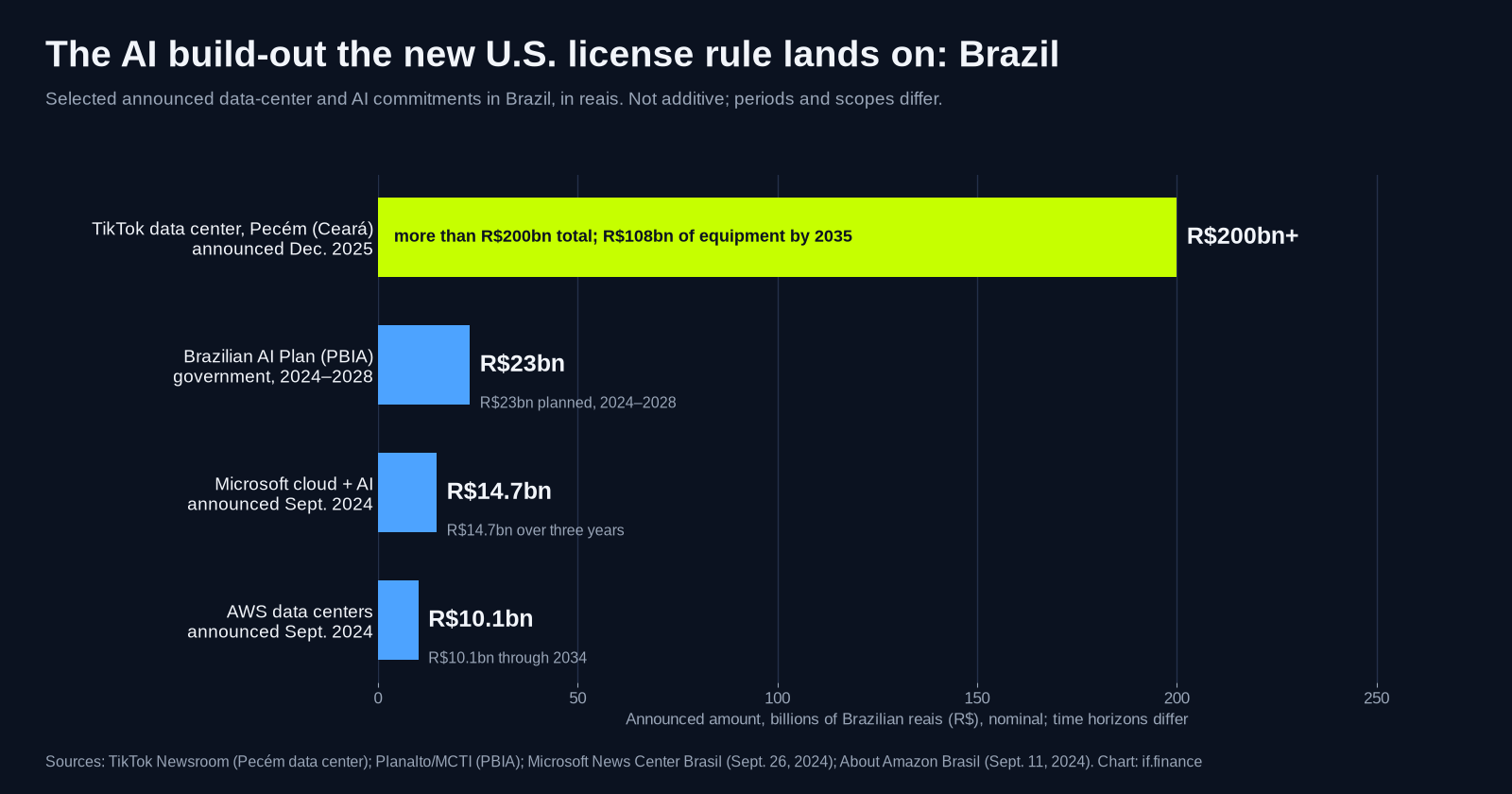
The rule lands two months after President Lula signed ReData into law on September 15, 2026. ReData offers five years of tax suspension on IT equipment bought locally or imported. Beneficiaries must use renewable or low-emission power and reserve at least 10% of capacity for the domestic market. [12] On top of that, the government’s AI plan (PBIA) budgets R$23 billion for 2024 to 2028. [15] Brazil is building the house. Washington now holds a key to the front door.
Brasília’s first response
Brazil’s trade and industry ministry (MDIC) said this is not a ban on advanced chip exports to Brazil but a requirement for authorization, so “it is not possible to assess, at the moment,” the concrete effect (our translation) on Brazilian imports. Sources told O Globo that negotiating with Washington or contesting the rule hasn’t been ruled out, though the issue hasn’t yet caused significant concern inside the government. [6] ABES wants the government and industry to work together with the U.S. on export-control cooperation. [7] Beijing went further: China’s Commerce Ministry said Tuesday it firmly opposes the rule and threatened countermeasures. [9]
Why now: the Nvidia scandal
The rule is Washington’s first policy response to the scandal that led Jensen Huang to resign as CEO of Nvidia ($NVDA) last week. That followed reports of his affair with Alice Huang, an alleged Chinese spy who worked for Singapore-based Megaspeed. China denies the spy claim. [4][5] We laid out the Singapore billing trail in our case against Jensen Huang. Shares of Nvidia, Micron ($MU), Intel ($INTC) and AMD ($AMD) fell Monday morning after the rule came out. [4]
Chris McGuire, a former National Security Council official, called it “a major step forward.” He said loopholes “related to activities inside the United States” still need to be closed. [4]
Our Take
The rule doesn’t cite a single Brazilian diversion case. Brazil got put on a list with Singapore, home of Megaspeed. That’s guilt by geography, and it comes with paperwork.
The U.S.-headquartered carve-out is the tell. Ship chips to Microsoft or AWS in Brazil, and the exporter files a monthly report. Ship them to a Brazilian-owned operator, and the exporter files a license application and waits. That isn’t a security filter. It’s an advantage for U.S. companies.
And the TikTok campus in Pecém is the elephant in the server room. Advanced chips for it face U.S. licensing. The exemption for commercial recommender systems, AI that ranks content for users, reads like it was written by someone who has spent a lot of time on a For You page. But anything generative is out. And this exemption only covers the new remote-access control, not every other license requirement.
Our verdict: Washington is right to shut the rent-a-GPU loophole, and Brasília should fight to get off the list. The fastest way off is to give BIS what the rule says it scores: a real export-control regime and enforcement it can coordinate with BIS.
What to watch next
- November 19: Federal Register publication, and the rule takes effect. [3]
- 60 days after publication: comment deadline, docket BIS-2026-0628 on regulations.gov. [2][3]
- 90 days after effectiveness: deadline for existing covered remote-access services to obtain authorization. [2]
- Brazil’s move: whether Brasília negotiates, contests or builds an export-control cooperation track. [6][7]
- Pecém: any sign of how BIS handles advanced-chip shipments for TikTok’s Brazilian campus. [10]
Related: AMD’s record AI quarter and our Grok picks page.
The bottom line: Washington is closing the rent-a-GPU back door. Brazil’s data-center boom now faces a U.S. licensing gate, with a faster lane for U.S.-headquartered buyers.
References
- BIS Issues Rule Addressing Remote Access to American Super Intelligence Technology, U.S. Bureau of Industry and Security (press release), November 16, 2026.
- Addressing Remote Access to Advanced Semiconductors (interim final rule, RIN 0694-AK50), U.S. Bureau of Industry and Security (rule text, PDF), November 16, 2026.
- Addressing Remote Access to Advanced Semiconductors (Federal Register document 2026-23529, public inspection), Federal Register (filed November 16, 2026; scheduled for publication November 19, 2026), November 16, 2026.
- Nvidia fallout: Commerce targets loophole for China’s data center use, CNBC, November 16, 2026.
- US moves to cut China’s remote access to AI chips, Ars Technica, November 16, 2026.
- Governo Lula avalia contestar restrições dos EUA à venda de chips para data centers no Brasil, O Globo (Portuguese), November 16, 2026.
- ABES avalia impactos da nova regra dos EUA que exige licença para exportação de chips avançados ao Brasil, DCD Brasil (Portuguese), November 2026.
- EUA passam a exigir licença para exportação de chips avançados de IA ao Brasil, DCD Brasil, citing Folha de S.Paulo (Portuguese), November 2026.
- China ameaça retaliar contra EUA por restrições a chips de IA que também afetam o Brasil, g1 (Portuguese), November 17, 2026.
- TikTok anuncia seu primeiro data center na América Latina com investimento superior a R$ 200 bilhões, TikTok Newsroom (Portuguese), December 3, 2025.
- TikTok confirma o seu primeiro data center na América Latina, no Ceará, Estadão (Portuguese), December 3, 2025.
- Presidente sanciona Regime Especial de Tributação para Serviços de Datacenter, Palácio do Planalto, Government of Brazil (Portuguese), September 15, 2026.
- Microsoft announces 14.7 billion Reais investment over three years in Cloud and AI infrastructure and provide AI training at scale to upskill 5 million people in Brazil, Microsoft News Center Brasil, September 26, 2024.
- AWS investirá mais de R$10 bilhões para expandir infraestrutura no Brasil, About Amazon Brasil (Portuguese), September 11, 2024.
- “Um marco neste país”, diz Lula ao receber proposta de Plano Brasileiro de Inteligência Artificial, Palácio do Planalto, Government of Brazil (Portuguese), July 30, 2024.
- Supplement No. 1 to Part 740: Country Groups, eCFR, Title 15 (Export Administration Regulations), current.
Image credits
- Featured image: graphic by if.finance from Natural Earth public-domain map data (terms); country list from the BIS rule. Linked to the BIS press release.
- Map: made by if.finance from Natural Earth public-domain data (terms); countries from the BIS interim final rule. Linked to the BIS press release.
- Chart: made by if.finance from the TikTok Newsroom, Microsoft News Center Brasil, About Amazon Brasil and Palácio do Planalto. Linked to the TikTok release.