Anthropic Just Went Public. Wall Street Expects Its Debt to Be Junk.
UPDATED Nov 22, 2026: Wall Street Expects Anthropic’s Debt to Be Junk
Four days after Anthropic priced the largest IPO on record, the bond market is already telling a colder story than the stock ticker did on opening day.
The Wall Street Journal, in a report published Sunday night by Matt Wirz and Jack Pitcher, says Anthropic has committed to spend some $900 billion in the coming years on the computing power behind its models, and that Wall Street expects the company’s debt to be rated junk, or below investment grade. The Journal’s dek is blunt about the stakes: after a turbulent IPO, that credit rating will affect Anthropic’s capital plans and the future of the AI industry.
The Journal’s own X account put it more sharply on Sunday, Nov. 22, 2026, at 10:23 p.m. Chicago time: “Anthropic is unprofitable, less than six years old and Wall Street isn’t confident it will meet its long-term obligations. The debt market expects credit-rating firms to rate its bonds as junk, or below investment grade.”
We could not read the full Journal article behind the paywall. The facts below come from the headline, dek, opening paragraphs and on-page summary bullets we were able to read on the Journal’s page, from the Journal’s X post, and from other primary and reputable sources we checked. We are not inventing numbers from the locked body.
The opening of the Journal story says Anthropic’s stock-market debut “was rocky,” and that there are even bigger questions about how it will fare in the bond market. It says the company raised more than $100 billion last week and is worth around $1.18 trillion, above Walmart or JPMorgan Chase, but has committed to spend some $900 billion on compute. On-page summary bullets add that, despite a $1.3 trillion market value, the debt market expects junk; that Anthropic is unprofitable and has committed to spend $900 billion on computing power “over the next couple of years”; and that some bond-fund managers expect a BB rating, which would make Anthropic the most valuable U.S. high-yield company.
Those commitments are not a surprise. Anthropic’s S-1/A, which we wrote about below, already disclosed roughly $900.9 billion of committed spending, substantially all on compute and infrastructure, with about $451.6 billion expected before the end of 2030 and about $70.7 billion due in the 12 months after Sept. 30.
What we can confirm about last week’s IPO, from Anthropic’s own announcement and from CNBC, is this: the company priced 980 million Class A shares at $83 on Wednesday, Nov. 18, raising about $81.3 billion, and the stock began trading on the Nasdaq as ANT on Thursday, Nov. 19, beating the prior record set by SpaceX in June. CNBC said ANT opened at $111.50 and closed the first day at $97.17, up 17% from the IPO price, with a fully diluted market cap of roughly $1.8 trillion. Yahoo Finance reported that shares dropped nearly 8.5% on Friday, Nov. 20, closing at $88.91, and put the market cap at about $1.17 trillion, in line with the Journal’s “around $1.18 trillion.”
This is not a published junk rating we have read from Moody’s, S&P or Fitch. It is the debt market’s expectation, as the Journal reports it, and it is not the first warning. On Oct. 30, TechCrunch, citing the Financial Times, reported that Blackstone, the anchor investor in a $63 billion deal to finance Anthropic’s chips, had told investors it now expects a “high” junk rating in the double-B range after the IPO, after previously saying it expected investment grade before 2027. TechCrunch said Anthropic and Blackstone declined to comment. That forecast is a prediction, not a rating.
On IPO day, CNBC reported that CEO Dario Amodei said Anthropic is “hoping” to secure an investment-grade credit rating in the future. “Obviously we will see how that turns out,” he said. “Debt is an instrument that we have available to us, and we’d like to use at some point in the future.”
Our opinion: hope is not a rating. A company can be worth more than a trillion dollars in the stock market and still be treated like junk in the bond market. Equity buyers paid up for growth. Credit buyers are being asked to fund a compute tab that already runs to about $900 billion, for a business that is still unprofitable and not yet six years old. If the Journal and the earlier FT reporting are right, Anthropic may have to pay high-yield rates, lean even harder on supplier financing, or slow the build. That is not just Anthropic’s problem. The AI industry has been spending as if cheap, deep capital was a given. A junk tag on the largest IPO in history would be a signal that it is not.
Our Opinion: SpaceXSI vs. Anthropic
In our opinion, this news makes SpaceXSI look like one of the titans.
We want to be precise about what we can and cannot verify. SpaceXSI is SpaceX’s AI company, not a separate listed stock. SpaceX announced on Feb. 2, 2026, that it had acquired xAI, later renamed SpaceXAI in July 2026 and SpaceXSI in October 2026. The listed parent is Space Exploration Technologies Corp., which trades on the Nasdaq as SPCX.
We could not find, and are not claiming, a standalone credit rating for SpaceXSI itself. We also could not independently confirm letter grades from Moody’s, S&P or Fitch. What we could verify is the parent. In June 2026, SpaceX priced a $25 billion inaugural issue of senior unsecured notes, in five tranches due 2031 through 2056, under the SPCX name. Bloomberg, in a report carried by Yahoo Finance, said SpaceX has sold high-grade corporate bonds, that CFO Bret Johnsen has described a “strong investment-grade balance sheet,” and that later chip-lease financings have been structured to help SpaceX maintain investment-grade credit ratings.
Set that next to Anthropic: newly public, still unprofitable, less than six years old, with some $900 billion of compute commitments and a debt market that, the Journal says, already expects junk. One AI effort sits inside a listed parent that has already issued high-grade bonds. The other may have to borrow like a high-yield issuer. In our opinion, that contrast is what makes SpaceXSI look like a titan.
The original story, written ahead of the IPO pricing, follows.
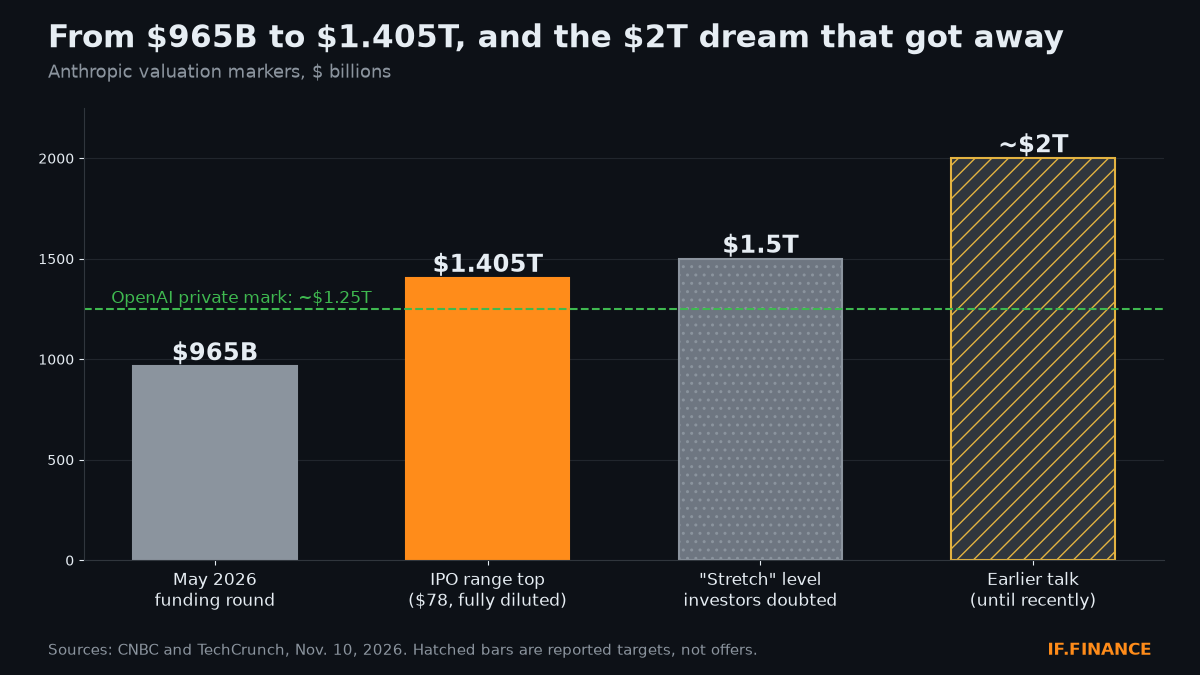
Anthropic is asking public investors for up to $1.405 trillion. It is asking during the week Nvidia lost its CEO, the 10-year Treasury yield punched through 5% and the AI trade started flinching at its own shadow. The Claude maker set a range of $70 to $78 a share on 825 million Class A shares, plans to price on Wednesday, Nov. 18, and expects to start trading on the Nasdaq under the ticker ANT on Thursday, Nov. 19 (CNBC). Anthropic confirmed those dates on Thursday (Yahoo Finance).
That is a lot of zeros for a five-year-old company. It is also, oddly, a discount. Not long ago, the talk was $2 trillion. Now the top of the range sits about 30% below that, and the book is reportedly about six times oversubscribed anyway (Bloomberg). So which is it: the deal of the cycle, or the moment the market finally puts a price tag on AI hype? We think it is a bit of both, and the details matter more than the headline number.
The deal, by the numbers
- Shares: 825 million Class A shares. Anthropic is selling 801,351,354 of them and existing holders are selling 23,648,646. Underwriters get a 30-day option on up to 123.75 million more (Anthropic).
- Price range: $70 to $78, for gross proceeds of $57.75 billion to $64.35 billion (TechCrunch).
- Valuation: up to $1.405 trillion on a fully diluted basis at the top of the range, up from the $965 billion mark set in a May funding round (CNBC).
- Side deal: AMD, Broadcom, Google, Micron, Microsoft, Nvidia and TSMC agreed to buy $26 billion of non-voting Class N stock at the IPO price. Google and Nvidia are in for $10 billion apiece (TechCrunch).
- Cash in the door: Anthropic estimates net proceeds from the IPO and the placement of about $84.6 billion, or $93.7 billion if the underwriters’ option is exercised in full (S-1/A).
- Retail: the company is targeting about 20% of the deal for individual investors, versus the usual 5% to 10%, according to people familiar with the plans (CNBC).
- Banks: Goldman Sachs and Morgan Stanley lead, alongside 20 other banks (Quartz).
Add the $64.35 billion top-end IPO to the $26 billion placement and you get roughly $90.4 billion, which would top the $85.7 billion SpaceX raised in its record IPO about five months ago (CNBC, Bloomberg).
The growth is real. Wildly, absurdly real.
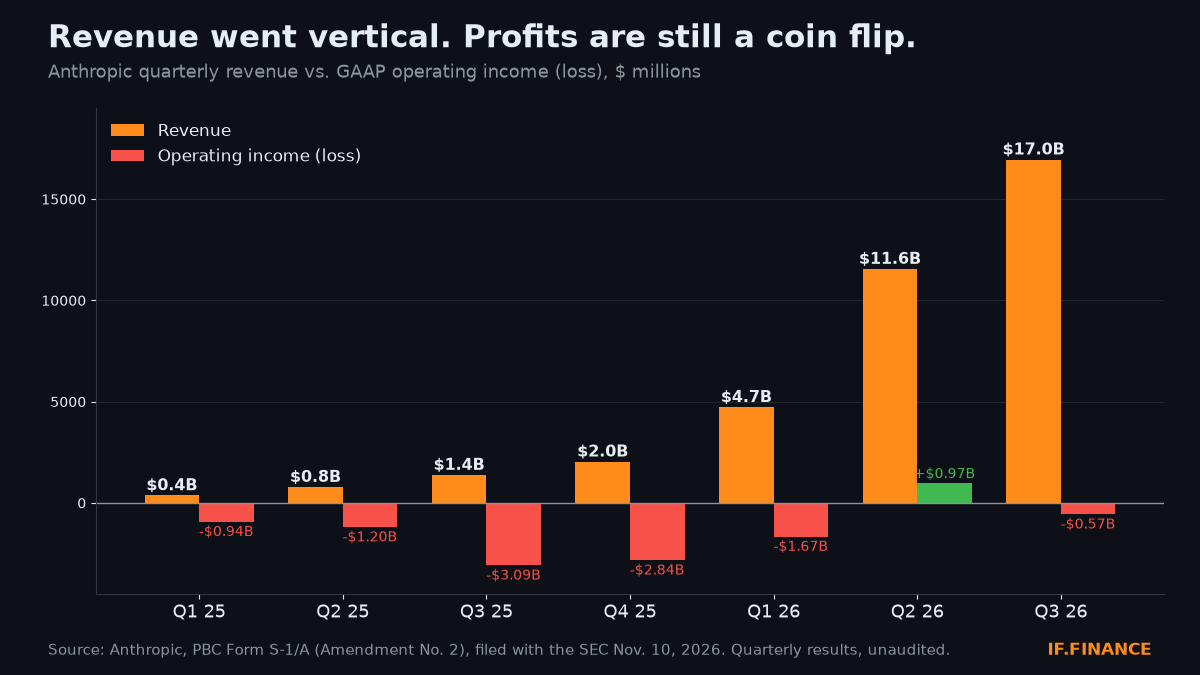
Strip out the noise and the core business is the most impressive thing in this prospectus. Revenue for the nine months to Sept. 30 was $33.24 billion, up from $2.55 billion a year earlier. Third-quarter revenue alone was $16.96 billion, up about 47% from $11.56 billion in the second quarter. For context, Anthropic booked $4.59 billion in all of 2025 (S-1/A).
Then there is the metric the bankers will lead with: run-rate revenue of about $81 billion as of Oct. 31, up $10 billion in a single month (S-1/A). Customers paying $100,000 or more over the trailing 12 months jumped from more than 950 to more than 11,900 in a year.
Read the fine print on that $81 billion, though. Anthropic calculates run-rate revenue by taking 28 days of usage-based fees and multiplying by 13, then adding a month of subscription fees times 12 (S-1/A). That is a snapshot, not a contract. The company itself warns that the figure can swing with seasonal usage, and that it hasn’t been independently verified. It is a great number. It is not revenue.
About that $104 billion loss
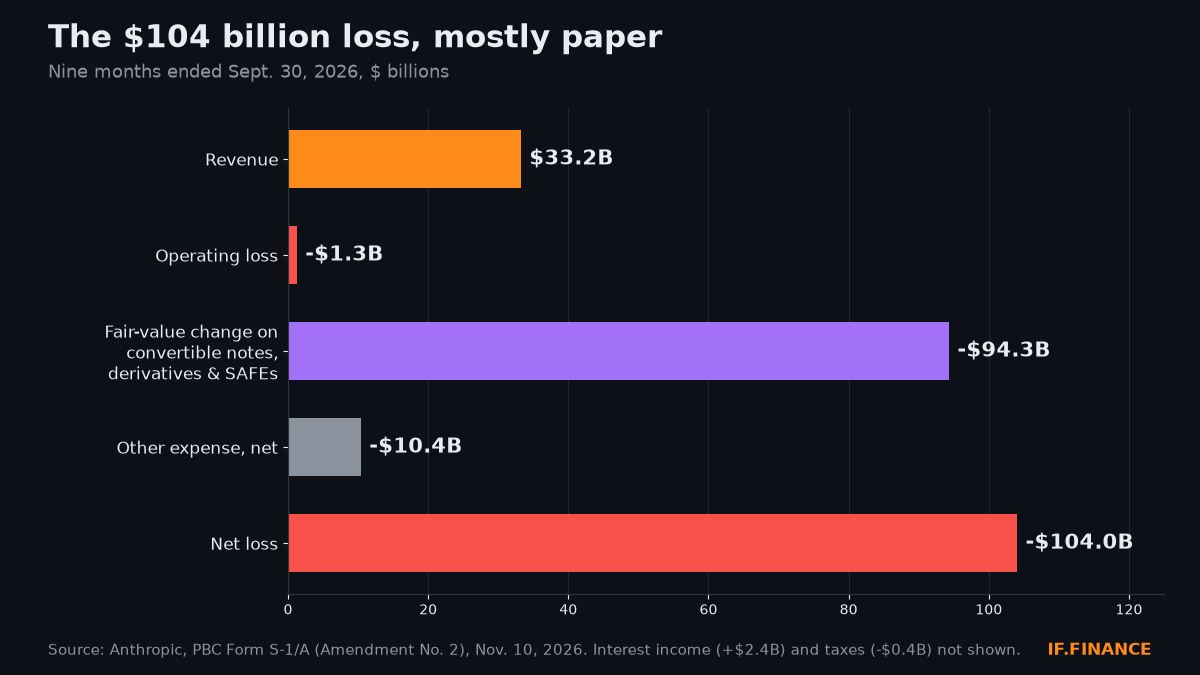
The scariest line in the filing is a nine-month net loss of $104.04 billion. Before anyone screams fraud, bubble or both: about $94.3 billion of that came from changes in the fair value of convertible notes, derivative liabilities and SAFEs (S-1/A). In plain English, Anthropic got more valuable, so the instruments it sold to early backers got more expensive on paper. That is accounting, not cash out the door.
The operating line is the honest one, and it is mixed. Anthropic lost $1.26 billion from operations over nine months, down from $5.22 billion a year earlier. The second quarter showed $974 million of operating income. Then the third quarter flipped back to a $567 million loss as compute and infrastructure costs nearly doubled quarter on quarter, to $9.86 billion (S-1/A). The filing blames the swing mainly on $5.0 billion of compute bought under short-term commitments, which costs significantly more than its multi-year deals, plus $2.0 billion of non-cash charges tied to its employee donation matching program. Adjusted operating margin slipped from 19% to 15%. On that adjusted measure, Anthropic earned $4.1 billion over the nine months (S-1/A).
The $900 billion elephant
Here is the number that should keep long-term holders up at night. Anthropic disclosed roughly $900.9 billion of committed spending, substantially all on compute and infrastructure. About $451.6 billion is expected before the end of 2030, and about $70.7 billion is due in the 12 months after Sept. 30 (S-1/A).
Put that next to the balance sheet. Anthropic had $131.8 billion in cash and short-term investments at Sept. 30, about $212.7 billion pro forma after the deal. That is a war chest, and it is spoken for. This IPO isn’t really a payday. It is a down payment on the biggest compute bill any company has ever signed up for.
And notice who is writing the $26 billion check on the side: the same chip, cloud and memory companies that sell Anthropic its compute. Nvidia and Google alone account for $20 billion of it (TechCrunch). Those placement shares are not registered in the offering and are not subject to underwriter lock-ups (CNBC). Suppliers funding their own customer is the circular-money pattern that has made AI skeptics nervous all year. Here it is, in a federal filing.
You are buying a seat, not a steering wheel
Anthropic is a public benefit corporation, and its governance says so loudly. A single Class F share, held by an LLC of the seven co-founders, carries 50.1% of the total voting power. A Long-Term Benefit Trust, through Class T stock, generally gets to elect and remove a majority of the board (S-1/A). Class A buyers get one vote per share and very little say.
Meanwhile, each of the seven co-founders plans to sell nearly 3.4 million shares, roughly $250 million apiece at the $74 midpoint (TechCrunch). That is a rounding error next to their stakes, and we don’t begrudge it. But the setup is clear: the public supplies capital, the founders and the trust keep control.
Our aim is to help humankind chart a safe course through this technological evolution, open new frontiers of discovery, and bring forth an age of miracles.
Anthropic co-founders, in the prospectus, via CNBC
Worst. Week. Ever. (To launch a roadshow.)
Now for the awkward timing. In the last 48 hours alone:
- Nvidia lost its CEO. Jensen Huang resigned on Thursday amid a widening personal scandal, and CFO Colette Kress became interim CEO. Nvidia shares fell as much as 16% before closing down 4.3% (NBC News, Reuters). Nvidia is one of Anthropic’s key chip suppliers and a $10 billion buyer in the placement.
- Nvidia reports on Tuesday, Nov. 17, one day before Anthropic prices (Axios). It will be the chipmaker’s first earnings report without Huang in charge (Fortune).
- Rates broke higher. The 10-year Treasury yield jumped more than 13 basis points to 5.125% on Thursday, and traders priced 100% odds of a Fed hike in December after a hot CPI print (CNBC). Long-duration growth stories hate this.
- Politics turned. Last week’s midterms brought a Democratic sweep in Congress and state ballot measures that could slow the AI data center buildout (CNBC).
And yet the demand keeps coming. CNBC’s sources said the book was covered across the whole range on an allocable basis on day one, with institutional demand ahead of where SpaceX’s was at the same stage (CNBC). By Thursday, Bloomberg reported orders of about six times the shares on offer (Bloomberg). Goldman Sachs analysts are circulating models that put Anthropic’s 2030 revenue near $685 billion (NDTV, via Bloomberg). Amodei is scheduled for a livestreamed IPO chat with JPMorgan CEO Jamie Dimon today, Friday, around lunchtime in New York (Bloomberg).
One analyst’s view, from Seaport Research’s Jay Goldberg, who has a sell rating on Nvidia: the Nvidia shock won’t derail the deal, but it will mean “much tougher questions” when Anthropic reports its first quarter as a public company (Fortune). We agree.
What the price actually implies
Some quick math of our own. At $1.405 trillion, ANT would be valued at about 17 times its $81 billion run-rate. Against third-quarter revenue annualized (about $67.8 billion), it is closer to 21 times. That is expensive for a company with negative GAAP operating income last quarter. It is cheap if Anthropic is anywhere near that $685 billion 2030 model.
| Metric | Figure | Source |
|---|---|---|
| IPO range | $70 to $78 per share | S-1/A |
| Fully diluted value (top) | $1.405 trillion | CNBC |
| May 2026 private mark | $965 billion | CNBC |
| Run-rate revenue (Oct. 31) | ~$81 billion | S-1/A |
| 9-month revenue | $33.24 billion | S-1/A |
| 9-month net loss | $104.04 billion | S-1/A |
| Compute commitments | ~$900.9 billion | S-1/A |
| Value / run-rate (our calc) | ~17x | IF.FINANCE |
For comparison, rival OpenAI was reportedly valued at $1.25 trillion after raising $11 billion, about half of what it first set out to raise (TechCrunch). Public investors are about to decide whether Anthropic deserves to sit above its biggest rival.
Our Take
We think Anthropic is the best business ever to arrive at an IPO looking this expensive. The revenue curve is real and the enterprise traction is real. The $104 billion loss is mostly an accounting echo of its own success. Pricing below the $2 trillion dream, into a frightened market, is smart. It leaves room for a first-day pop, and a pop is what every bank on that 22-name cover wants.
But we are not drinking the run-rate Kool-Aid. A $900.9 billion compute bill, an operating line that flipped back to red last quarter, and a cap table stuffed with suppliers buying their own customer’s stock make this a leveraged bet on AI demand staying vertical through 2030. Add a 20% retail allocation, a 5.125% 10-year and Nvidia reporting the day before pricing, and the setup for a sharp first-week reversal is just as real as the setup for a pop.
Our playbook: let the opening frenzy burn off. The first real test is the first earnings report, when run-rate meets GAAP in public. If ANT trades through the range on day one, that tells you about the AI mood, not about Anthropic’s value. Watch the Nov. 17 Nvidia print, watch the 10-year, and watch whether Anthropic upsizes. An upsize into this tape would be the strongest demand signal we have seen all year. It would also leave less on the table for everyone buying after the bell.
This article is for informational and entertainment purposes only and is not investment advice. Do your own research. IPO prices, schedules and allocations can change before pricing.
References
- Anthropic, PBC: Form S-1/A, Amendment No. 2 (U.S. SEC (EDGAR), Nov. 10, 2026)
- Anthropic launches roadshow for proposed initial public offering (Anthropic, Nov. 10, 2026)
- Anthropic sets IPO price range of $70 to $78, looks to start trading Nov. 19, sources say (CNBC, Nov. 10, 2026)
- Anthropic sets IPO price range of $70 to $78 per share to reach an implied valuation of $1.404 trillion (TechCrunch, Nov. 10, 2026)
- Anthropic Plans IPO Live Stream With Amodei, JPMorgan CEO Dimon (Bloomberg News via Bloomberg Law, Nov. 10, 2026)
- Anthropic’s IPO is said to be multiple times oversubscribed as roadshow gets under way (Quartz, Nov. 11, 2026)
- Anthropic’s IPO roadshow kicks off, and the big money is already lining up (MarketWatch via Morningstar, Nov. 11, 2026)
- Marketing, Pricing, Trading: 5 Things To Watch As Anthropic IPO Nears (NDTV (Bloomberg), Nov. 2026)
- Anthropic’s IPO Is Said to Be About Six Times Oversubscribed (Bloomberg News via Bloomberg Law, Nov. 12, 2026)
- Anthropic sets IPO date for Thursday, Nov. 19 (Yahoo Finance, Nov. 12, 2026)
- Nvidia stock falls after Jensen Huang resigns (NBC News, Nov. 12, 2026)
- Nvidia CEO Jensen Huang resigns in blow to AI boom he helped foster (Reuters via Investing.com, Nov. 12, 2026)
- Anthropic’s blockbuster IPO just got harder after Jensen Huang’s dramatic exit as Nvidia CEO (Fortune, Nov. 12, 2026)
- Huang’s exit triggers an AI earthquake (Axios, Nov. 12, 2026)
- 10-year Treasury yield jumps back above 5% as oil gains and more Fed rate hikes expected (CNBC, Nov. 12, 2026)
- Anthropic Committed to Spend $900 Billion. Wall Street Expects Its Debt to Be Junk (The Wall Street Journal, Matt Wirz and Jack Pitcher, Nov. 22, 2026, 9:00 p.m. Chicago time)
- Anthropic is unprofitable, less than six years old and Wall Street isn’t confident it will meet its long-term obligations… (The Wall Street Journal via X, Nov. 22, 2026, 10:23 p.m. Chicago time)
- Anthropic prices initial public offering (Anthropic, Nov. 18, 2026)
- Anthropic IPO raises over $81 billion in largest offering on record, topping SpaceX (CNBC, Nov. 18, 2026)
- Anthropic IPO takeaways: ANT debuts with $1.8 trillion market cap in landmark moment for AI (CNBC, Nov. 19, 2026)
- Anthropic stock drops 8% after rip-roaring IPO (Yahoo Finance, Nov. 20, 2026)
- Anthropic expected to receive high ‘junk’ rating from credit agencies following IPO, FT report says (TechCrunch, citing the Financial Times, Oct. 30, 2026)
- xAI joins SpaceX (SpaceXSI / x.ai, Feb. 2, 2026)
- Elon Musk’s SpaceX acquiring AI startup xAI ahead of potential IPO (CNBC, Feb. 2, 2026)
- xAI is now officially known as SpaceXAI (Engadget, July 7, 2026)
- XAI makes its rebrand to SpaceXAI complete with a new logo (Yahoo Finance, July 6, 2026)
- Elon Musk rebrands SpaceXAI following Trump directive (Fox Business, Oct. 4, 2026)
- SpaceX Announces Pricing of $25 Billion Inaugural Bond Issuance (SpaceX investor relations, June 23, 2026)
- SpaceX Sells $32 Billion of AI Chip Debt at Yields Topping 8% (Bloomberg via Yahoo Finance, Nov. 20, 2026)
Read the book: THE EMPTY BOX: The Bill Is Coming
Disclosure: THE EMPTY BOX is written by if.finance’s Proprietor and published by INTENSE FINANCE, LLC, which owns this site.