

Terafab is a planned vertically integrated semiconductor manufacturing complex led primarily by SpaceX (with Tesla and xAI involvement) at the former Gibbons Creek, near Navasota coal-fired power plant site and surrounding lands in Grimes County, Texas. The production facility is designed as the high-volume manufacturing counterpart to a smaller research and development (R&D) pilot fab at Tesla’s Giga Texas North Campus in Travis County. Together they form a two-site program aimed at producing AI logic and memory chips at enormous scale.
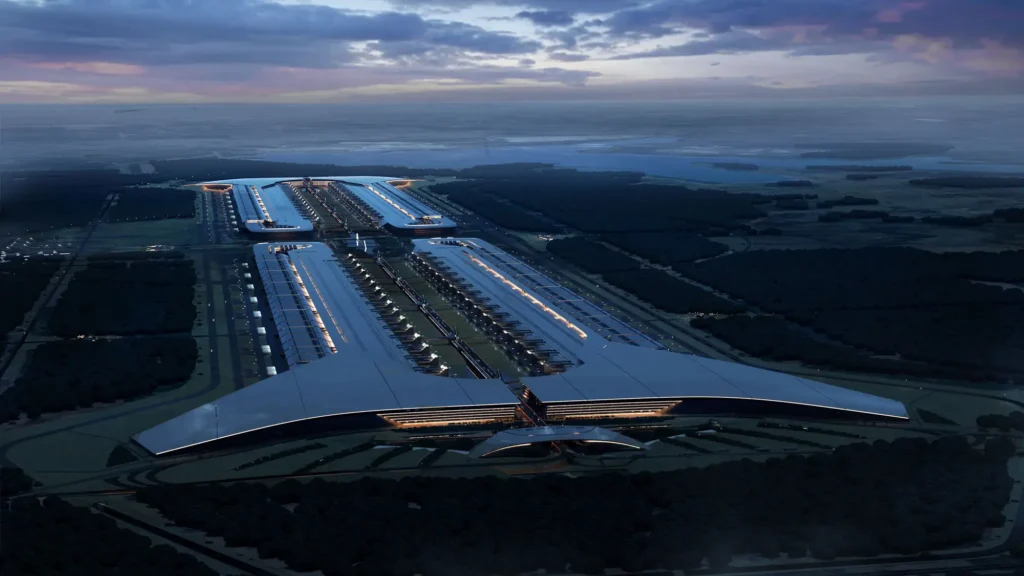
SpaceX describes a single primary building of roughly 100 million square feet—at least 2.5 miles long and about 10 times the footprint of the main Tesla Giga Texas building—which would rank among the largest buildings on Earth by floor area. The full multi-phase vision encompasses fab buildings, cleanrooms, advanced packaging and testing, central utility plants, substations, water treatment and recycling, on-site power generation, industrial wastewater treatment, and space-compute test facilities. County and state filings project up to four phases totaling as much as $119 billion in capital investment, with a confirmed first-phase commitment of $16.8 billion.
The plant is intended to manufacture, package, and test chips including low-power inference devices for Tesla Optimus humanoid robots and Cybercab robotaxis, high-power chips for SpaceX’s planned space-based data centers, and broader AI compute silicon targeting ambitious capacity goals (including references to 1 terawatt of new compute per year in related statements). Customers are primarily Musk-affiliated entities: Tesla (vehicles, robots, ground AI), SpaceX (Starlink, orbital compute, radiation-tolerant chips), and xAI (training compute). Elon Musk has framed the project as a necessity driven by chip supply constraints for these ambitions.
Key Companies and Entities Involved
- SpaceX (via TeraFab AI, LLC or related filings): Primary operator of the Grimes County production fab. Handles high-volume manufacturing. Land acquisition has been conducted through entities such as WIT TECH LLC, is a private limited liability company (shell/holding entity) closely linked to Elon Musk’s orbit (Wyoming company with Palo Alto address; deeds linked to Jared Birchall of Musk’s family office). SpaceX confirmed the project publicly in August 2026 and is pursuing on-site natural gas power generation to keep the load largely off the ERCOT grid (with potential excess power export).
- Tesla: Partner in the overall Terafab program. Operates the smaller Research Fab at Giga Texas (groundbreaking April 2026) focused on process development, transistor architectures, and packaging iteration. Shares the goal of securing proprietary AI silicon supply.
- xAI: Affiliated for AI training compute needs; part of the broader Musk ecosystem that the chips will serve.
- Intel: Named foundry partner (announced around April 2026). Terafab plans to use Intel’s 14A node (roughly 1.4 nm-class process featuring High-NA EUV lithography, PowerDirect backside power delivery, and advanced packaging). Musk has indicated 14A should be mature by the time high-volume production scales. Discussions with TSMC have also been confirmed by Musk (“Just discussions, but something may come of it”), though Intel remains involved.
- Prior site owners: Texas Municipal Power Agency (TMPA—cities of Bryan, Denton, Garland, Greenville) operated the ~470 MW Gibbons Creek Steam Electric Station (1982–2018). Charah Solutions acquired the plant and reservoir (~6,166 acres including the ~3,500-acre reservoir) in 2021 for demolition and remediation.
- Supporting context includes Texas A&M University System research assets (Semiconductor Institute, AggieFab, Cyclotron Institute, RELLIS Campus) and nearby projects such as Substrate Inc.’s prospective facility, forming part of a broader Brazos Valley semiconductor concentration.


SpaceX’s S-1 IPO filing (May 2026) described only a “general framework” with Tesla; specific IP, financial terms, and timelines remain subject to further agreements, and neither Tesla nor Intel is obligated to stay involved.
Site, Location, and Infrastructure Advantages
The core site centers on the former Gibbons Creek Reservoir area in Grimes County, roughly 20 miles east of Bryan-College Station, ~70 miles northwest of Houston, and ~90 miles northeast of Austin. Access is via Timberwolf Trail off Texas Highway 30. Nearby communities include the small city of Iola (Iola ISD), the unincorporated community of Carlos, and Anderson (Grimes County seat). College Station and Bryan form the primary nearby urban/employment base and are preparing for secondary growth impacts (housing, services, suppliers).
WIT TECH LLC assembled substantial acreage (reports of ~7,700+ acres across dozens of parcels by late August 2026), with a larger reinvestment zone exceeding 22,000 acres. The site reuses coal-plant infrastructure: reservoir water rights and intake (from Navasota River), discharge history, grid interconnection point, substation footprint, and transmission rights-of-way.
Why this site? It uniquely combines power potential, water, contiguous land (thousands of acres needed for vertical integration plus buffers/suppliers), and workforce access (Texas A&M engineering pipeline, commuting distance to Bryan-College Station, Houston, and Austin). Alternatives (near Samsung Taylor, Permian Basin, Arizona, Gulf Coast) were constrained by land, ERCOT interconnection queues (often 5–7+ years), water, workforce, or contamination risks. SpaceX plans behind-the-meter natural gas plants (plus batteries) for power quality and speed—critical for sensitive fab tools—and recycled surface water from the reservoir (no local groundwater commitment, with notice requirements for any groundwater permit). Full buildout water needs have been estimated in the tens of millions of gallons per day range for ultrapure water production.

Maps and location resources (approximate coordinates for Gibbons Creek Reservoir ~30.62–30.63°N, 96.05–96.06°W):
- Google Maps search for “Gibbons Creek Reservoir, Grimes County, TX”
- Wikipedia location map and coordinates: https://en.wikipedia.org/wiki/Gibbons_Creek_Reservoir
- USGS/National Map and topo resources via searches for the reservoir
- Highway 30 corridor linking westward to Bryan-College Station and Texas A&M assets
The closest named communities are Iola and Carlos; Anderson is the county seat a short drive away. Bryan-College Station is the nearest major population center (~20–25 miles west).

Technology, Timeline, and Scale
Process technology centers on Intel 14A (High-NA EUV) with possible multi-node evolution. An intriguing element is discussion of a free-electron laser (FEL) as a potential shared EUV light source for many scanners—more efficient at extreme scale than individual laser-produced plasma sources used by ASML tools today. xLight (with CHIPS Act support and Pat Gelsinger involvement) is a leading FEL-EUV developer; Musk has publicly reacted positively to the concept. ASML scanners would still handle exposure even with an external source.
Status as of mid-to-late 2026: Tax agreements in place; site clearing and early structural work (foundation excavation, rebar) reported underway. Targets have included limited operations toward late 2027 in some statements, with independent analyses projecting later volume production (e.g., operations late 2029, volume mid-2030 for Phase 1 depending on build/equip/ramp timelines). Phase 1 is the firmest commitment; later phases are conditional.
Capital figures vary by source and phase: $5 billion minimum by 2030 in county agreements; $16.8 billion first-phase; earlier filings citing $55 billion initial-phase figures; up to $119 billion full four-phase buildout. Jobs: Phase 1 commitments around 3,000 permanent positions (plus thousands of construction jobs), spanning engineering to support roles; county agreements have lower minimum thresholds in some documents. A $30 million Texas Enterprise Fund grant and JETI (Jobs, Energy, Technology and Innovation) agreements with Anderson-Shiro CISD and Iola ISD provide additional incentives. Grimes County deals involve substantial property tax abatement (reported variously as near-100% on eligible value for periods, or effective ~78% in company clarifications) in exchange for fixed payments (e.g., $10 million upfront + $20 million annually for extended periods, totaling hundreds of millions).

Community Concerns in Detail
The project has divided Grimes County residents. Supporters highlight generational economic transformation for a rural county (population under ~35,000), potential tax-base growth (projections of the project dwarfing current county valuation), high-wage jobs, and national strategic value in domestic advanced semiconductor capacity amid U.S.-China competition. Texas A&M and regional economic groups have emphasized multipliers, earnings, and output gains. College Station officials are proactively studying housing, infrastructure, and service needs, drawing lessons from other Texas boom areas.
Opposition and caution, organized in part through Grimes County Citizens for Responsible Development (GCCRD), center on process and impacts:
- Transparency and process speed: Many residents felt “blindsided.” Land deals and incentive negotiations advanced rapidly with limited early public detail. Petitions (nearly 900 signatures reported) demanded stronger protections, independent legal counsel for the county, fuller disclosure of maps/parcels/water/power/road/emergency plans, and clawbacks. County commissioners tabled broader accountability resolutions at times while advancing the specific deals (4-1 votes). One commissioner opposed, citing insufficient transparency.
- Water, environment, and rural character: Fears over reservoir use, potential contamination risks from industrial processes, impacts on local animals/land, noise, lighting (night-sky or residential effects), and irreversible change to a quiet agricultural/recreational area. SpaceX commitments to surface water recycling and on-site treatment are noted but met with calls for enforceable safeguards and independent oversight.
- Infrastructure strain: Roads (Highway 30 and local routes), emergency services (fire/EMS funding), traffic from construction and operations, and secondary growth (housing, RV parks, services). Residents near the site report property uncertainty, shared fences with assembled parcels, and difficulty selling or planning.
- Tax policy and equity: Criticism of large abatements for a well-capitalized company (“world’s richest man” framing in some comments), questions about net local benefit versus costs borne by residents, and whether guidelines against projects creating hazards were adequately applied. Fixed payments provide certainty but forgo potential upside from full valuation.
- Other: Quality-of-life loss for those who moved for rural living; long-term population and cost-of-living pressures; secondary effects on neighboring Brazos County/College Station.

SpaceX has engaged in public Q&A sessions, clarified payment structures, and emphasized local hiring breadth and construction opportunities. A lawsuit by SpaceX against the Texas Attorney General and Grimes County seeks to seal certain records (land deals, full tax applications, costs, designs) as trade secrets after public-information requests (including from GCCRD affiliates) and an AG ruling favoring partial disclosure. Critics argue taxpayers deserve transparency on incentive deals.
Broader angles: The project exemplifies Texas “brownfield inheritance” (reusing retired industrial sites with existing infrastructure) and the structural logic of concentrating AI/industrial capacity where power, water, land, and talent align. It advances U.S. semiconductor reshoring and vertical integration ambitions but raises classic large-project tensions between economic development, environmental stewardship, democratic process, and rural identity. Success depends on execution of power/water systems, technology readiness (14A maturity, any FEL path), supply-chain buildout, and managing community relations over a multi-decade horizon. Later phases are not guaranteed and hinge on commercial and technical outcomes. Independent analyses note ambitious timelines given fab complexity.
This remains an active, evolving project with site work underway as of fall 2026. Local governments, residents, and the companies continue to navigate the balance between transformative opportunity and protective governance.
References
- Terafab Production Fab at Gibbons Creek, Grimes County | AustinIO
- Elon Musk, SpaceX confirm $16.8B Terafab facility in Texas
- SpaceX confirms Terefab project is a done deal as reps meet face-to-face with Grimes County residents
- Texas city near Musk’s Terafab prepares for housing, population growth
- Grimes County hits pause on TeraFab accountability resolution
- Terafab Semiconductor Production Set to Launch Mid-2030
- SpaceX Sues to Seal Records as County Filings Reveal $119 Billion Terafab Buildout
- SpaceX wins incentives to build Terafab in rural Texas county
- SpaceX sues Ken Paxton, Grimes County over Terafab records
- SpaceX Terafab Could Reach $119B in Texas | Westside Construction Group
- Terafab, Iola | Markets of Tomorrow
- SpaceX Records Fight Exposes $119B Terafab Buildout Plans
- Terafab’s ripple effect could transform the Brazos Valley beyond Grimes County
- SpaceX wins Texas county approval for Terafab reinvestment zone
- PRESS RELEASE: Grimes County Commissioners Approve Tax Abatement For Proposed Terafab Semiconductor Facility
- Gibbons Creek Reservoir – Wikipedia
- Grimes County residents deliver petition demanding protections ahead of Terafab development
- SpaceX Terafab project at Gibbons Creek divides local Grimes County residents
- Grimes County residents voice concerns over SpaceX TerraFab facility
- ‘I thought I had more time’: Grimes County resident reacts as land clearing begins near Terafab site
- Elon Musk Plans To Erect the Largest Building on Earth, and His Neighbors Aren’t Happy
- About Our Grimes County Citizen Advocates | Transparency & Responsible Development
- SpaceX – TeraFab Project | Grimes County Citizens for Responsible Development
- Texans push back on Elon Musk’s bid for tax breaks for Terafab
- Power ‘quality’ is why SpaceX’s Terafab is going with on-site gas, analysts say
- SpaceX to invest $16.8B on first phase of Terafab project
- Elon Musk says Terafab is in talks with semiconductor giant TSMC