The Deadly Math of the Counter-Drone Gold Rush
This weekend Iran sent drones at a U.S. helicopter base in Bahrain. Bahrain’s air defenses shot them down before they reached their targets. The interior ministry told civilians to get to shelter. On Friday, the U.S. military said it knocked down two one-way attack drones with no injuries and no damage.
That is the version of the story that ends with an intercept. The other version already happened, and people are dead because of it.
On March 1, the second day of the war, a Shahed-variant drone came through the roof of a logistics post at Port Shuaiba, Kuwait. Six U.S. Army Reserve soldiers from the 103rd Sustainment Command were killed. More than two dozen were wounded. It remains the deadliest attack on U.S. troops in the war. The building was a trailer-style tactical operations center. Maj. Stephen Ramsbottom, the unit’s deputy chief of operations, told 60 Minutes there was “nothing there designed to protect from an aerial attack.” Soldiers said a counter-drone system was supposed to be sent out. It never arrived.
“My wife’s death, I already know, was preventable. I will not accept, ‘That’s the cost of war.'”
Joey Amor, husband of Master Sgt. Nicole Amor, on CBS 60 Minutes, Nov. 15, 2026
Pete Hegseth said the day after the strike that the post was “fortified.” Cheap drones kill people when air defense is treated as optional, when magazines are emptied on the wrong layer of the fight, and when a kit that costs a rounding error in a defense budget never shows up.
Washington Admits the Holes
The foolishness does not stop at a trailer in Kuwait. The same cheap air threat is already over American borders and American stadiums. On Sunday, DHS Secretary Markwayne Mullin told Peter Doocy on Fox News’ The Sunday Briefing, “It’s my number one issue.” Fox News posted the line as his verdict on the drone threat.
“There are holes in our counter-UAS ability to be kinetic and bring down real threats.”
DHS Secretary Markwayne Mullin, on Fox News’ The Sunday Briefing, Nov. 15, 2026
He did not leave much room for a cheerful read. “Our counter-UAS measures need help, and DHS is leading that, because we encounter more drones on our southern border because of the cartels and the fight we’re having with them every single day trying to get drugs into the United States. And we’re seeing new technologies that we’re having a hard time defeating right now,” Mullin said, in the same interview. During the World Cup, he said law enforcement encountered more than 2,000 drones and confiscated 700. He has set up a dedicated counter-drone office at DHS. That is progress. It is also an admission that the holes were already there, and that a cheap drone does not wait for the office to finish hanging its sign.
The Iranian threat is not a thought experiment. “Well, every single day during our presidential briefings, we receive aspirational threats from Iran. We know that President Trump — and his family — is target number one,” Mullin said. He also said, “They are constantly talking about this drone technology that they’re saying is very aspirational, but we are well prepared inside the United States,” as Iran International reported from the same appearance. Prepared is a comforting word. Holes in the ability to bring down a real threat are how people die. We already have the receipt from Port Shuaiba.
The math that should have been obvious
A Shahed-136 one-way attack drone costs about $20,000 to $50,000 to build, according to estimates by the Center for Strategic and International Studies, as reported by Reuters and Stars and Stripes. A single Patriot interceptor costs about $4 million. Reuters did the arithmetic: the money for one Patriot buys about 115 one-way drones at $35,000 each. THAAD interceptors run $13 million to $15.5 million apiece.
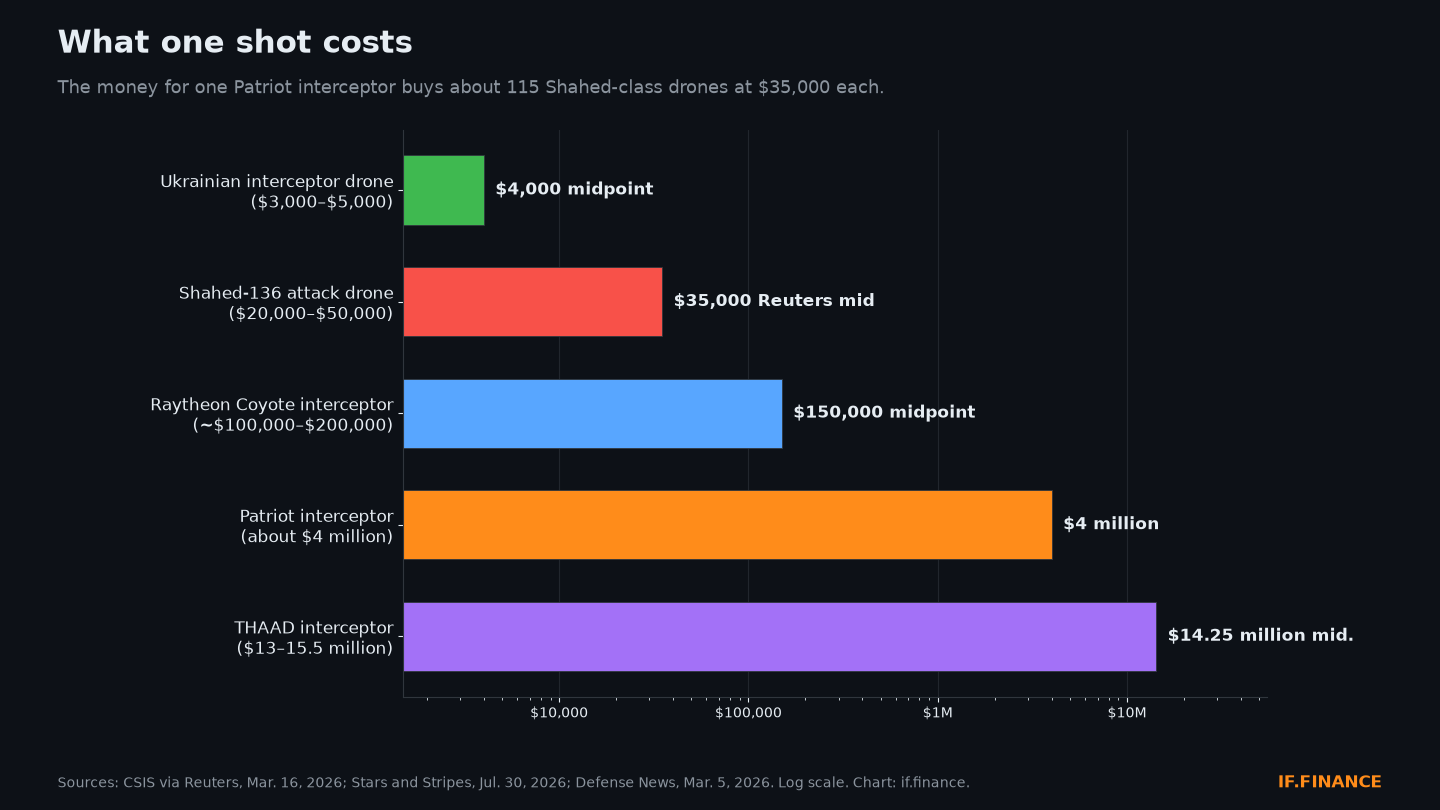
Bill LaPlante, then the Pentagon’s chief weapons buyer, told the Senate in May 2024: “If we’re shooting down a $50,000 one-way drone with a $3 million missile, that’s not a good cost equation.” That equation now has a body count.
Ukraine already built the cheap layer. Interceptor drones that cost $3,000 to $5,000, with an average success rate over 60%, have changed that country’s air-defense math, President Volodymyr Zelenskyy told Fox News, as reported by Defense News. In February, Ukraine’s commander-in-chief said drones were credited with more than 70% of Shahed downings over Kyiv. Ukraine’s air force says one in every three Russian aerial targets destroyed over the country is now brought down by an interceptor drone, not a missile or a gun. Kyiv produced 100,000 interceptor drones in 2025.
The U.S. military knew. The Atlantic reported Sunday that Army officers circulated a December 2025 report on Ukraine’s UAV interceptors, trained on the systems, and repeatedly warned commanders in the Middle East before the war started. The Pentagon called it “disgusting” to suggest U.S. forces were unprepared and said Central Command had “the most extensive air defense umbrella in the world.” Eight months after Port Shuaiba, The Atlantic reported, the U.S. military still has not deployed the kind of sensor-and-interceptor network Ukraine uses against Shaheds. Soldiers in the Middle East are staying close to their shelters, listening for the whine.
“This type of fight has been going on for five years in Ukraine, and our excuse is we didn’t expect it to happen to us. That’s preposterous in my mind.”
Maj. Stephen Ramsbottom, quoted by The Atlantic, Nov. 15, 2026, from his earlier remarks to the Associated Press
Empty magazines
CSIS analysts Mark Cancian and Chris Park estimated on Nov. 10 that two-thirds of the prewar U.S. Patriot interceptor inventory has been expended in nine months of war with Iran, mostly against ballistic missiles. Few, if any, were used by U.S. forces against one-way attack drones. About half the prewar THAAD inventory is gone. In late July, the same team put remaining Patriots at 759 to 827 and remaining THAAD interceptors at 234 to 278.
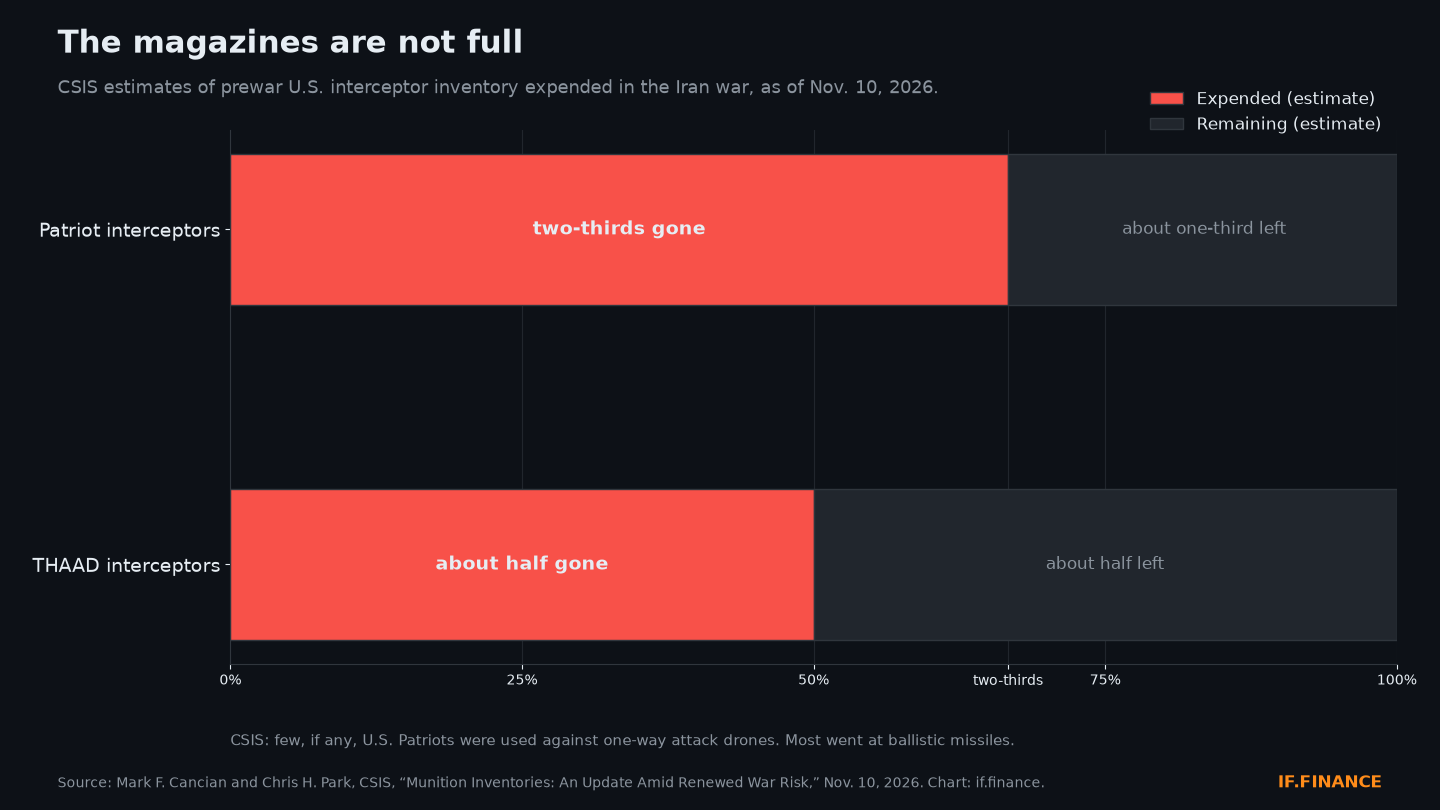
The United States burned through the magazine that stops ballistic missiles, and it never fielded a cheap, thick layer for the drones. When the next missile salvo comes in, those missing Patriots are not a spreadsheet problem.
The International Institute for Strategic Studies said in October that restoring Tomahawk, Patriot and THAAD stocks to pre-war levels is expected to take three years or more. CSIS notes that 18 other countries operate Patriot, and that even before the war an estimated 1,600 interceptors were already sitting in the allied backlog. In October the Trump administration approved a sale of 500 interceptors to Ukraine, which CSIS said has reportedly run out of its Patriot stock.
60 Minutes reported Sunday that 23 U.S. service members have died in the war and more than 800 have been wounded. The Pentagon’s latest price tag on the war is $47 billion. On July 17, Iranian missiles hit housing units on a U.S. base in Jordan and killed three more American soldiers. The same broadcast, using satellite imagery and new video, said Iran has hit at least 31 U.S. military and diplomatic sites across eight countries, and that the headquarters of the U.S. Navy’s Fifth Fleet in Bahrain was destroyed.
So when sirens went off in Bahrain this weekend, this was not a drill in a vacuum. People were told to run to shelter. The interceptors that worked on Sunday are coming out of the same scarce inventory everyone is arguing about in Washington.
Budget games
After the Democratic midterm sweep, investors treated the defense budget like a mood ring. Lockheed Martin and L3Harris each fell 6.9%. RTX fell 3.1%. The sector had been riding President Trump’s call for a $1.5 trillion military budget for 2027, well above the currently approved $901 billion. Jefferies told clients it expects something closer to the House’s roughly $1.15 trillion proposal. TD Cowen’s Roman Schweizer wrote that “Trump ‘branded’ programs are dead,” including Golden Dome.
Congress can fight over the topline. That fight does not refill a magazine this year, and it does not put a jammer on a trailer in a commercial port. CSIS itself said Congress looks unlikely to pass the full $1.5 trillion request, while munitions funding has had bipartisan support and could be protected. The question is whether the cheap, unglamorous counter-drone layer gets funded at the speed of a Shahed, or at the speed of a continuing resolution. Fiscal 2027 has already opened under a continuing resolution, 24/7 Wall St. noted in its Lockheed write-up. Delays are not a theory.
The gold rush
The money is finally moving, because the threat is no longer theoretical.
In July, NATO Secretary General Mark Rutte said drones have “fundamentally altered” the character of modern warfare. Allies committed to invest more than $40 billion in counter-drone capabilities over the next five years, and to train five times as many drone operators by the end of 2027. NATO is standing up a counter-drone marketplace so countries can buy tested, compatible systems at speed. That is a polite way of saying the alliance was late, and now it is writing checks.
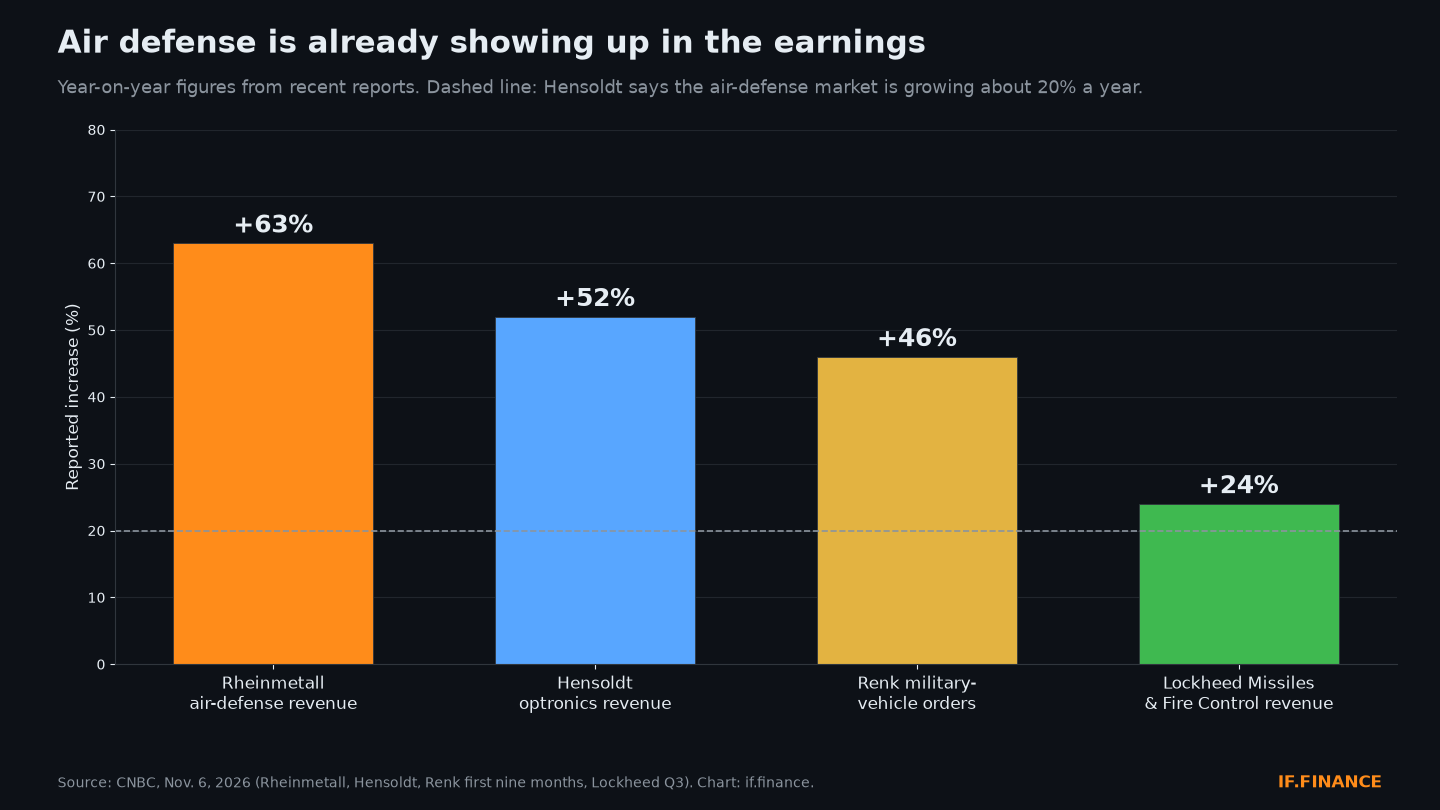
The earnings already show it. Rheinmetall’s air-defense business, which includes counter-drone systems, reported 63% revenue growth, even as the wider company cut its full-year outlook on project delays. Hensoldt’s optronics revenue jumped 52%. CFO Christian Ladurner told CNBC the air-defense market is “underinvested” and growing 20% a year, as militaries face everything from small drones to ballistic missiles. German supplier Renk saw military-vehicle orders surge 46% in the first nine months. Lockheed’s Missiles and Fire Control revenue rose 24%.
The specialists are booking the work that should have been on the ramp before March.
- RTX: Raytheon announced a $729 million award on Oct. 13 to deliver LIDS counter-drone components — the KuRFS radar and the Coyote effector — to the U.S. Army, Qatar and Jordan, the first international sales of those systems. The company said Coyote has hundreds of intercepts in combat and that it is accelerating production (RTX, Oct. 13, 2026).
- L3Harris: In its third-quarter results, the company said it secured more than $500 million in VAMPIRE counter-UAS orders from the United States and allies, and delivered the first units to the U.S. Army just two months after the Army’s order. Management put the pipeline at about $1 billion and said VAMPIRE has more than 350,000 operational hours since 2023 (L3Harris Q3 release; earnings call).
- AeroVironment: Management said counter-UAS was about a $200 million business in fiscal 2026, with Titan radio-frequency systems more than doubling (FY2026 earnings call). In September the company was selected for a nearly $500 million U.S. Army contract to produce LOCUST high-energy lasers under the Enduring-High Energy Laser program (AeroVironment). Breaking Defense reported the contract value as $465 million and called it the Army’s first directed-energy production contract.
- Anduril (still private): The State Department in June approved a possible $1.98 billion Foreign Military Sale to Kuwait for Roadrunner-Munition and Anvil-Kinetic interceptors, plus the Lattice command system (U.S. State Department, June 5, 2026). That is an approval for a possible sale, not a completed delivery. Kuwait is where this war’s first American dead were killed by a drone.
Lockheed is getting paid to refill the expensive magazine. A $52.5 billion PAC-3 MSE award helped push backlog to a record $292 billion. CEO Jim Taiclet’s line: “Our product is deterrence.”
Deterrence is a fine product. It does not work if the cheap drone is already over the trailer, and the interceptor that might have stopped it was never ordered.
What we take from this
The market has found the trade: Rheinmetall, Hensoldt, RTX, L3Harris, AeroVironment, Lockheed, and the private shops behind them. NATO has put a $40 billion number on the wall. That is the gold rush.
The other numbers are the ones that do not show up on an earnings call: six dead at Port Shuaiba, three more in Jordan in July, and 23 American dead and more than 800 wounded, as 60 Minutes counted them on Sunday. Bahrain’s sirens went off again this weekend. The next cheap drone will not wait for a conference report on the 2027 budget.
If we are going to talk about war stocks, we should talk about what the stocks are being paid to prevent. Empty magazines and skipped counter-drone kits are not a strategy. They are how people die.
References
- DHS chief Mullin says Iran poses daily threat to Trump and his family amid drone concerns (Fox News, Nov. 15, 2026)
- The Sunday Briefing – Sunday, November 15 (Fox News video, Nov. 15, 2026)
- “It’s my number one issue.” (Fox News on X, Nov. 15, 2026)
- US prepared for potential Iranian attacks targeting Trump, DHS chief says (Iran International, Nov. 15, 2026)
- Families of U.S. military members killed in Iran war want answers from the Pentagon (CBS 60 Minutes, Nov. 15, 2026)
- The Pentagon Ignored a Warning About the Danger of Iran’s Drones (The Atlantic, Nov. 15, 2026)
- Iran targets US military base in Bahrain with drone attack (BBC, Nov. 15, 2026)
- Iran launches drone attacks against US military base in Bahrain (The Guardian, Nov. 15, 2026)
- Bahrain intercepts Iranian attacks after first nationwide alert in months (The National, Nov. 15, 2026)
- Drones are changing warfare. But defense giants are still making billions from old-school weapons (CNBC, Nov. 6, 2026)
- Munition Inventories: An Update Amid Renewed War Risk (CSIS, Nov. 10, 2026)
- Iran war has consumed nearly 67% of US Patriot interceptor stockpile, report says (Stars and Stripes, Jul. 30, 2026)
- Renewed Iran War Would Test Diminished Interceptor Inventories (CSIS, Jul. 27, 2026)
- The Iran war and the depletion of the US munitions arsenal (IISS, October 2026)
- Cheap drones are reshaping the war in the sky (Reuters, Mar. 16, 2026)
- Novel interceptor drones bend air-defense economics in Ukraine’s favor (Defense News, Mar. 5, 2026)
- Defense firms fall as Democratic victory stokes fears of tighter Pentagon budget (Reuters via Investing.com, Nov. 4, 2026)
- Defense Realignment: Lockheed Martin vs. Palantir (24/7 Wall St., Nov. 9, 2026)
- NATO Allies invest 40 billion dollars in counter-drone capabilities and drone training (NATO, Jul. 7, 2026)
- Remarks by NATO Secretary General Mark Rutte on NATO’s Drone Edge (NATO, Jul. 7, 2026)
- RTX’s Raytheon awarded $729 million in counter-drone contracts for U.S., Qatar, and Jordan (RTX, Oct. 13, 2026)
- L3Harris Delivers Record Backlog and Strong Third-Quarter Results (L3Harris, 2026)
- L3Harris (LHX) Q3 2026 Earnings Call Transcript (The Motley Fool, Oct. 29, 2026)
- AV’s LOCUST Selected for Nearly $500 million Army Counter-UAS Contract for Enduring-High Energy Laser (E-HEL) Program (AeroVironment, September 2026)
- Earnings call transcript: AeroVironment tops Q4 2026 estimates (Investing.com)
- Kuwait – Counter-Unmanned Aerial Systems Platforms (U.S. Department of State, June 5, 2026)
- Army Reserve Confirms Casualty (U.S. Army Reserve, 2026)