📦 MercadoLibre Stock Hits a 52-Week Low While Sales Soar 45% 📉🔥
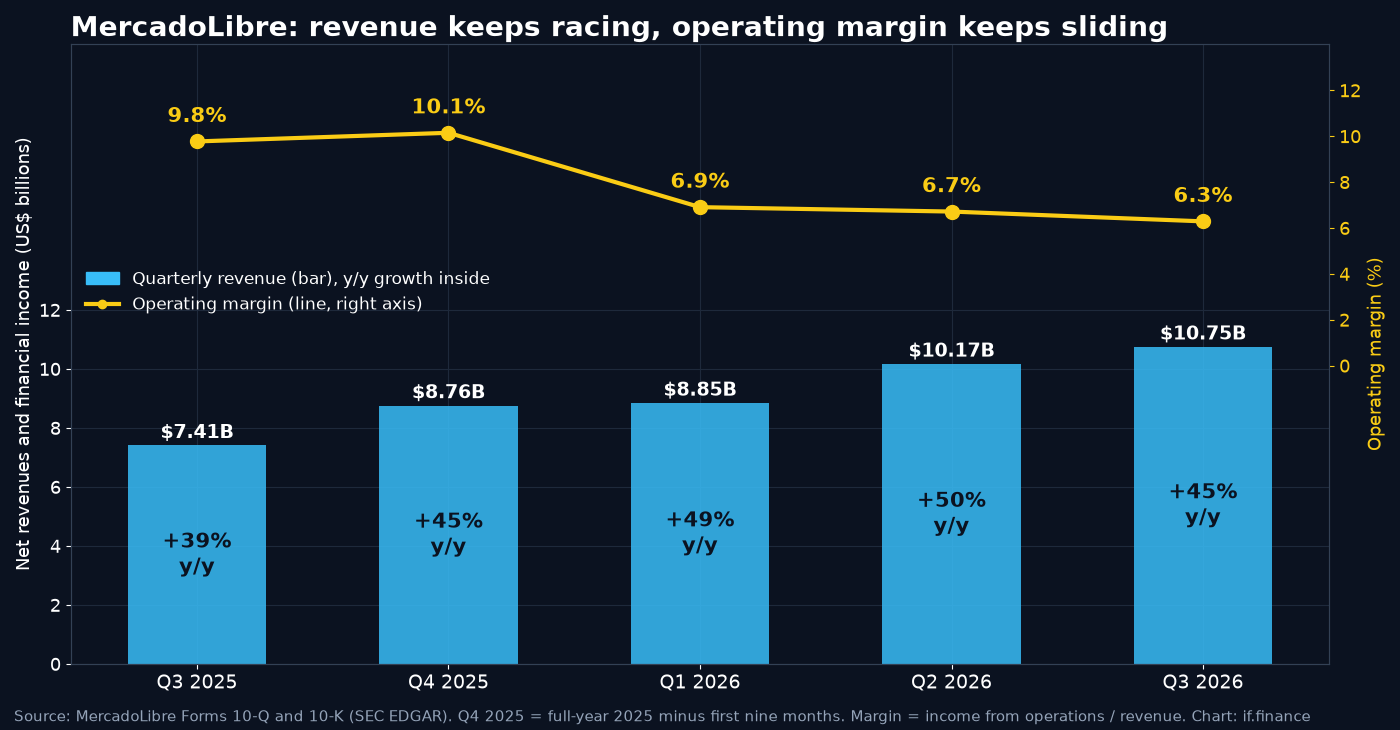
MercadoLibre ($MELI) just grew revenue 45% to $10.75 billion, and its stock answered by sliding to a 52-week low. The culprit is a 6.3% operating margin, squeezed by a warehouse building spree and Brazil marketing, and Wall Street is reaching for the red pen.


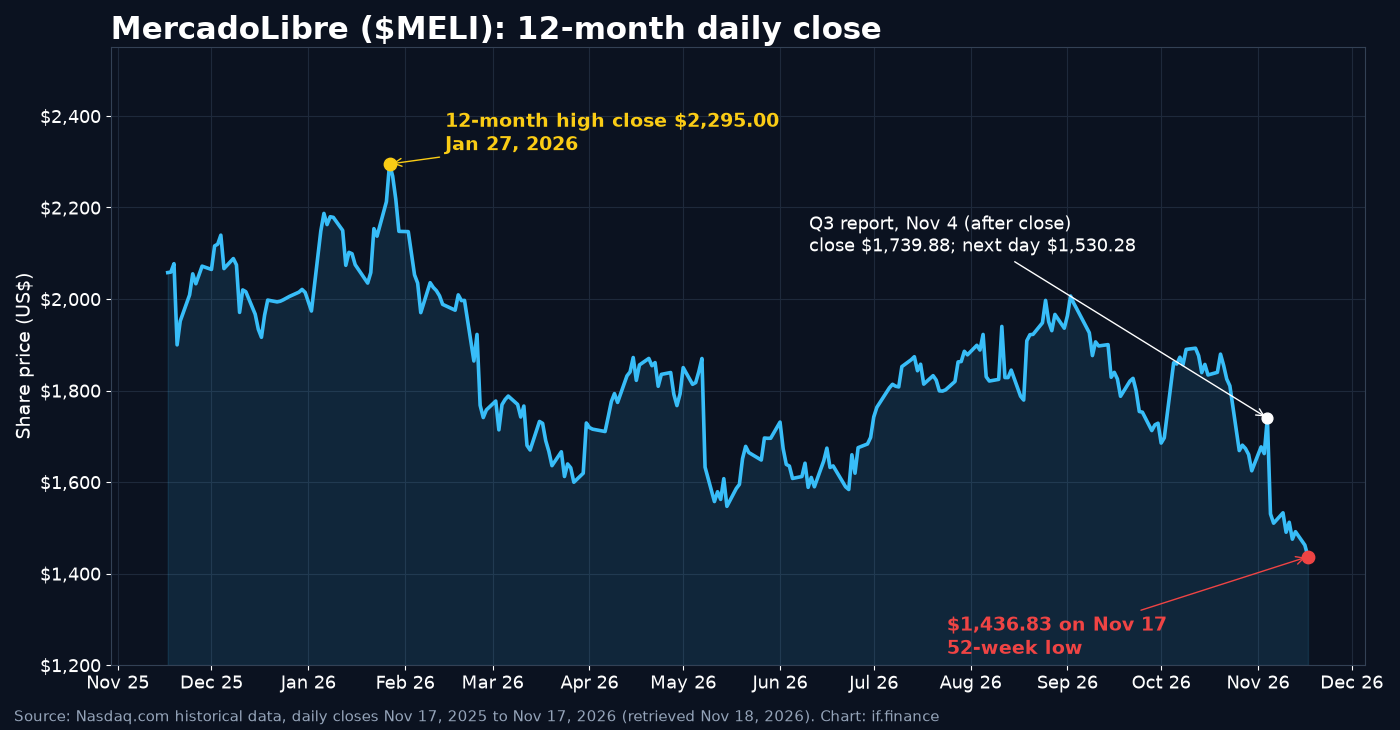
MercadoLibre stock is having the kind of month that makes a 45% growth rate feel like bad news. Latin America’s leading e-commerce and fintech platform just grew sales 45%, then watched $MELI close Tuesday at $1,436.83, its lowest close in a year and about 37% below its 12-month closing high of $2,295.00 on Jan. 27. [1][8]
MercadoLibre sits on Grok’s stock picks list, so we took a hard look at what went wrong. Short version: nothing broke in demand. Something broke in the math.
What MercadoLibre Actually Does
If Amazon is the default online store in the United States, MercadoLibre is that company in Latin America. It is the region’s leading e-commerce and fintech platform, measured by the value of goods sold on its marketplace. Marcos Galperin and a small group of entrepreneurs founded it in 1999. The company is incorporated in Delaware, its principal executive offices are in Montevideo, Uruguay, and its shares trade on Nasdaq as $MELI. [2][11][12]
It makes money from four tightly linked businesses:
- The Marketplace. Shoppers buy goods on the Mercado Libre website and app, mostly from third-party sellers. The company also sells some products from its own inventory, but that first-party business is less than 10% of gross merchandise volume (GMV), the dollar value of goods sold on the site. The marketplace operates in 18 countries. Brazil, Mexico and Argentina are the main markets. [2][11]
- Mercado Pago. This is the payments and financial-services arm. It began as a checkout tool for the marketplace and now also works in physical stores and on other sites. Users get a digital wallet and account they can use to pay, send money, hold savings, invest, and borrow, including credit cards and loans. Mercado Pago operates in eight countries. It is a regulated fintech. In Colombia, a Mercado Pago unit is licensed as a financial institution. The company has applied for banking licenses in Mexico and Argentina; as of its 2025 annual report, those applications were still under review. [2][11]
- Mercado Envios. This is MercadoLibre’s own logistics network. Sellers can store inventory in its fulfillment centers, which the company says handle more than half of shipments, or hand off sold items at drop-off stores called MELI Places. The company then moves packages on aircraft, trucks and last-mile vans, most of them run by third-party carriers. In the third quarter, it said it delivered 79% of fast shipments within 48 hours. [1][11]
- Mercado Ads. Sellers and brands pay to promote products to shoppers on the marketplace, and in some ad formats off it as well. Advertising revenue rose 58% from a year earlier in the third quarter. [1][11]
In the third quarter of 2026, the commerce business brought in $6.14 billion, or about 57% of the $10.75 billion in net revenues and financial income. Mercado Pago brought in $4.61 billion, or about 43%. Brazil accounted for $6.00 billion, Mexico $2.43 billion, Argentina $1.82 billion, and other countries $502 million. Unique active buyers reached about 94 million, and Mercado Pago had about 93 million monthly active users. [1][2]
The 45% quarter that broke the stock
For the quarter ended Sept. 30, net revenues and financial income rose 45% to $10.75 billion from $7.41 billion a year earlier. That is 41% on an FX-neutral basis, meaning with currency swings stripped out. [1][2][3] Gross merchandise volume (GMV), the dollar value of goods sold on the marketplace, hit about $23 billion, up 33% FX-neutral, and items sold jumped 36% to 867 million. [1]
Profit went the other way. Income from operations fell 6.6% to $676 million from $724 million, cutting the operating margin to 6.3% from 9.8% a year earlier and about 6.7% in the second quarter. [2][9] Net income rose to $448 million, or $8.83 per share, from $421 million, or $8.32. [2] Investing.com said analysts had expected $9.34 per share on revenue of $10.69 billion, so sales beat and earnings missed. [4]
Shares fell 7.8% in after-hours trading on report day, Nov. 4. [4] The next day $MELI closed at $1,530.28, down 12% from $1,739.88. It has kept leaking since, down about 17% from that pre-report close. [8]
Where the margin went
The 10-Q, the company’s quarterly filing with the SEC, lays out the bill. Cost of net revenues climbed to 59.2% of revenue from 56.7%, shrinking gross margin to 40.8% from 43.3%. [2] Shipping operating and carrier costs alone rose $1.06 billion from a year earlier. Online and offline marketing spending rose $276 million, mainly in Brazil and Mexico. [2]
Management says it planned the pain. Fulfillment capacity grew almost 20% from the second quarter, versus a 10% increase a year earlier, to get ready for the holiday peak. [1] Sales and marketing reached 11.6% of revenue as MercadoLibre leaned into its Brazil affiliate and creator programs. [1][2][3] Lending adds its own drag: the provision for doubtful accounts, money set aside for expected loan losses, jumped 65% to $1.34 billion as loan originations grew 70%. [2]
“These are deliberate investments.” Martín de los Santos, CFO [3]
He also flagged higher energy prices, which raised transportation costs, and said that in Brazil, cost per shipment still fell 5% year over year on an FX-neutral basis. [3] In plain English: MercadoLibre is paying today for warehouses, trucks and buyers it expects to cash in on later.
MercadoLibre stock vs. Wall Street’s red pens
Analysts trimmed, but few walked away. JPMorgan cut its price target to $1,850 from $2,150 and kept a Neutral rating, citing a tougher near- and long-term outlook. [6] Morgan Stanley cut its target to $2,350 from $2,450, kept its Overweight rating and lowered its 2027 and 2028 operating profit (EBIT) forecasts by 16% and 14%. [7] It conceded that its call for margins to stabilize this quarter did not pan out, and it puts its bear case at $1,150 and its bull case at $2,700. [7] Cantor Fitzgerald and Raymond James both moved to $2,000, from $2,200 and $2,100. [5]
Investing.com flagged a 52-week low of $1,464.61 on Nov. 13. [5] The stock has since gone lower, closing Tuesday at $1,436.83 after trading as low as $1,427.00, about 30% below where it stood a year earlier. [8]
The engine is still running
Here is the part the selling ignores. In Brazil, FX-neutral GMV grew 36% and items sold rose 45%, the fifth straight quarter above 40%. Items per buyer there grew 16%, up from a single-digit pace before MercadoLibre cut its free-shipping threshold in June 2025. [1] Mexico was softer, with GMV up 21% amid weaker consumer spending, while Argentina grew 40%. [1]
Mercado Pago, the fintech arm, reached about 93 million monthly active users, up 29%. Assets under management rose 67% to $25 billion, and the credit portfolio grew 62% to $17.9 billion. The 15-to-90-day non-performing loan ratio held at 7.0%. [1] Advertising revenue jumped 58% in dollars, and the company recently announced ad partnerships with TikTok and Netflix. [1]
CEO Ariel Szarfsztejn summed up the pitch on the call: users “are doing more with us, and it is costing us less to serve each of them.” [3] Investors want to see that second half show up in the margin line.
Our Take
We think the market is punishing MercadoLibre for building the store before the crowd arrives. A company that adds nearly a fifth more warehouse space in one quarter is not shrinking. It is betting big on peak season, and those costs show up first.
But we are not handing out free passes either. This is the third straight quarter of margin slippage, and Morgan Stanley, a fan, just admitted its stabilization call missed. [2][7][9][10][11] “Trust us, it’s an investment” works for a quarter or two. After that, investors want receipts.
Our view: at 52-week lows, the stock is pricing in a lot of bad news for a business still growing 45%. The Brazil shipping-rate update in late August and the September MELI+ expansion in Argentina will be fully reflected in the fourth quarter, per Morgan Stanley’s note. [7] If fourth-quarter margins stop sliding, today’s price could look like a holiday sale. If they slide again, the red pens come back out. We are watching the receipts.
What to watch next
- Fourth-quarter margin. Operating margin has gone 6.9%, 6.7% and 6.3% this year. Any uptick is the first proof the warehouse bet pays. [2][9][10]
- Peak season volume. The new fulfillment space was built for the holidays; items sold growth needs to stay strong to fill it. [1]
- Credit quality. NPLs held at 7.0%, but provisions grew 65%. Watch whether provisions keep outrunning the 62% loan-book growth. [1][2]
- Brazil. The company says Brazil delivered its strongest growth, and it is also where much of the extra marketing money is going. Brazil is in the news on tech, too: see our take on the Brazil AI chip license rule. [1][2]
- More targets. Further cuts or downgrades would signal patience is running out. Follow more tech names in our Technology Picks section.
Bottom line: MercadoLibre is still growing like a rocket; now it has to prove the rocket fuel is not burning up the profits.
This article is for information only and is not investment advice.
References
- Mercado Libre Revenue Reaches $10.75 billion in Q3 2026, up 45% year over year, Mercado Libre (company newsroom), November 4, 2026.
- MercadoLibre, Inc. Form 10-Q for the quarter ended September 30, 2026, MercadoLibre, Inc. via SEC EDGAR, filed November 5, 2026.
- MercadoLibre (MELI) Q3 2026 Earnings Call Transcript, The Motley Fool, November 5, 2026 (call held November 4, 2026).
- MercadoLibre falls on earnings miss, margin pressure, Investing.com (Luke Juricic), November 4, 2026.
- MercadoLibre stock hits 52-week low at $1,464.61, Investing.com, November 13, 2026.
- MercadoLibre price target lowered to $1,850 from $2,150 at JPMorgan, TheFly via TipRanks, November 9, 2026.
- Morgan Stanley Trims MercadoLibre (MELI.US) Price Target on Logistics and Marketing Margin Pressure, Keeps Overweight Rating, Tiger Brokers, November 9, 2026.
- MercadoLibre, Inc. Common Stock (MELI) Historical Data, Nasdaq, daily closes retrieved November 18, 2026.
- MercadoLibre, Inc. Form 10-Q for the quarter ended June 30, 2026, MercadoLibre, Inc. via SEC EDGAR, filed August 6, 2026.
- MercadoLibre, Inc. Form 10-Q for the quarter ended March 31, 2026, MercadoLibre, Inc. via SEC EDGAR, filed May 8, 2026.
- MercadoLibre, Inc. Form 10-K for the year ended December 31, 2025, MercadoLibre, Inc. via SEC EDGAR, filed February 25, 2026.
- History of Mercado Libre: our first steps, our journey, Mercado Libre (company newsroom), April 8, 2024.
Image credits
- Featured image: base photo “Anúncio de parceria e investimentos com o Mercado Livre” (Mercado Livre fulfillment center, Cajamar, Brazil, May 17, 2021) by Governo do Estado de São Paulo, Wikimedia Commons, CC BY 2.0. Cropped, adjusted and overlaid with text and data by if.finance.
- Logo: Mercado Libre wordmark, Wikimedia Commons, public domain (PD-textlogo). Trademark of MercadoLibre, Inc., used for identification only.
- Revenue and margin chart: made by if.finance from MercadoLibre’s Q3 2026 Form 10-Q and earlier SEC filings.
- Price chart: made by if.finance from Nasdaq daily closing prices.