ClosedAI, Meet Closed Grok = BROKEN PROMISES
Disclosure: The publisher of if.finance owns shares of Space Exploration Technologies Corp. (Nasdaq: SPCX). This is not investment advice. Do your own research.
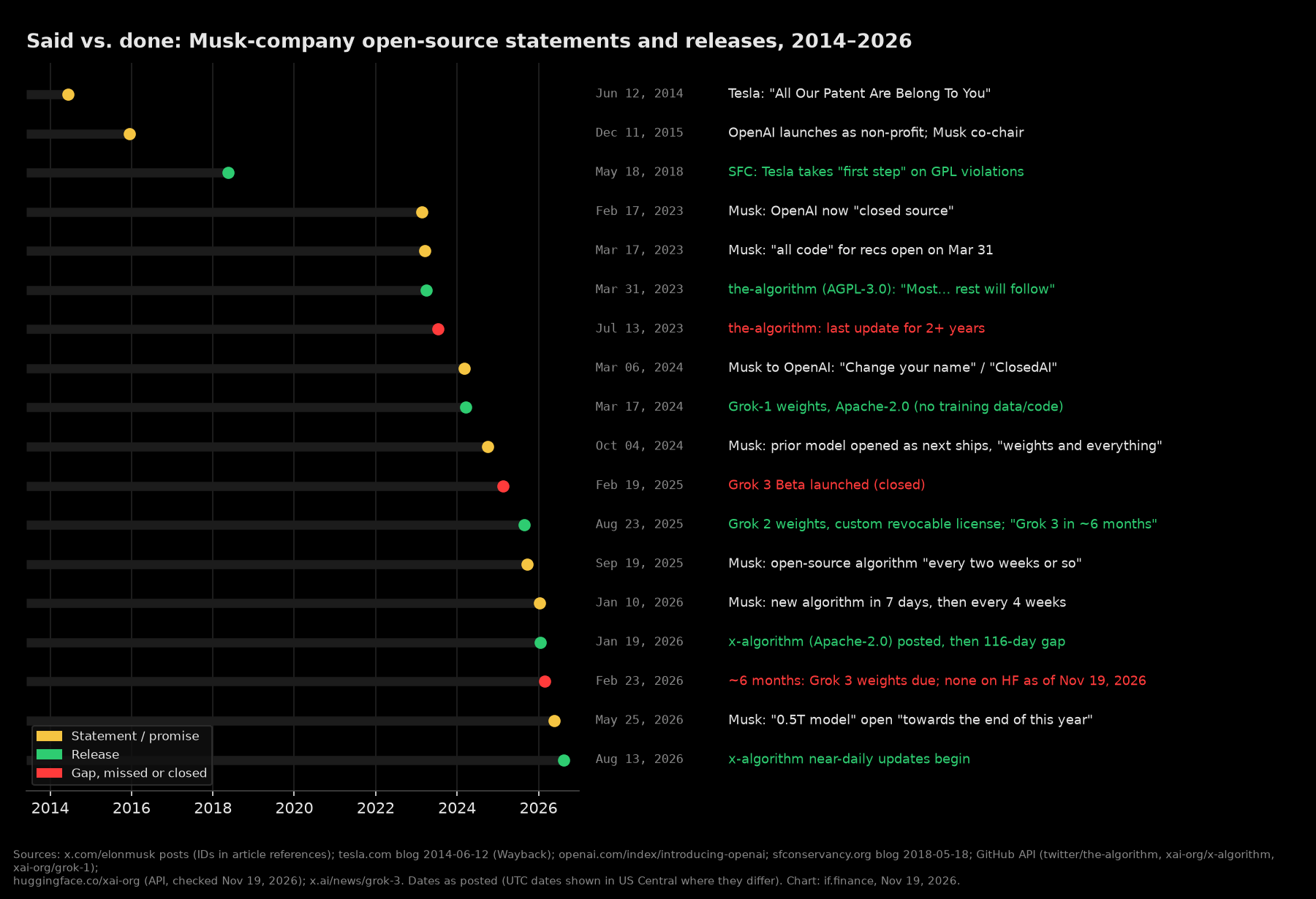
Elon Musk says he named OpenAI “Open” because it was meant to be open source. He sued its leaders, in part for going closed, and told it to rename itself “ClosedAI.” He promised that each Grok model would be opened when its successor shipped.
This story checks those words against GitHub commit logs, Hugging Face pages, license texts, court filings and Musk’s own posts. Then it measures his companies against the strictest yardstick in software: the GNU GPL, versions 2 and 3, and the Free Software Foundation’s four freedoms.
The short version: Musk’s companies have released real code. But “open” is the standard he applies to rivals. His own products get sliding deadlines, licenses with strings attached and releases with key parts missing. Grok Bot, the paid agent this site’s publisher uses, has no public source at all.
What Musk said OpenAI was supposed to be
OpenAI’s December 11, 2015 launch post, which lists Musk as co-chair, said: “Researchers will be strongly encouraged to publish their work, whether as papers, blog posts, or code, and our patents (if any) will be shared with the world.”
On February 17, 2023, Musk wrote on X: “OpenAI was created as an open source (which is why I named it ‘Open’ AI), non-profit company to serve as a counterweight to Google, but now it has become a closed source, maximum-profit company effectively controlled by Microsoft. Not what I intended at all.”
On March 6, 2024, he told OpenAI to “Change your name”, then “To ClosedAI and I will drop the lawsuit.” On January 6, 2025, he repeated that OpenAI “has become a closed source, profit-maximizer.”
His federal complaint, filed August 5, 2024, put the same idea in legal form. The complaint says Altman promised OpenAI “would make OpenAI, Inc.’s technology largely open source, subject only to genuine safety considerations, and to not conceal nor concentrate its technology for proprietary commercial reasons.”
OpenAI’s reply, published March 5, 2024, quoted Musk’s own emails. In one, Ilya Sutskever told Musk: “As we get closer to building AI, it will make sense to start being less open. The Open in openAI means that everyone should benefit from the fruits of AI after its built, but it’s totally OK to not share the science…” OpenAI says Musk replied: “Yup.”
On May 18, 2026, per the court’s minutes, an advisory jury found Musk’s charitable-trust and unjust-enrichment claims “barred by the Statute of Limitations.” Judge Yvonne Gonzalez Rogers adopted that verdict on May 20. The ruling was about timing, not openness. Musk said as much: “the judge & jury never actually ruled on the merits of the case, just on a calendar technicality.”
The Grok promises, one by one
On March 11, 2024, five days after the “ClosedAI” posts, Musk wrote: “This week, @xAI will open source Grok.” He delivered. On March 17, 2024, xAI released Grok-1, a 314-billion-parameter model, “under the Apache 2.0 license.” Credit where due: it was a real, permissive release.
But look at what xAI said it was releasing: “the base model weights and network architecture.” It called this “the raw base model checkpoint,” “not fine-tuned for any specific application.” The GitHub repo describes itself as “JAX example code for loading and running the Grok-1 open-weights model.” There is no training code and no training data. The repo’s main branch has nine commits, the last on March 19, 2024.
On October 4, 2024, Musk made a broader pledge: “@xAI has been and will open source its models, including weights and everything, As we create the next version, we open source the prior version, as we did with Grok 1 when Grok 2 was released.” The dates don’t match. Grok-1’s weights came out March 17, 2024. Grok-2 Beta was announced August 13, 2024, five months later. And “weights and everything” has never meant training data or training code for any Grok model.
Grok 3 Beta arrived on February 19, 2025, with closed weights. The Grok 2 weights followed about six months later. On August 23, 2025, Musk wrote: “The @xAI Grok 2.5 model, which was our best model last year, is now open source. Grok 3 will be made open source in about 6 months.”
Six months from August 23, 2025, is February 23, 2026. On November 19, 2026, the Hugging Face API for xAI’s organization listed exactly two models, grok-1 and grok-2. There is no Grok 3. xAI’s own docs say the grok-3 API slug was retired on May 15, 2026, with requests redirected to grok-4.3. The model was pulled from the API before its promised weights ever shipped. The promise is now 269 days overdue.
The next promise is on the books. On May 25, 2026, Musk wrote: “We will open source the 0.5T model towards the end of this year.” That deadline has not passed yet.
“Open source” with a revocable license
Musk called the Grok 2 release “open source.” The license says otherwise. The current Grok 2 license, now called the “xAI Community License Agreement” and last updated November 4, 2025, grants “a non-exclusive, worldwide, revocable license.” Commercial use is allowed “solely if you and your affiliates abide by all of the guardrails” in xAI’s Acceptable Use Policy. You “may not use the Materials, derivatives, or outputs (including generated data) to train, create, or improve any foundational, large language, or general-purpose AI models.” Redistributors must “Prominently display ‘Powered by xAI'” and carry a notice that ends “All rights reserved.”
The terms have also moved. The repo’s history shows the first August 23, 2025 license allowed commercial use only below “one million U.S. dollars ($1,000,000) in annual revenue.” Hours later the cap was replaced by the Acceptable Use Policy test, and the license was rewritten again in November 2025.
Under the Open Source Initiative’s Open Source Definition, item 6, a license “must not restrict anyone from making use of the program in a specific field of endeavor.” Under the Free Software Foundation’s Free Software Definition, freedom 0 is “The freedom to run the program as you wish, for any purpose.” In our reading, a ban on using the model to build other models is a field-of-use restriction, and it fails both tests. By the standard Musk invoked against OpenAI, Grok 2 is source-available, not open source.
The X algorithm: open, then stale, then open again
GitHub keeps receipts. On March 24, 2022, before he owned Twitter, Musk posted: “Twitter algorithm should be open source.” On March 17, 2023, he promised: “Twitter will open source all code used to recommend tweets on March 31st.” On March 31, 2023, he narrowed it: “Most of the recommendation algorithm will be made open source today. The rest will follow.”
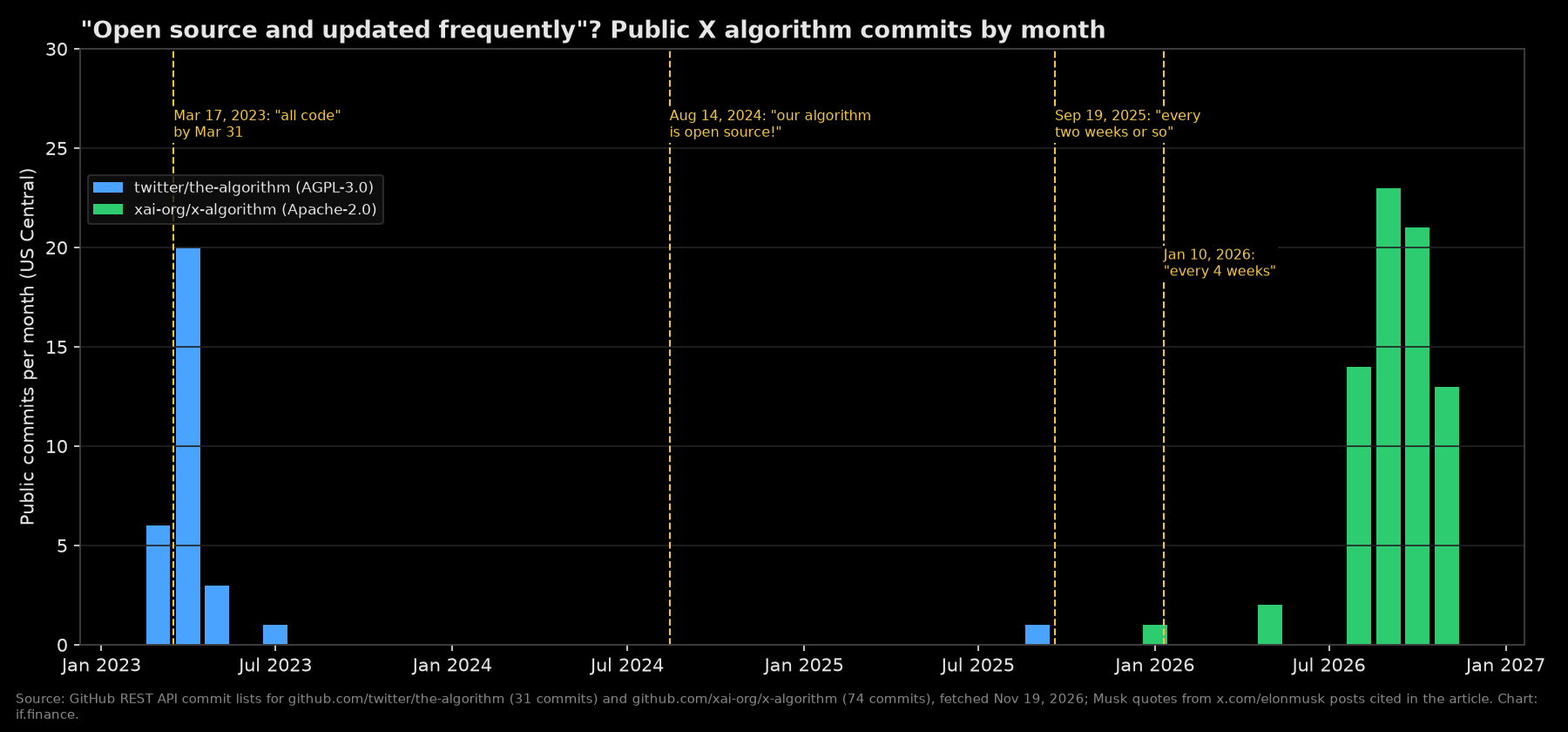
The code landed at github.com/twitter/the-algorithm. To Twitter’s credit, it used the copyleft GNU Affero GPL v3. Then updates stopped. Of its 31 commits, none landed between July 13, 2023, and a single commit on September 3, 2025.
Musk kept calling it open. On August 14, 2024, he wrote: “Unlike the other platforms, our algorithm is open source!” The public code was then 13 months old. On September 19, 2025, he promised: “We will open source the algorithm every two weeks or so.” The next public update came four months later.
On January 10, 2026, he promised again: “We will make the new 𝕏 algorithm, including all code used to determine what organic and advertising posts are recommended to users, open source in 7 days. This will be repeated every 4 weeks, with comprehensive developer notes.” The new repo, xai-org/x-algorithm, got its first commit nine days later, on January 19, 2026 (US Central). Then it went quiet for 116 days, until May 15, and another 90 days, until August 13.
Fairness requires the rest. Since August 13, 2026, the repo has had 71 commits through November 18, several a week. Its README admits “a limited set of files not currently published,” including “Grox prompts” and “Some botmaker rules,” withheld to deter gaming. And the license changed: the 2026 repo uses permissive Apache-2.0, not the 2023 code’s copyleft AGPLv3.
The GNU yardstick: what GPLv2 and GPLv3 actually demand
The FSF’s four essential freedoms are the freedom to run a program for any purpose (0), to study and change it (1), to redistribute copies (2), and to distribute modified versions (3). For freedoms 1 and 3, the FSF says “Access to the source code is a precondition.”
GPLv2, section 3, lets you ship binaries only if you include “the complete corresponding machine-readable source code,” or “a written offer, valid for at least three years.” It defines source code as “the preferred form of the work for making modifications to it.”
GPLv3 goes further. Its preamble targets devices “designed to deny users access to install or run modified versions of the software inside them.” Section 6 requires “Installation Information,” meaning the “methods, procedures, authorization keys, or other information required to install and execute modified versions” on consumer “User Products.” Section 11 adds an explicit patent grant from every contributor. The AGPLv3, section 13, extends source rights to users “interacting with it remotely through a computer network.”
Copyleft, in the FSF’s words, means “requiring all modified and extended versions of the program to be free as well.” Apache-2.0 does not. The FSF’s license list calls it “a free software license, compatible with version 3 of the GNU GPL” and recommends it “over other lax permissive licenses.” Anyone may build a closed product on Apache code.
The OSI’s Open Source AI Definition 1.0 says “‘Open Source models’ and ‘Open Source weights’ must include the data information and code used to derive those parameters.” Grok-1 shipped weights and inference code only. By that definition it is open weights, not open-source AI.
A caveat: the GPL binds only those who distribute GPL-covered code. Keeping your own product closed is legal. The GNU standard here is the benchmark Musk’s rhetoric invites, not proof of a violation, except where noted.
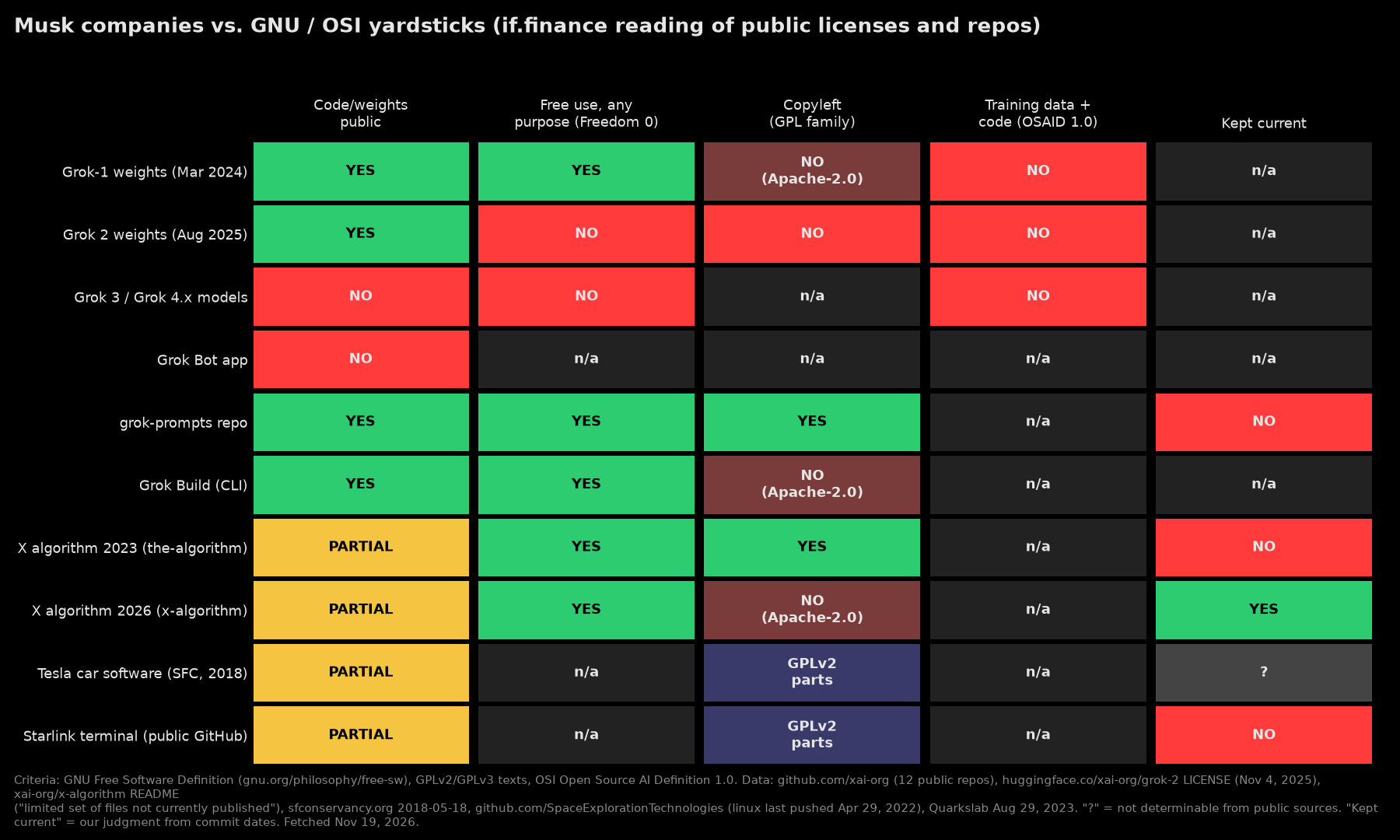
Scorecard: Musk’s companies against GNU and OSI criteria
| Product / release | License (verified) | Source or weights public? | Copyleft (GPL standard)? | Four freedoms / OSI test | Record vs. promise |
|---|---|---|---|---|---|
| Grok-1 (Mar 17, 2024) | Apache-2.0 | Weights + inference code; no training code or data | No (permissive) | Freedoms OK for what was released; fails OSAID 1.0 data/code test | Delivered on time (“this week”) |
| Grok 2 (Aug 23, 2025) | xAI Community License (revocable) | Weights | No | Fails freedom 0 and OSD #6 (bans training other models; AUP gate) | About 6 months after Grok 3 launched |
| Grok 3 | Proprietary | No (HF lists grok-1 and grok-2 only, Nov 19, 2026) | No | Fails | Promised “in about 6 months” (Aug 23, 2025); API retired May 15, 2026 |
| Grok Bot (agent app) | No public license found | No public repo among xai-org’s 12 public GitHub repos; changelog offers a macOS download | No | Not assessable as free software; no source | No open-source promise found |
| grok-prompts | AGPL-3.0 | Yes | Yes | Passes | Last commit Nov 17, 2025; lists prompts up to Grok 4.1 |
| Grok Build CLI | Apache-2.0 (first-party code) | Yes | No (permissive) | Passes for released code | Public since July 2026 |
| X algorithm, 2023 (twitter/the-algorithm) | AGPL-3.0 | “Most” of it | Yes | Passes for released code | “All code” promised; gap from Jul 2023 to Sep 2025 |
| X algorithm, 2026 (xai-org/x-algorithm) | Apache-2.0 | Yes, minus withheld files | No (permissive) | Passes for released code | “Every 4 weeks” missed Feb to Aug 2026; near-daily since Aug 13 |
| Community Notes | Apache-2.0 | Yes (repo active Nov 18, 2026) | No (permissive) | Passes for released code | Repo dates to Jan 2021, before Musk bought Twitter |
| Tesla vehicle software | Linux and BusyBox (GPLv2-only) | Incomplete source published May 2018, per SFC | GPLv2 parts | SFC cited “GPL violations” dating to 2013 reports | Patent pledge 2014 (not a license) |
| SpaceX / Starlink | Notice lists BusyBox 1.36.0 GPL-2.0, U-Boot GPL-2.0+ | Six public repos; Linux repo last pushed Apr 29, 2022 | GPLv2 parts | Public kernel lagged shipped kernel in 2023 (Quarkslab) | No open-source pledge found |
Tesla and SpaceX: the GPL record
On June 12, 2014, Musk published “All Our Patent Are Belong To You” (archived copy). He said Tesla’s patents had been removed from its lobby wall “in the spirit of the open source movement,” and he pledged: “Tesla will not initiate patent lawsuits against anyone who, in good faith, wants to use our technology.” On January 9, 2025, he described it as: “We even made the Tesla patents open source.” A pledge not to sue, conditioned on an undefined “good faith,” is not an open-source license, and it is no substitute for GPLv3’s written patent grant.
Tesla’s GPL history is documented by the people who enforce it. On May 18, 2018, the Software Freedom Conservancy wrote (archived) that it had been “engaging with Tesla on its GPL compliance since June 2013.” Model S buyers “received on-board system(s) that contained BusyBox and Linux, but did not receive any source code, nor an offer for the source.” That week, SFC said, Tesla “has acted publicly regarding its current GPL violations” by posting incomplete source on GitHub. Tesla’s linux and buildroot repos are still up. Nearly five years from first contact to incomplete source is not “the spirit of the open source movement.”
SpaceX runs on Linux. In a June 2020 Reddit AMA, as quoted by Slashdot, its software team said: “All of our on-board computers either run Linux (with the PREEMPT_RT patch) or are microcontrollers that run bare-metal code.” The kernel is licensed “GPL-2.0 WITH Linux-syscall-note”, GPLv2 only, so GPLv3’s anti-tivoization rule does not bind the kernel in a Tesla or a Starlink dish.
Starlink’s own open-source notice, dated December 11, 2024, lists BusyBox 1.36.0 under GPL-2.0 and U-Boot under GPL-2.0+. SpaceX’s public GitHub, SpaceExplorationTechnologies, has six repositories; its Linux repo was last pushed April 29, 2022. In August 2023, security firm Quarkslab wrote that “the open-source version of Linux published by SpaceX is 5.10.90, while the one found on the dish was 5.15.55.” GPLv2 allows source by written offer, so a stale public repo is not proof of a violation. It is still a long way from “open.”
Amateur hour: why this matters to a paying Grok Bot customer
The Proprietor of this site pays for Grok Bot and runs this publication’s workflow on it. Our WRONG List logs the failures in public: 77 dated entries as of its November 17, 2026 update. They include links displayed without their real addresses, a bug report meant for support@x.ai that went out with no To: header, and a support reply saying a human review “may take a few days.”
With open source, a customer could read the code, find the bug and propose the fix. Grok Bot offers no such path. Its official changelog shows version 1.2.3, dated November 18, 2026, and a macOS download. We found no source repository for it. The FSF has a name for this arrangement, “Service as a Software Substitute”: “the users do not have even the executable file that does their computing… it is impossible for them to ascertain what it really does, and impossible to change it.”
That is the hypocrisy in one line: Musk sued OpenAI over openness, while his paying customers can’t see the code that keeps getting it wrong.
The verdict
Grok-1 under Apache-2.0, the AGPL Twitter code, Community Notes and Grok Build are real contributions. Since August 2026, the X algorithm repo has finally beaten the cadence he promised.
But by the GNU standard Musk invokes against OpenAI, the record falls short. Releases have been late or partial. Licenses have moved from copyleft to permissive to “revocable.” The flagship models are closed, Grok 3’s weights are 269 days overdue, and the product customers pay for is a black box. “Open” is a weapon when it’s aimed at rivals and a press release when it’s his own.
Commentary and opinion: This article contains the author’s opinions and analysis, based on the public sources linked below. Statements about license compliance compare public documents with published license texts. They are not legal conclusions. Corrections: if you have a primary source showing something here is wrong, send it and we will fix it and note the change.
References
- Elon Musk on X, Mar 24, 2022: “Twitter algorithm should be open source” (https://x.com/elonmusk/status/1507041396242407424)
- Elon Musk on X, Feb 17, 2023: OpenAI “closed source, maximum-profit” (https://x.com/elonmusk/status/1626516035863212034)
- Elon Musk on X, Mar 17, 2023: “all code used to recommend tweets on March 31st” (https://x.com/elonmusk/status/1636835209587949570)
- Elon Musk on X, Mar 31, 2023: “Most of the recommendation algorithm” (https://x.com/elonmusk/status/1641874582473695246)
- Elon Musk on X, Mar 6, 2024: “Change your name” (https://x.com/elonmusk/status/1765262842498847174)
- Elon Musk on X, Mar 6, 2024: “To ClosedAI and I will drop the lawsuit” (https://x.com/elonmusk/status/1765409615070601417)
- Elon Musk on X, Mar 11, 2024: “This week, @xAI will open source Grok” (https://x.com/elonmusk/status/1767108624038449405)
- Elon Musk on X, Aug 14, 2024: “our algorithm is open source!” (https://x.com/elonmusk/status/1823793304296935624)
- Elon Musk on X, Oct 4, 2024: “weights and everything” (https://x.com/elonmusk/status/1842248588149117013)
- Elon Musk on X, Jan 6, 2025: OpenAI “closed source, profit-maximizer” (https://x.com/elonmusk/status/1876175322598838408)
- Elon Musk on X, Jan 9, 2025: “We even made the Tesla patents open source” (https://x.com/elonmusk/status/1877367852795330813)
- Elon Musk on X, Aug 23, 2025: Grok 2.5 open; “Grok 3… in about 6 months” (https://x.com/elonmusk/status/1959379349322313920)
- Elon Musk on X, Sep 19, 2025: “every two weeks or so” (https://x.com/elonmusk/status/1969081066578149547)
- Elon Musk on X, Jan 10, 2026: new algorithm “in 7 days… every 4 weeks” (https://x.com/elonmusk/status/2010062264976736482)
- Elon Musk on X, May 25, 2026: “open source the 0.5T model towards the end of this year” (https://x.com/elonmusk/status/2058796067592736866)
- OpenAI, “Introducing OpenAI,” Dec 11, 2015 (https://openai.com/index/introducing-openai/)
- OpenAI, “OpenAI and Elon Musk,” Mar 5, 2024 (https://openai.com/index/openai-elon-musk/)
- Musk v. Altman, N.D. Cal. No. 4:24-cv-04722, Complaint (Dkt. 1), Aug 5, 2024 (https://storage.courtlistener.com/recap/gov.uscourts.cand.433688/gov.uscourts.cand.433688.1.0.pdf)
- Musk v. Altman, Civil Minutes (Dkt. 576), May 18, 2026 (https://storage.courtlistener.com/recap/gov.uscourts.cand.433688/gov.uscourts.cand.433688.576.0.pdf)
- Musk v. Altman, Post-Trial Order re: Advisory Verdict (Dkt. 580), May 20, 2026 (https://storage.courtlistener.com/recap/gov.uscourts.cand.433688/gov.uscourts.cand.433688.580.0_1.pdf)
- Elon Musk on X, May 18, 2026: “calendar technicality” (https://x.com/elonmusk/status/2056474896641782077)
- xAI, “Open Release of Grok-1,” Mar 17, 2024 (https://x.ai/news/grok-os)
- GitHub, xai-org/grok-1 (https://github.com/xai-org/grok-1)
- xAI, “Grok-2 Beta Release,” Aug 13, 2024 (https://x.ai/news/grok-2)
- xAI, “Grok 3 Beta — The Age of Reasoning Agents,” Feb 19, 2025 (https://x.ai/news/grok-3)
- Hugging Face, xai-org/grok-2 (https://huggingface.co/xai-org/grok-2)
- Hugging Face, xai-org/grok-2 LICENSE, updated Nov 4, 2025 (https://huggingface.co/xai-org/grok-2/blob/main/LICENSE)
- Hugging Face, xai-org/grok-2 commit history (https://huggingface.co/xai-org/grok-2/commits/main)
- Hugging Face, xai-org/grok-1 (https://huggingface.co/xai-org/grok-1)
- SpaceXSI Docs, “Grok Model Retirement on May 15, 2026” (https://docs.x.ai/developers/migration/may-15-retirement)
- GitHub, twitter/the-algorithm (https://github.com/twitter/the-algorithm)
- GitHub, xai-org/x-algorithm (https://github.com/xai-org/x-algorithm)
- GitHub, xai-org organization (https://github.com/xai-org)
- GitHub, xai-org/grok-prompts (https://github.com/xai-org/grok-prompts)
- GitHub, xai-org/grok-build (https://github.com/xai-org/grok-build)
- GitHub, twitter/communitynotes (https://github.com/twitter/communitynotes)
- SpaceXSI, Grok Bot Changelog (https://x.ai/changelog/bot)
- GNU Project, “What is Free Software?” (https://www.gnu.org/philosophy/free-sw.html)
- GNU General Public License, version 2 (https://www.gnu.org/licenses/old-licenses/gpl-2.0.txt)
- GNU General Public License, version 3 (https://www.gnu.org/licenses/gpl-3.0.txt)
- GNU Affero General Public License, version 3 (https://www.gnu.org/licenses/agpl-3.0.txt)
- GNU Project, “What is Copyleft?” (https://www.gnu.org/licenses/copyleft.html)
- GNU Project, “Various Licenses and Comments about Them” (https://www.gnu.org/licenses/license-list.html)
- GNU Project, “Who Does That Server Really Serve?” (https://www.gnu.org/philosophy/who-does-that-server-really-serve.html)
- Open Source Initiative, The Open Source Definition (https://opensource.org/osd)
- Open Source Initiative, The Open Source AI Definition 1.0 (https://opensource.org/ai/open-source-ai-definition)
- Tesla, “All Our Patent Are Belong To You,” Jun 12, 2014 (https://www.tesla.com/blog/all-our-patent-are-belong-you)
- Wayback Machine copy of Tesla patent post (https://web.archive.org/web/2014/http://www.teslamotors.com/blog/all-our-patent-are-belong-you)
- Software Freedom Conservancy, “Congratulations to Tesla on Their First Public Step Toward GPL Compliance,” May 18, 2018 (https://sfconservancy.org/blog/2018/may/18/tesla-incomplete-ccs/)
- Wayback Machine copy of SFC Tesla post (https://web.archive.org/web/20190110183526/https://sfconservancy.org/blog/2018/may/18/tesla-incomplete-ccs/)
- GitHub, teslamotors/linux (https://github.com/teslamotors/linux)
- GitHub, teslamotors/buildroot (https://github.com/teslamotors/buildroot)
- Reddit r/spacex, “We are the SpaceX software team, ask us anything!,” Jun 5, 2020 (https://www.reddit.com/r/spacex/comments/gxb7j1/we_are_the_spacex_software_team_ask_us_anything/)
- Slashdot, “How SpaceX Uses Linux, Chromium, C++ and Open Source Libraries,” Jun 6, 2020 (https://science.slashdot.org/story/20/06/06/2023249/how-spacex-uses-linux-chromium-c-and-open-source-libraries)
- Linux kernel COPYING file (https://github.com/torvalds/linux/blob/master/COPYING)
- Starlink Open Source Components License Notices, Dec 11, 2024 (https://api.starlink.com/public-files/Starlink-Open-Source-Components-License-Notices.pdf)
- GitHub, SpaceExplorationTechnologies organization (https://github.com/SpaceExplorationTechnologies)
- Quarkslab, “Diving into Starlink’s User Terminal Firmware,” Aug 29, 2023 (https://blog.quarkslab.com/starlink.html)
- if.finance, “The WRONG List” (https://if.finance/grok-wrong-answers-paid-usage-broken-trust/)
- SEC EDGAR, SpaceX filing note on the xAI merger (Feb 2, 2026) (https://www.sec.gov/Archives/edgar/data/1181412/000162828026066880/R10.htm)
Read the book: THE EMPTY BOX: The Bill Is Coming
Disclosure: THE EMPTY BOX is written by if.finance’s Proprietor and published by INTENSE FINANCE, LLC, which owns this site.