“We’ve Got Their Strait”: Trump Kills the Deal Talk, and Oil Remembers the War Isn’t Over
For about ten days, the oil market traded like the war was ending. Then the President of the United States logged on to Truth Social and reminded everyone that it isn’t.
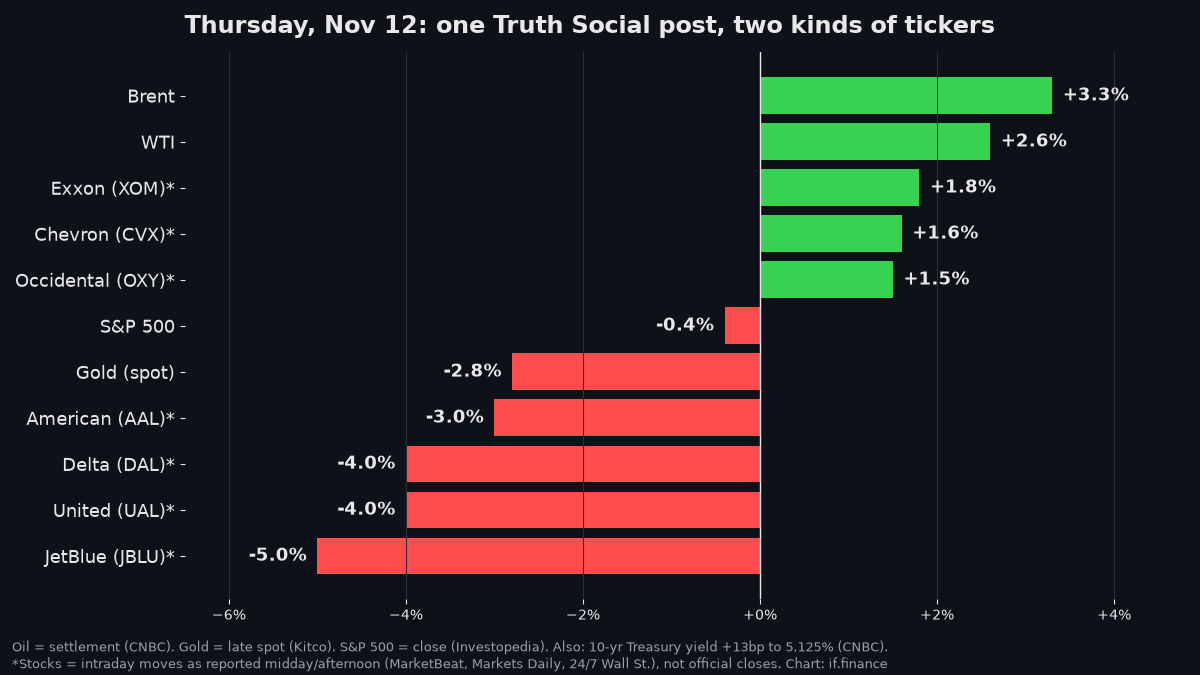
Brent crude settled 3.3% higher at $95.82 a barrel on Thursday, Nov. 12, and West Texas Intermediate rose 2.6% to $88.74, according to CNBC. The trigger was one post. As reported verbatim by CNBC and others, President Trump wrote:
“We don’t need a deal with Iran. Those days have long since passed. We’ve got their money, Hundreds of Billions of Dollars, and we’ve got their Strait!”
President Donald Trump on Truth Social, Nov. 12, 2026, as reported by CNBC
Our read: this wasn’t a supply move. It was the market repricing a tail risk it had thrown away too early. Here’s what happened, why it reaches well past the pump, and the tickers we’re watching.
The peace premium got priced in, then priced back out
Context matters here. Thursday’s pop came after a brutal slide. Before the bounce, WTI was down 16% in November and Brent had lost 20%, per CNBC, after Trump’s post-midterm comments cooled fears of more strikes on Iran. On Sunday he’d said fresh attacks were highly unlikely as talks progressed, and that further military action didn’t appear necessary “at this point.”
Go back two weeks and the picture was very different. On Oct. 30 the expiring December Brent contract settled at $117.64, the highest since April, as traders braced for escalation after the midterms (CNBC). In other words, oil gave up more than $20 a barrel on hopes of peace in roughly a week and a half. One post clawed back about $3 of it.
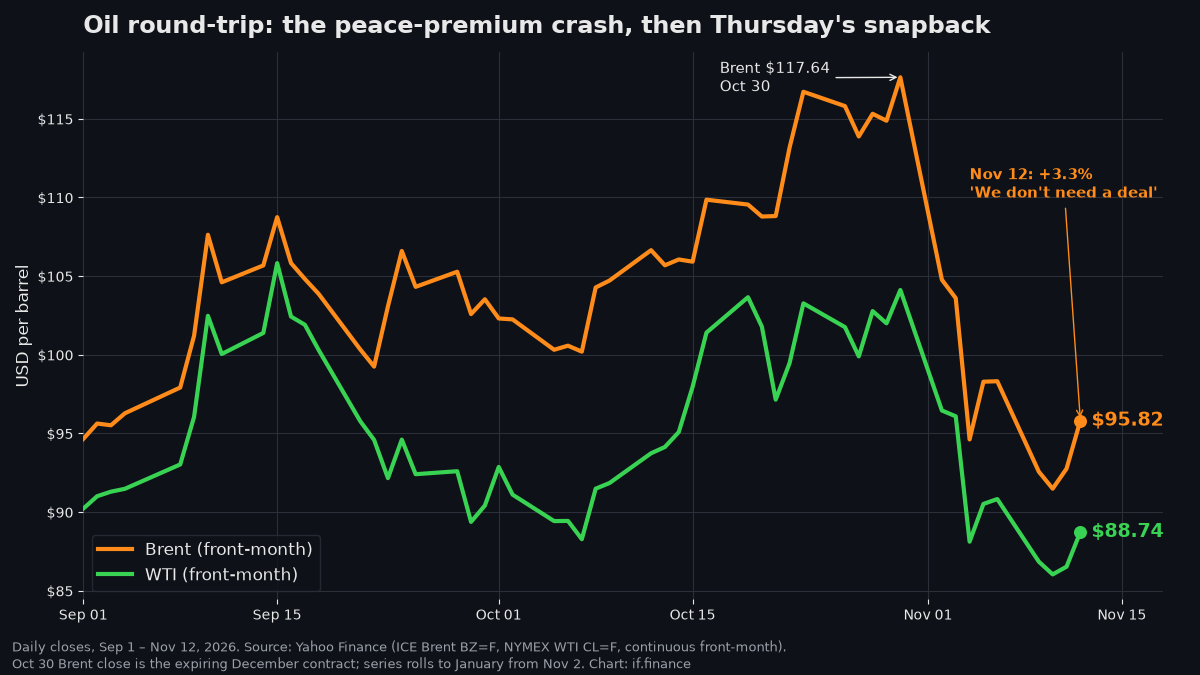
John Kilduff of Again Capital put it bluntly to CNBC: “The market may have gotten ahead of itself on pricing in a cessation of hostilities.” We agree. When a market pulls a war premium that fast, all it takes is one sentence to put some of it back.
The Strait is the whole story
The Strait of Hormuz normally carries about one-fifth of the world’s oil, as Arab News Japan notes. Since the war began in late February, Iran has heavily restricted traffic and insisted ships use routes it approves. Washington answered with a naval blockade of Iranian ports and has been escorting tankers through. So when Trump says “we’ve got their Strait,” he is describing a waterway where both sides are claiming control at the same time.
Thursday’s headlines show how contested it still is:
- Tankers hit. Iran’s military said four oil tankers were struck by explosions in the Strait after ignoring warnings and entering what it calls restricted areas (Straits Times/Reuters). The IRGC Navy said two supertankers carrying more than 4 million barrels were stopped after explosions on an “unauthorized” southern route (Iran International). Reuters said it couldn’t immediately verify Iran’s accounts.
- Threat level: severe. The Joint Maritime Information Center’s Nov. 12 advisory rates the Hormuz threat “SEVERE,” with deliberate attacks “considered highly likely.” Independent tracking shows only single-digit to low double-digit transits a day, while U.S. data shows about 34 U.S.-assisted transits a day over the prior 96 hours (JMIC/UKMTO).
- The blockade is real. Per official CENTCOM figures cited by JMIC, nearly 150 commercial vessels have been redirected and five merchant ships disabled as part of blockade enforcement.
- Saudi infrastructure in the crosshairs. Yemen’s Iran-aligned Houthis said they attacked a pumping station on the Saudi East-West pipeline, an oil facility in Yanbu, and an Aramco building in Riyadh (CNA/Reuters). The Saudi-led coalition said it intercepted two drones (Economic Times).
Andy Lipow of Lipow Oil Associates told CNBC that neither side’s negotiating position has really changed. Iran wants the blockade ended, sanctions lifted and a ceasefire that includes Lebanon. The U.S. wants Iran’s entire nuclear stockpile gone and free transit through Hormuz. That gap is the war premium, and nothing on Thursday narrowed it.
Why oil didn’t go to the moon
If the Strait is this dangerous, why is Brent at $95 and not $130? Two reasons: physical barrels are flowing, and U.S. inventories just got bigger.
Jeffrey Currie of Real Macro told CNBC that a substantial amount of volume is now coming out of the Middle East, which keeps near-term prices tame. Sky-high insurance and tanker rates, though, keep longer-dated futures elevated. “While it caps the prompt barrel, it does nothing to cheapen the next one, which is why you can’t get bearish here nor can you get really bullish,” he said. Currie said he still favors long-dated oil and drillers and producers.
The EIA build, and the cushion it hides
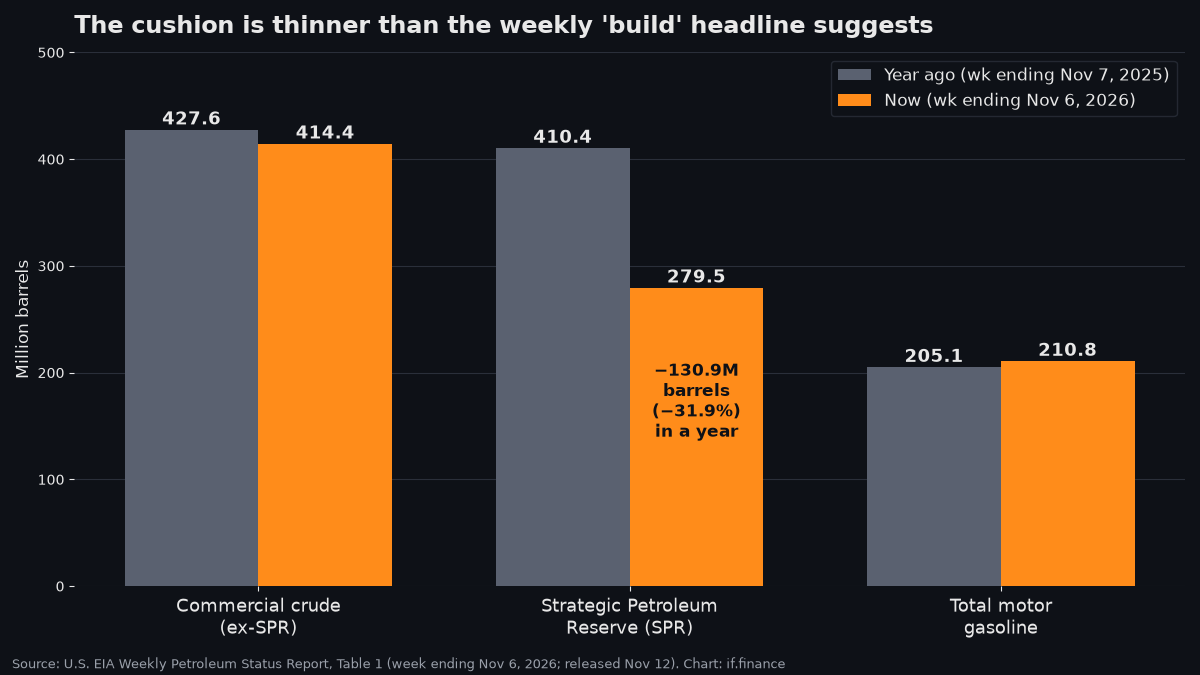
The weekly EIA report (delayed a day by the Nov. 11 federal holiday) showed commercial crude stocks up 4.7 million barrels to 414.4 million in the week ended Nov. 6. Analysts in a Reuters poll had expected a 1.1-million-barrel draw (EnergyNow/Reuters). Gasoline stocks rose to 210.8 million barrels. On its face, that’s bearish.
Look one line down in EIA’s Table 1, though. The Strategic Petroleum Reserve fell another 2.6 million barrels to 279.5 million. That’s 130.9 million barrels, or 31.9%, below a year ago. Commercial crude is also 13.2 million barrels below last year. The emergency cushion has been spent, and we think that’s exactly why every Hormuz headline hits harder than it would have in 2025.
OPEC+: the Nov. 29 meeting is the real test
On Nov. 1, seven core OPEC+ members (Saudi Arabia, Russia, Iraq, Kuwait, Kazakhstan, Algeria and Oman) kept December targets at September levels (OPEC statement). The bigger decision comes at the full ministerial meeting on Nov. 29, when the group is expected to set its 2027 production framework. Rystad’s Jorge Leon called December “the easy one” (CNBC).
The awkward part is that targets mean little while Gulf members are still pumping well below them because of the war. The UAE quit OPEC in May. About 2 million barrels a day of remaining cuts run through year-end. The IEA and other forecasters have warned of excess supply in 2027 if Gulf flows normalize. On the other side, Goldman Sachs’ upside scenario has Brent reaching $140 and averaging around $130 in 2027 if Gulf output stays 3.5 million barrels a day below its 2025 average (Economic Times, citing Reuters). A gap that wide between a glut and $140 is a sign of how little anyone can see right now.
The ripple: yields, the Fed, gold and the pump
This is where the post spread beyond the oil pit. Higher oil feeds straight into inflation expectations at the worst possible moment.
- Treasuries: The 10-year yield jumped more than 13 basis points to 5.125%. The 2-year rose more than 15 bps to 4.879%, and the 30-year hit 5.449%. CNBC explicitly tied the move to oil and Fed expectations (CNBC).
- The Fed: After Tuesday’s hot October CPI, CME FedWatch showed 100% odds of a December hike and about 13% odds of a half-point move, per CNBC. Kitco’s late read was roughly 85% for 25 bps and 15% for 50 at the Dec. 8–9 meeting (Kitco). Goldman added another hike to its forecast, for March.
- Gold: Spot gold fell $110.60, or 2.77%, to about $3,876.40 (Kitco), its lowest since early October 2025. Investopedia notes it is roughly 30% off record highs above $5,500 (Investopedia). In a war, that looks backwards. But this is a rate-hike tape, and gold pays no yield. The dollar index hit 103.23.
- Housing: October existing-home sales fell 5.5% to a 3.75 million annual rate, the weakest since August 2010 (Kitco).
- Gasoline: AAA’s national average fell below $4 for the first time since July, to $3.908, down from $4.100 a week ago. But a year ago it was $3.075, and AAA says this is the most expensive November on record (AAA). Diesel was $6.13 on Nov. 11 (USA Today, citing AAA). If Thursday’s crude bounce holds, the Thanksgiving relief at the pump could shrink.
Winners, losers and the one-post scoreboard
The stock market drew the line exactly where you’d expect. Energy was the top-performing sector (24/7 Wall St.). Midday, Exxon traded up about 1.8% near $170, Chevron about 1.6% near $216.64 and Occidental about $1.48 higher at $58.72. Refiners Valero and Marathon Petroleum posted the biggest dollar gains on MarketBeat’s oil list (MarketBeat, Markets Daily). USO, the WTI-tracking ETF, was up about 2%.
Airlines took the other side. JetBlue fell about 5% to $3.83, United about 4% to $113.30, Delta about 4% to $87.96 and American about 3% to $13.67 (24/7 Wall St.). Fuel is the swing cost. United’s Q4 guidance assumes jet fuel around $4.80 a gallon. Delta guides to $4.25 a gallon including the benefit of its own refinery. United CFO Michael Leskinen has said the airline is confident it can recapture fuel costs, “but with a lag.” That lag is where the pain sits.
Overnight: the bounce holds, mostly
In Asian trading Friday, Brent was down 28 cents at $95.54 and WTI was 56 cents lower at $88.18 as of 11:27 p.m. CT Thursday (05:27 GMT), per CNA/Reuters. Even after Thursday, both benchmarks were on pace for a weekly drop of about 2.9%, following a 16% plunge in Brent the week before. So the bounce is real, but it’s small next to the losses that came before it.
Our Take
We think the market made a classic mistake in early November. It priced the end of a war on the strength of comments, not a signed agreement, and Thursday was the correction. Our base case is a choppy, headline-driven range. Physical flows and the weekly builds cap the front month, while drained reserves, nine-month-old shipping risk and an OPEC+ group that can’t hit its own targets keep a floor under longer-dated barrels. That fits Currie’s framing, and it’s the setup we’d respect.
The bigger second-order risk, in our view, isn’t $100 oil. It’s oil feeding a Fed that’s already hiking into a housing market at a 16-year low. Rising crude and rising yields at the same time is the combination that breaks things. If Friday’s PPI runs hot, oil stops being just a commodity trade and becomes a macro problem.
Tickers we’re watching (watch list, not a buy list)
- XOM, CVX: integrated majors with refining offsets. Chevron goes ex-dividend Nov. 18.
- OXY: higher-beta U.S. producer. The cleanest equity read on WTI.
- VLO, MPC: refiners. Thursday’s biggest dollar gainers on MarketBeat’s oil list.
- XLE, USO: sector and crude proxies. Note that USO tracks front-month WTI, the barrel Currie says is capped.
- DAL, UAL, JBLU, AAL: the inverse trade. Delta’s refinery is a partial hedge; JetBlue has the least cushion.
- GLD: the tension trade, with war on one side and the Fed on the other. On Thursday, the Fed won.
Dates that matter
| Date (CT) | Event | Why it matters |
|---|---|---|
| Fri, Nov. 13, 7:30 a.m. | October PPI | Another hot inflation print would harden Fed hike bets and push yields up |
| Wed, Nov. 18 | Chevron ex-dividend | $1.78 a share payable Dec. 10 |
| Thu, Nov. 26 | Thanksgiving | GasBuddy expects record holiday pump prices even after the slide |
| Sun, Nov. 29 | OPEC+ ministerial meeting | 2027 production framework and baselines |
| Dec. 8–9 | FOMC meeting | Markets price a hike; the debate is 25 vs. 50 bps |
This article is for informational and entertainment purposes only and is not investment advice. Do your own research and consult a licensed professional before making investment decisions. Prices and figures are as reported by the cited sources at the times stated and can change quickly.
References
- Oil prices rise after Trump says no Iran deal needed: ‘We’ve got their Strait’ (CNBC, Nov. 12, 2026)
- 10-year Treasury yield jumps back above 5% as oil gains and more Fed rate hikes expected (CNBC, Nov. 12, 2026)
- Markets News, Nov. 12, 2026 (Investopedia, Nov. 12, 2026)
- Gold, silver slide as Treasury yields surge, Fed hike concerns intensify (Kitco News, Nov. 12, 2026)
- Oil prices set for second weekly decline as Trump sticks with Iran blockade (CNA/Reuters, Nov. 13, 2026)
- Oil Price Today (November 13): Brent crude climbs above $95 after fresh Middle East attacks (The Economic Times, Nov. 13, 2026)
- Four tankers struck by explosions in Strait of Hormuz, Iran says (The Straits Times, Nov. 12, 2026)
- IRGC says two supertankers caught fire in Strait of Hormuz (Iran International, Nov. 12, 2026)
- Iran says four tankers on fire in Hormuz (Arab News Japan, Nov. 12, 2026)
- JMIC Advisory Update 113 (Joint Maritime Information Center/UKMTO, Nov. 12, 2026)
- OPEC+ seven countries reaffirm commitment to market stability (OPEC, Nov. 1, 2026)
- OPEC+ keeps December oil output targets steady ahead of tougher call for 2027 (CNBC, Oct. 31, 2026)
- Weekly Petroleum Status Report, Table 1: U.S. Petroleum Balance Sheet (U.S. EIA, week ending Nov. 6, 2026)
- US Crude Stocks, Gasoline and Distillate Inventories Rise – EIA (EnergyNow/Reuters, Nov. 12, 2026)
- For the First Time Since July, National Average Drops Below $4 (AAA Newsroom, Nov. 12, 2026)
- Gas prices dropping ahead of Thanksgiving, but still record highs (USA Today, Nov. 11, 2026)
- Top Oil Stocks To Keep An Eye On – November 12th (MarketBeat, Nov. 12, 2026)
- Chevron (NYSE:CVX) Stock Jumps 1.6% – Here’s What Happened (Markets Daily, Nov. 12, 2026)
- JetBlue Drops 5% as Rebounding Oil Prices Hit Airline Stocks; United and Delta Fall 4% (24/7 Wall St., Nov. 12, 2026)
- Brent Crude (BZ=F) historical prices (Yahoo Finance, accessed Nov. 13, 2026)