They’re Skipping the Rent to Pay for Christmas
The tree is going up. For a lot of households, the rent notice is going under it.
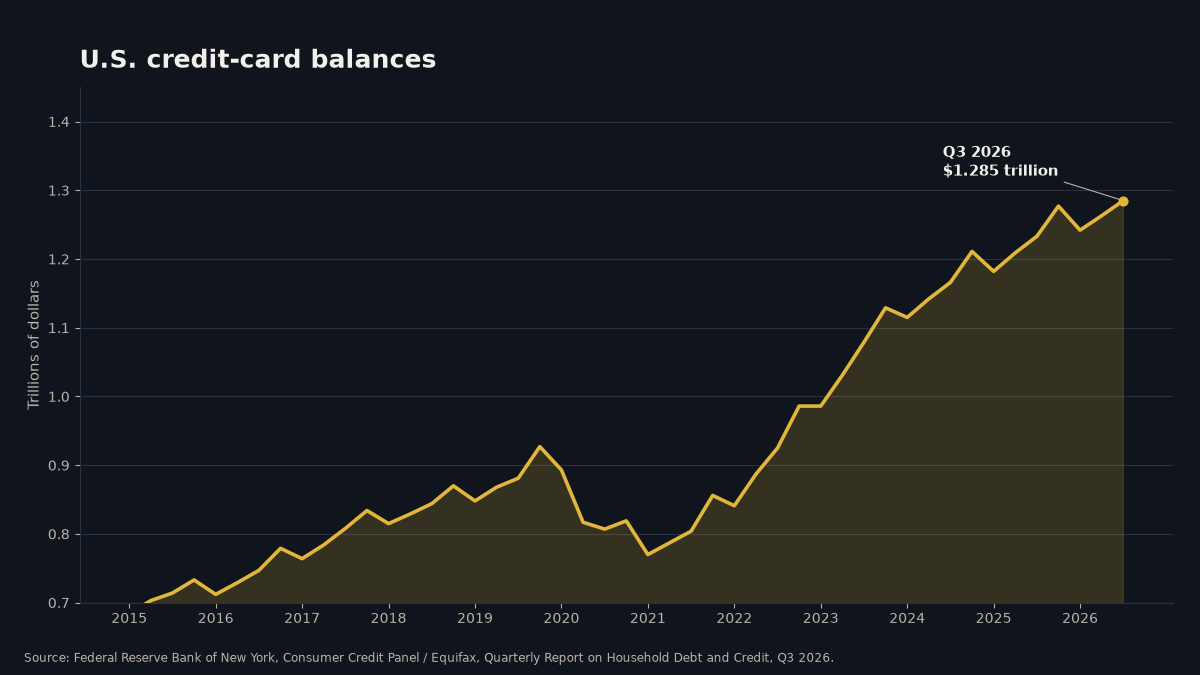
On November 10 the New York Fed reported that U.S. credit-card balances rose another $22 billion in the third quarter, to $1.285 trillion. Five percent of all household debt is now in some stage of delinquency, up 0.3 percentage points from the second quarter. And just as the shopping season starts, a debt-settlement firm asked 2,000 U.S. adults who celebrate a winter holiday whether they had put off the rent or the mortgage to pay for the holidays. Nearly half of the Gen Z respondents said they already had.
We are not here to scold anyone for buying a present. We are here because the bill and the lease are about to occupy the same month, and the math is not sentimental.
The tab is already $1.285 trillion
Total household debt in the United States hit $19.1 trillion at the end of September, the Fed said, up $334 billion in three months. Credit-card balances accounted for $22 billion of that increase and now stand at $1.285 trillion, up $52 billion from a year earlier. Auto-loan balances rose $21 billion, to $1.734 trillion. Mortgage balances are $13.4 trillion.
The part that should make a renter sit down is not the headline total. It is the late payments. Five percent of outstanding debt is now in some stage of delinquency. People are still slipping into early delinquency on auto loans and mortgages. The share of auto-loan balances that are 90 or more days late reached 5.66 percent in the third quarter, the highest reading in the Fed’s series, which goes back to 2003. Credit-card balances in that same serious-delinquency bucket were 12.90 percent.
The flow of new serious credit-card delinquencies did ease a little, to an annualized 6.87 percent from 7.05 percent a year earlier. That is not the same thing as the bill getting smaller. The balances are still at a record, and Christmas has not even been charged yet.
The late payments are worse where the paychecks are thinner
The same morning, the Fed’s researchers published a companion look at credit-card trouble by neighborhood income. Delinquency fell and the gaps narrowed during the pandemic, when stimulus checks, forbearances and less spending kept more accounts current. Since 2022 the trouble has come back, and it has come back harder in lower-income ZIP codes than in higher-income ones. The researchers say recent delinquency rates are higher than they were before the pandemic for every income group, and that the gap between them has widened. They also point to inflation outpacing wage growth for lower-income households.
They trace part of the damage to the cards issued during the pandemic, when a larger share of new accounts and new credit lines went to borrowers in the lowest-income ZIP codes, and the median credit score at issuance slipped. Those 2020-22 accounts piled up a lot of the new late payments in 2023 and 2024. Newer cards have gone, on the whole, to stronger scores, and the researchers say the pandemic-vintage mess may fade if the economy does not deliver another shock. That is a comfort for the averages. It is not a comfort if you are the household still carrying the 2022 card into December.
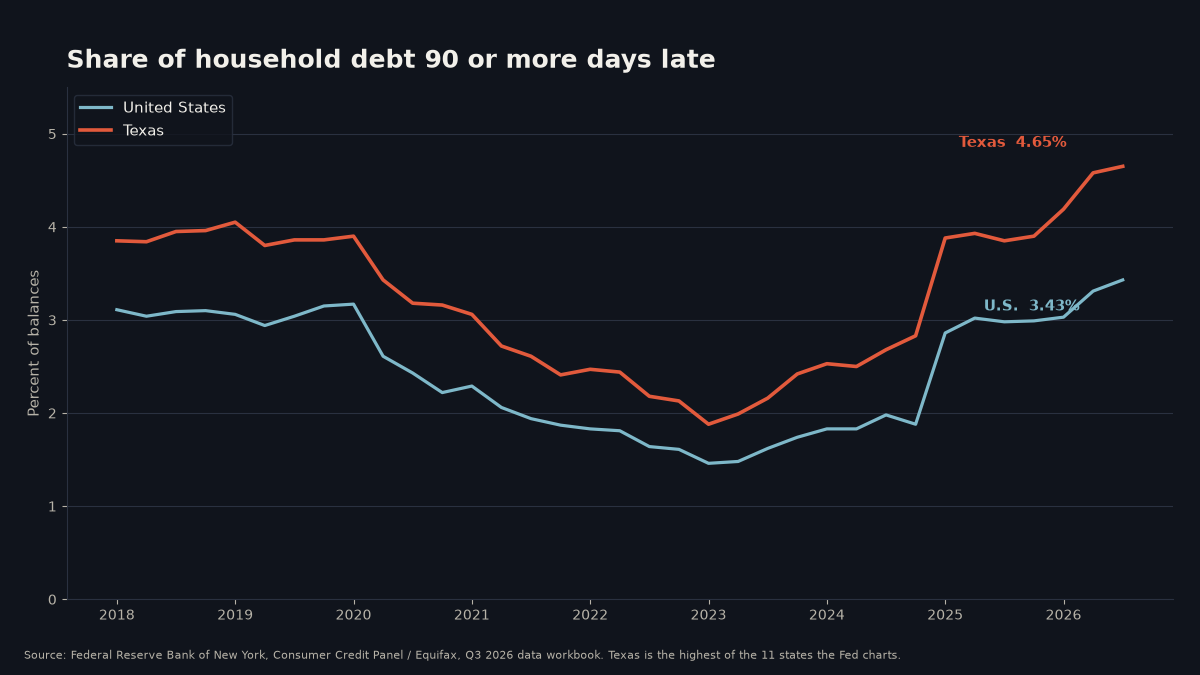
In Texas, a bigger share of the debt is already late
The Fed’s quarterly workbook charts 11 states, not all 50. Among those 11, Texas had the highest share of household debt 90 or more days late at the end of the third quarter: 4.65 percent, up from 4.58 percent in the spring and 3.85 percent a year earlier. The national figure on that same sheet was 3.43 percent.
The mix of that debt looks like Texas. Per person with a credit report, Texans carried $8,420 in auto loans in the third quarter, against $5,850 for the country. Credit-card debt per person was $4,590 here, against $4,340 nationally. Total debt per person was $61,380, up from $60,110 in the second quarter. On mortgages, 1.52 percent of Texas balances were 90 or more days late, against 1.13 percent nationwide and 0.92 percent in Texas a year earlier.
None of that is a lockout notice by itself. It is the sound of a state that drives to work, carries a heavier car loan, and is already late on a larger share of what it owes, just as the stores start piping in carols.
Rents, for once, are not the thing racing higher. Zillow, in data last updated November 9, put the average rent for all bedrooms and property types in Texas at $1,850, down $25 from the prior month and $40 from a year earlier. Apartment List’s November index, using October figures, shows the same easing in the big metros: San Antonio’s median rent was $1,140, down 3.8 percent from a year earlier, the steepest drop among large U.S. metros; Houston was $1,330, down 1.9 percent; Dallas-Fort Worth $1,413, down 1.3 percent; Austin $1,296, down 1.2 percent. The lease can be slightly cheaper than last fall and still be the payment a family skips when the toy aisle and the late fees start talking at once.
Eviction filings have not packed up and left. Eviction Lab, in a tracker last updated October 1 and covering the prior 12 months, counted 16,110 filings in Austin, 38 percent above its baseline; 79,971 in Houston; 47,132 in Dallas; and 48,024 in Fort Worth. A filing is not the same thing as a family put out on the curb. It is a court paper, and there are a lot of them.
They call it buy now, pay later
Holiday spending is being sold as the bright spot in the economy. Newsweek, writing Wednesday off the Fed report, cited a mid-October forecast from the National Retail Federation that November and December retail sales will grow 4.2 percent, to $1.01 trillion, crossing a 13-digit total for the first time. The same article cited a KPMG Consumer Pulse survey of 2,005 people, taken September 10 to 25, that put expected average holiday spending at $783, up 5 percent, with close to a quarter of respondents expecting to use buy-now-pay-later plans for more than 21 percent of their purchases. Visa, also as reported by Newsweek, expected holiday retail sales to rise 4.5 percent and average spending to $777, and found that about a third of households earning under $100,000 a year planned to switch to cheaper items or cheaper stores.
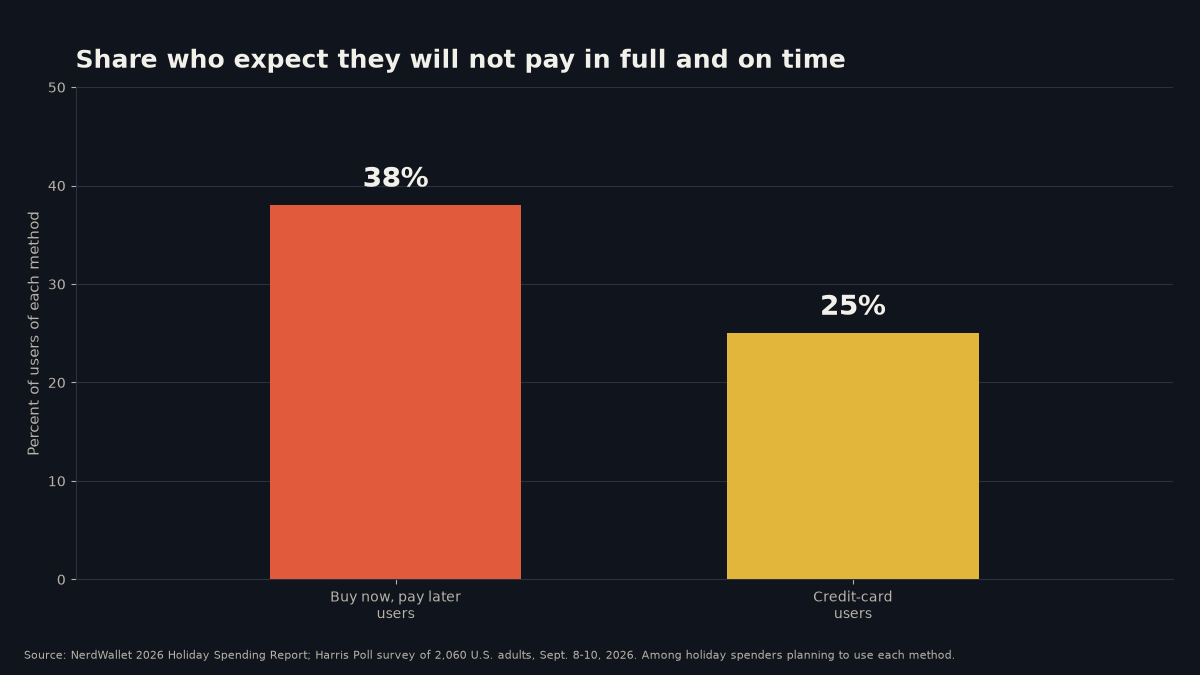
Those averages do not all measure the same basket, and we will not pretend they do. NerdWallet’s 2026 Holiday Spending Report, based on a Harris Poll of 2,060 U.S. adults taken September 8 to 10, found that people who plan to buy gifts expect to spend $879 on them, down 21 percent from $1,107 last year, while “holiday spenders” expect to spend $2,525 in all, including travel, parties and decorations. What matters for this story is how they plan to pay. About 74 percent of those holiday spenders said they will use a credit card. Thirty-eight percent said they will use buy now, pay later.
Buy now, pay later is a lovely phrase until later shows up in January wearing a late fee. Among the people who plan to use it, 38 percent already expect they will not pay in full and on time. Among credit-card users, 25 percent say the same.
Accredited Debt Relief, a debt-settlement firm, had Talker Research survey 2,000 U.S. adults who celebrate a winter holiday, from October 16 to 20. In that survey, 46 percent of Gen Z respondents said they have postponed or skipped a rent or mortgage payment to cover holiday spending, compared with 28 percent of millennials and 14 percent of Gen X. Forty-five percent of all respondents said they have or expect holiday-season debt, including 67 percent of Gen Z.
Diesel does not help. Newsweek, citing AAA, put diesel at $6.13 a gallon on November 11 (AAA’s average had eased to $6.04 by November 14), and noted that shippers including the Postal Service and Amazon have been adding fuel surcharges since the Iran war began. If a box costs more to move, the store has a way of putting that on the shelf, or on the shipping line at checkout.
If the rent has to clear first
The useful move, if the month is already tight, is boring, and it beats a past-due notice under the tree.
If the rent is late or an eviction paper has shown up, Texans can start with 211, which is built to point people to local rent help, food and legal aid, at 211 Texas. Texas Law Help publishes plain-language guides on eviction and the notices a landlord has to give before a case can be filed.
If the problem is the cards and the installment plans piling up, the National Foundation for Credit Counseling is a nonprofit network of counselors, not a debt-settlement shop, and the Consumer Financial Protection Bureau keeps a plain explainer on credit cards and another on what a buy-now-pay-later loan actually is.
- 211 Texas — local rent help, food and legal aid
- Texas Law Help: eviction — notices, court process and tenant rights under Texas law
- National Foundation for Credit Counseling — nonprofit credit counseling
- CFPB: credit cards and what a buy-now-pay-later loan is
The presents can wait a week. The rent usually cannot. Black Friday is November 27.
References
- Federal Reserve Bank of New York, “Household Debt Increased Moderately; Delinquency Transition Rates Remain Flat,” Nov. 10, 2026
- Federal Reserve Bank of New York, Quarterly Report on Household Debt and Credit, Q3 2026 (PDF)
- Federal Reserve Bank of New York, Household Debt and Credit Report data workbook, Q3 2026 (Excel)
- Donghoon Lee, Daniel Mangrum, Joelle W. Scally, Tejas Sinha and Wilbert van der Klaauw, “A Look at the Wider Divide in Credit Card Delinquency by Income,” Liberty Street Economics, Nov. 10, 2026
- Hugh Cameron, “Americans Are Going Into Debt to Pay for Christmas,” Newsweek, Nov. 11, 2026
- NerdWallet, “2026 Holiday Spending Report,” updated Oct. 13, 2026 (Harris Poll, Sept. 8-10, 2026)
- Zillow Rentals, “Average Rental Price in Texas,” last updated Nov. 9, 2026
- Apartment List, “Where Are Rents Falling the Most Right Now? (2026),” November 2026 Rent Index
- Eviction Lab, Eviction Tracking System, last updated Oct. 1, 2026
- AAA, Daily Fuel Gauge Report
- 211 Texas
- Texas Law Help, Eviction
- National Foundation for Credit Counseling
- Consumer Financial Protection Bureau, Credit cards
- Consumer Financial Protection Bureau, “What is a Buy Now, Pay Later loan?”
- PR Newswire, Accredited Debt Relief and Talker Research, “Nearly half of Gen Z have skipped or delayed rent or mortgage payments to afford holiday spending”