🎯 QF-16 Viper Drones: The F-16s That Fly With No One Home 🤖✈️
The QF-16 Viper drone, a retired F-16 that flies with nobody in the seat, just finished its production run at 127 jets. Now the Air Force has handed Boeing ($BA) a sole-source deal to keep the robot Vipers flying into the 2030s, while it shops for cheaper targets and tests real AI pilots in other F-16s.

The QF-16 Viper drone is the strangest retirement plan in the U.S. military. Take a fighter jet that spent decades guarding American airspace, pull it out of the Arizona desert, wire it for remote control, and then let missile testers shoot at it. Some missions are scored near-misses; some end in a fireball. [6]
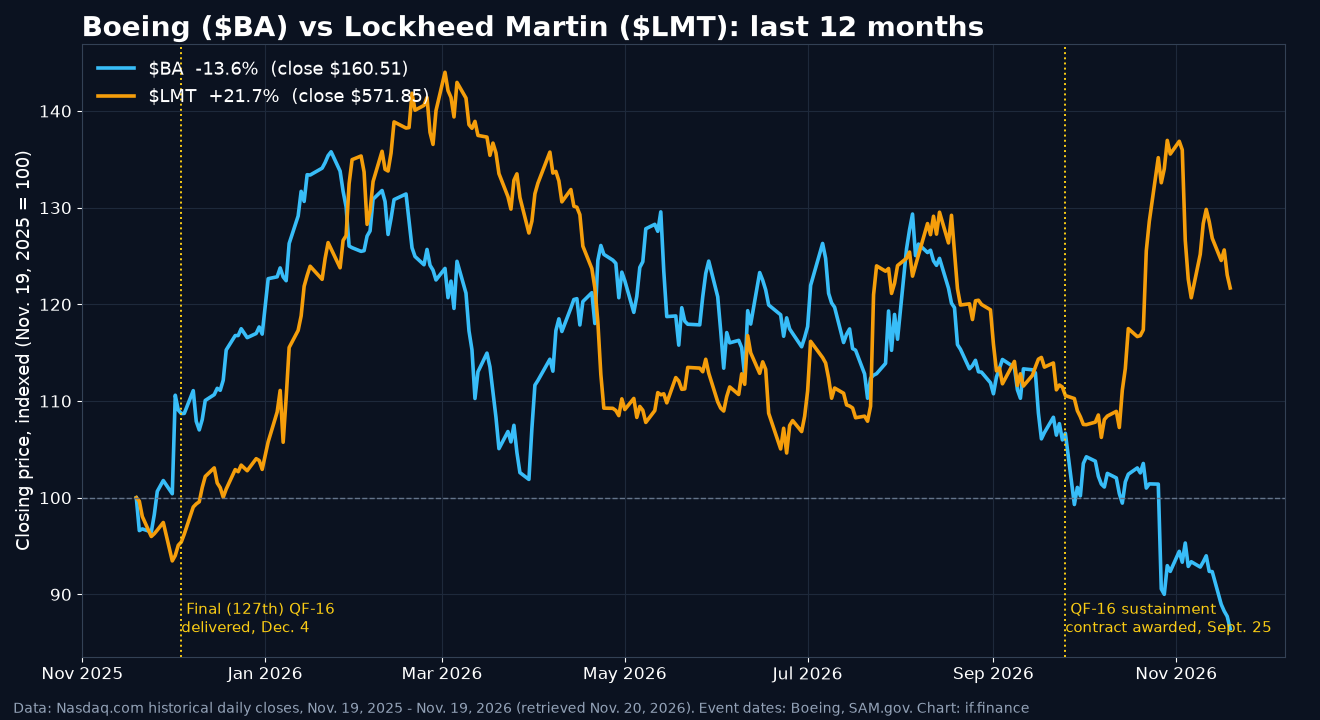
Boeing ($BA) said in December 2025 that it had delivered the 127th and final QF-16 to the Air Force. [6] On Sept. 25, 2026, the Air Force awarded Boeing a sole-source contract to sustain the fleet, according to a notice posted on SAM.gov on Oct. 7. [1] The F-16 itself is a Lockheed Martin ($LMT) product: the Air Force lists Lockheed as the jet’s contractor. [9] So one defense prime builds the fighter, and its biggest rival turns the leftovers into flying targets.
What is the QF-16 Viper drone?
“QF” is Air Force shorthand for a manned jet converted into a full-scale aerial target, and “Viper” is the F-16’s nickname among pilots. The QF-16 replaced the QF-4, a converted F-4 Phantom II, which retired at the end of 2016. [6] It keeps what made the F-16 dangerous: supersonic speed, 9G turns and a ceiling of about 55,000 feet. [6] Testers want missiles chasing something that flies like a real enemy fighter.
The jets fly with the 82nd Aerial Targets Squadron, based mainly at Tyndall Air Force Base in Florida, with a detachment at Holloman Air Force Base in New Mexico. [6] A QF-16 can fly with a pilot aboard or fully remote as a “NULLO,” short for “Not Under Live Local Operator.” [4]

Conversion usually takes about six months. Boeing adds an automatic flight control computer, remote-control gear, scoring antennas that measure how close a missile came, and a smoke system that fills the empty cannon bay. [6] It also installs explosive charges as a flight termination system, so a jet that loses control can be destroyed in a safe footprint. [6] The very last one, serial 83-1079, was delivered as an F-16A in 1984 and last flew operationally with the North Dakota Air National Guard’s “Happy Hooligans.” [6]
One fun detail: the switch that arms the remote self-destruct now costs about $60. Airmen of the 53rd Test Support Squadron redesigned an industry-built panel that cost thousands of dollars each, the Air Force said in August. [4] A senior airman on the project put it bluntly: the switch lets pilots “remotely detonate the aircraft in the event that something goes wrong in flight.” [4]
The money: a $318.7 million production contract, then sustainment
The original production contract went to Boeing in 2010 at $69.7 million. [6] By May 2025 that same contract, FA8678-10-C-0100, had a cumulative face value of $318,737,710, after a $10,249,959 modification that settled a Boeing request for equitable adjustment tied to earlier production. [3] That work runs to Dec. 30, 2026. [3] Separately, the Air Force awarded Boeing a $49.68 million letter contract in November 2021 for Lot 6 conversion material, warranty and support. [11]
The new deal is the sequel. The Air Force’s June 2025 notice estimated the sustainment contract at $50 million to $100 million, with a five-year base ordering period plus three one-year options. [2] The justification document says the work covers field service reps, engineering, spare parts, out-of-warranty repairs, tooling and technical data. [1] It also explains why nobody else got a shot: Boeing asserted limited and restricted rights over the QF-16 integration data, and the Air Force said a new contractor would face “substantial, unrecoverable cost duplication.” [1]
Note the fine print. The notice gives the award date and contract number, FA823226DB011, but no dollar amount, and we could not find the value in a Pentagon daily contract announcement. Treat the $50 million to $100 million range as the Air Force’s own estimate, not the final price. [1][2]
Why Wall Street barely notices, and why it still matters
For Boeing, $50 million to $100 million over up to eight years is a rounding error. Investors are staring at airliners instead. Boeing delivered 49 jets in October, down from 57 in September, and its 737 production ramp to 47 a month has slipped to early 2027, CNBC reported. [8] $BA closed at $160.51 on Nov. 19, its lowest close in 12 months of Nasdaq data and 13.6% below where it stood a year earlier. [10] Over the same stretch, $LMT rose 21.7% to $571.85. [10]
Still, the QF-16 deal is the kind of business defense investors like: sole-source, multi-year and backed by a legal testing requirement. The justification cites the federal rule that new weapon systems must prove their lethality before production. [1] Every new air-to-air missile needs something fighter-shaped to shoot at.
The threat to this niche is price. In August, Defense Daily reported the Air Force is looking for aerial targets that cost less than the QF-16 and the more than $1 million BQM-167A built by Kratos Defense ($KTOS). [7] Boeing expects to support the current fleet for at least five to 10 more years. [6] For more on how cheap drones are rewriting defense budgets, see our look at the counter-drone gold rush.
The other robot F-16s: VENOM and AI pilots
Do not confuse the QF-16 with VENOM. In July 2026, DARPA and the Air Force said an F-16 modified under the VENOM program flew at Eglin Air Force Base with an artificial intelligence agent controlling the flight. [5] A pilot stays in the cockpit and can switch between human and AI control “with the flip of a switch,” DARPA said. [5] DARPA says the work is meant to help future pilots command teams of uncrewed aircraft, including Collaborative Combat Aircraft. [5] The QF-16 is the target; VENOM is training the hunters. We covered the next wave of uncrewed fighters in our X-BAT story.

Our Take
We have a soft spot for the QF-16. It is the F-16’s brother from another mother: same airframe and the same 9G attitude, but raised by Boeing instead of the family that built it. Think of it as an AI assistant that finally got a physical body, a robot pilot riding in a real fighter jet. One honest caveat: in a QF-16 the “brain” is a remote pilot on the ground plus a flight computer, and the true AI-flown F-16s are the VENOM test jets. And unlike your chatbot, this one ships with a $60 self-destruct switch.
For investors, the QF-16 will not move $BA. It is a small, steady, sole-source annuity in a company whose stock lives and dies by 737 deliveries. The bigger signal is the trend: the Pentagon wants targets, wingmen and pilots that are cheaper and more autonomous. That favors drone makers and AI software over 40-year-old airframes. More defense names live in our War Stocks section and on our team stock picks list.
What to watch next
- Whether the Pentagon or SAM.gov publishes a dollar value for QF-16 sustainment contract FA823226DB011. [1]
- The close-out of the original production contract, scheduled for Dec. 30, 2026. [3]
- Any Air Force solicitation for a cheaper next-generation aerial target, and who bids, including $KTOS. [7]
- VENOM’s next phase under DARPA’s AI Reinforcements program, moving toward multi-ship flights. [5]
- Boeing’s November delivery numbers and the 737 ramp, which will matter far more to $BA than target drones. [8]
Bottom line: The QF-16 production line is done at 127 jets, but Boeing keeps a sole-source paycheck to keep the robot Vipers flying, and the real money fight is shifting to cheaper drones and AI pilots.
This article is for information only and is not investment advice.
References
- Justification and Approval Other than Full and Open Competition (DB25001), QF-16 Sustainment, SAM.gov, U.S. Air Force AFLCMC/WAMK, posted Oct. 7, 2026.
- QF-16 Sustainment (pre-solicitation notice DB25001), SAM.gov, U.S. Air Force AFLCMC/WAMK, June 4, 2025.
- Contracts For June 4, 2025, U.S. Department of War, June 4, 2025.
- $60 NULLO panel helps safeguard QF-16 weapons testing, DVIDS, 53rd Wing (Staff Sgt. Christian Conrad), Aug. 28, 2026.
- DARPA, U.S. Air Force fly AI-controlled F-16, DARPA, July 16, 2026.
- Boeing Marks Final Delivery of Converted QF-16 Target Drone to USAF, The Aviationist (Kai Greet), Dec. 5, 2025.
- Air Force Interested In New, Lower-Cost Aerial Targets, Defense Daily (Frank Wolfe), Aug. 19, 2026.
- Boeing jet deliveries drop 14% in October, CNBC, Nov. 10, 2026.
- F-16 Fighting Falcon fact sheet, U.S. Air Force, accessed Nov. 20, 2026.
- Boeing (BA) and Lockheed Martin (LMT) historical daily prices, Nasdaq.com, retrieved Nov. 20, 2026.
- Full Scale Aerial Targets QF-16 Production Lot 6 award notice (FA8678-22-C-0003), SAM.gov, U.S. Air Force, Dec. 2, 2021.
Image credits
- Featured photo: “QF-16 Full Scale Aerial Target Holloman Air Force Base” by Tech. Sgt. Perry Aston, U.S. Air Force, via DVIDS and Wikimedia Commons. Public domain (U.S. government work). Cropped to 1200×628 with text overlay by if.finance.
- QF-16 first unmanned flight, Sept. 19, 2013: Master Sgt. J. Scott Wilcox, U.S. Air Force, via Wikimedia Commons. Public domain.
- First QF-16 arrives at Tyndall AFB with a QF-4E escort, Nov. 19, 2012: Chris Cokeing, U.S. Air Force, via Wikimedia Commons. Public domain.
- Chart: made by if.finance from Nasdaq.com historical daily closes for $BA and $LMT.