Huawei’s “World’s First” Quantum Grid Claim Comes With Zero Numbers
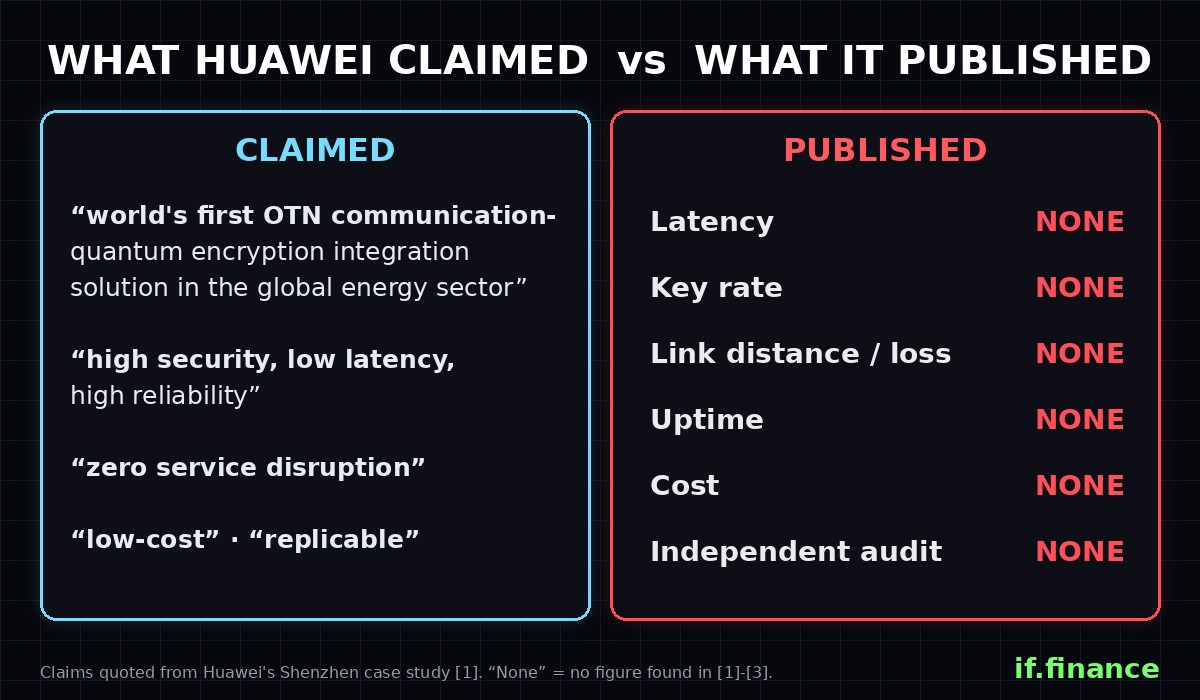
Huawei says it helped build the world’s first quantum-encrypted grid network in the energy sector. It has not published one number to prove the network works better than anything else. For a company selling “cutting-edge,” that is a big gap.
Shenzhen Power Supply Bureau, part of state-owned China Southern Power Grid (CSG), and Huawei say they put quantum encryption on the fiber that carried power-control traffic for the 15th National Games in 2025. Huawei calls it “the world’s first OTN communication-quantum encryption integration solution in the global energy sector.” Read the Huawei case study yourself. [1] The project is real and was reported by Chinese state media. [2][3] The proof behind the marketing is thin.
What was actually built
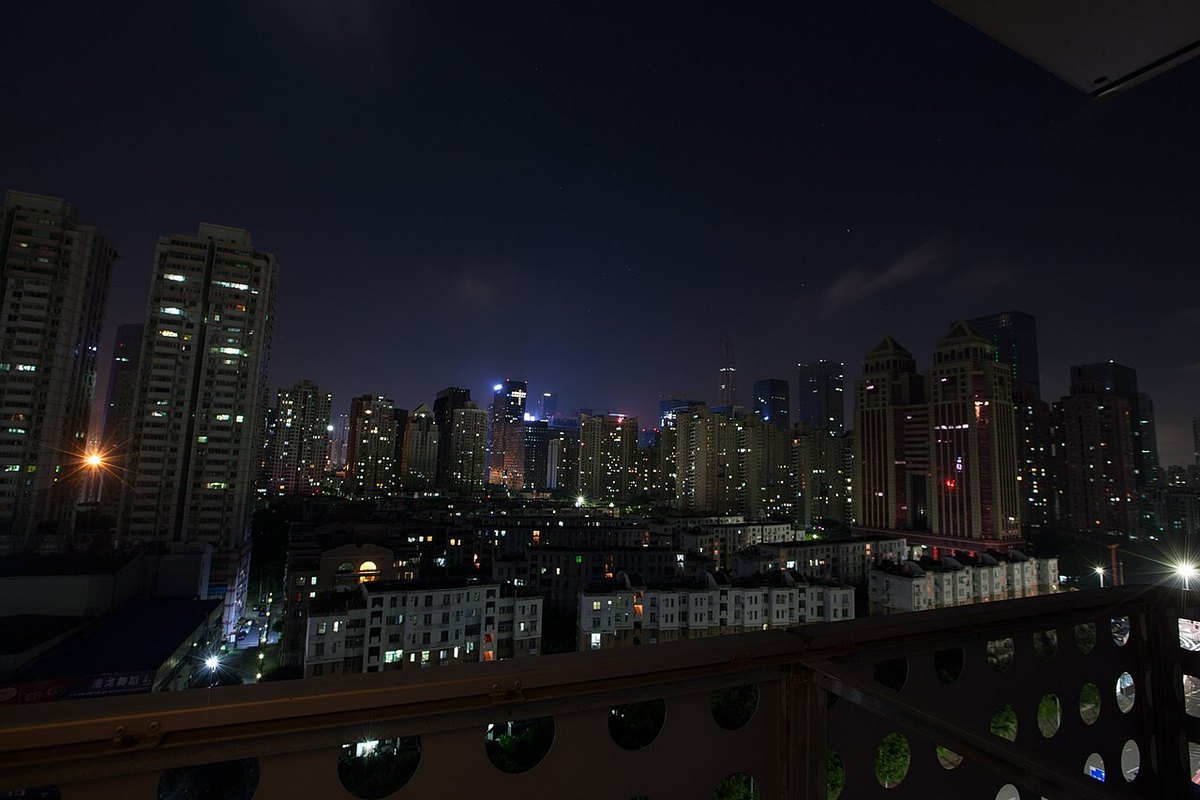
According to CSG’s Shenzhen bureau, the network covered two key power-assurance links and six substations. It carried real-time production control (telecontrol and stability-control channels), a private network for substation drones, quadruped robots and smart cameras, and video conferencing. It ran from the Games’ power command center to the front-line command posts, and was shown at the 27th China Hi-Tech Fair on November 14, 2025. [2][3]
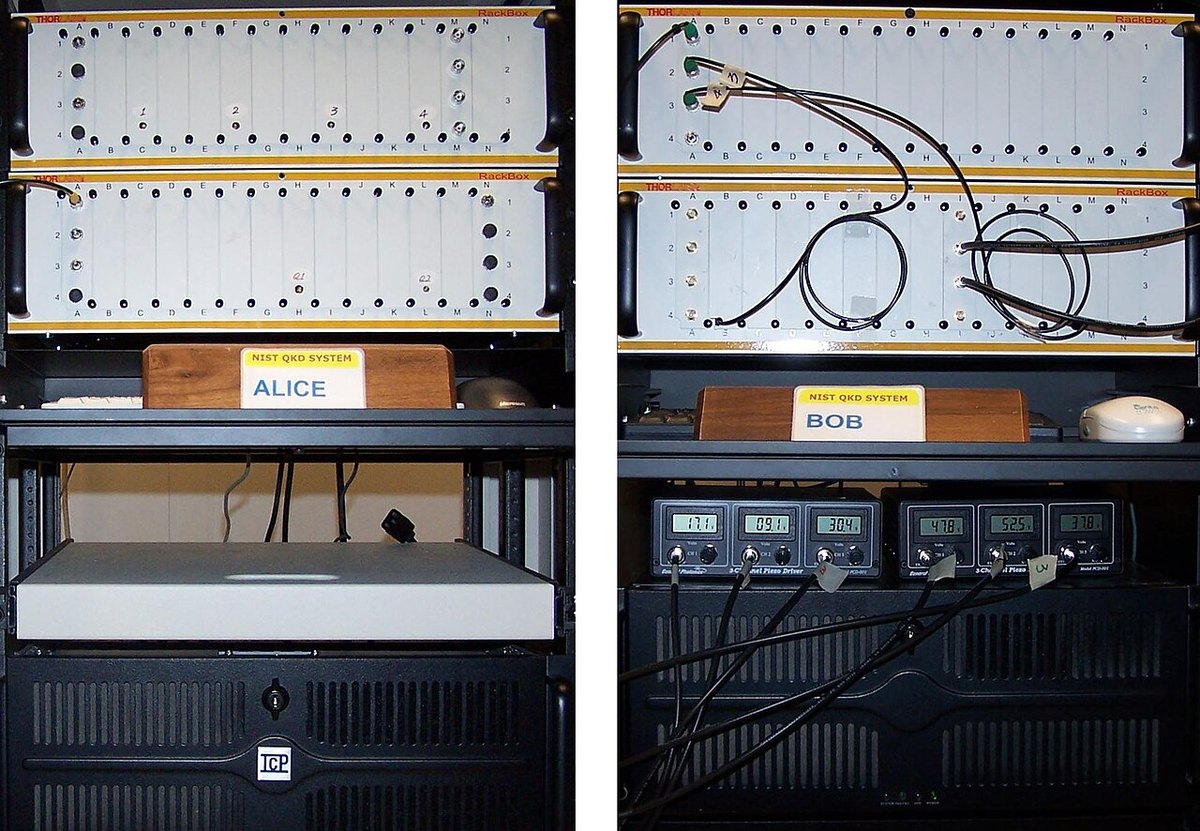
The pitch is clever engineering. Quantum key signals are extremely weak next to normal data light, so they usually need their own fiber. Huawei says its “optical quantum equalization algorithm” lets both share one fiber, and that the quantum function sits on a plug-in board for existing equipment. The bureau says that meant no new devices and no extra fiber. [1][3]
Where Huawei’s story falls short
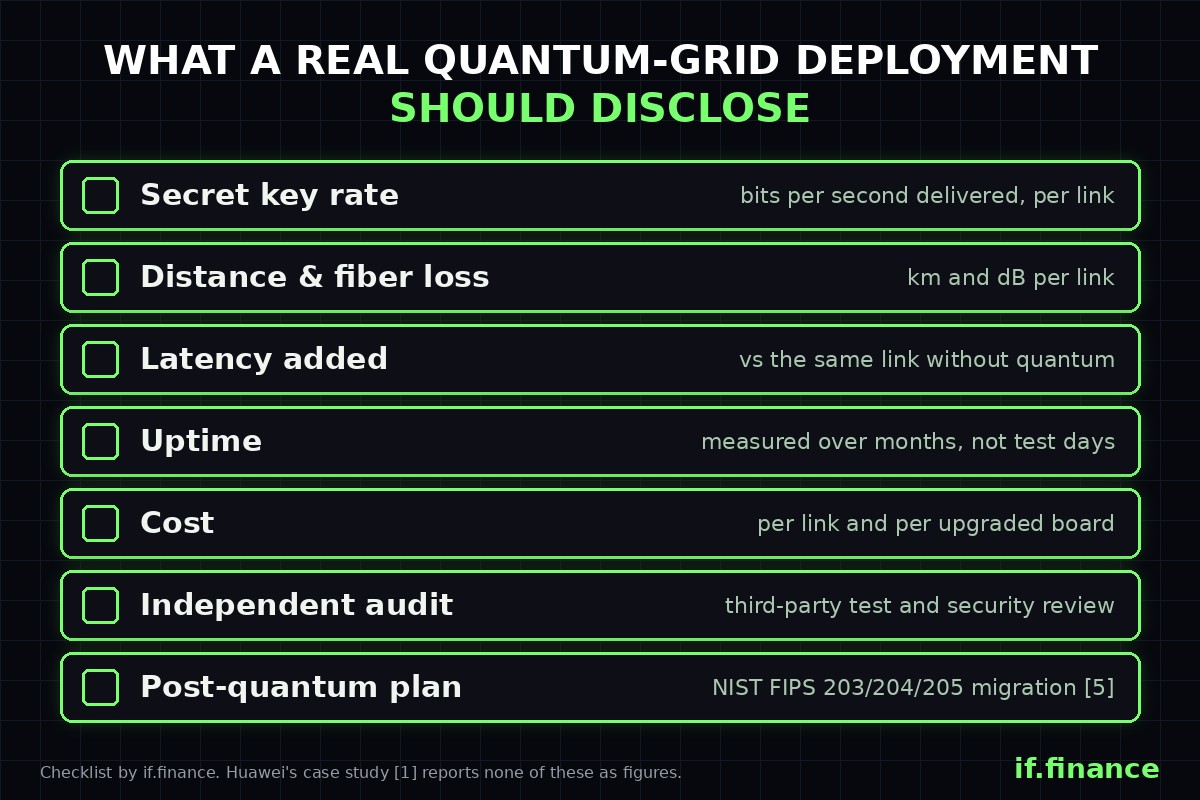
- No numbers. The case study gives no latency, key rate, link distance, uptime or cost figures. It claims “high security, low latency, high reliability” and “zero service disruption” without measurements. [1] CSG’s release says only that multi-day test runs were “stable.” [3] A “low-cost” claim with no cost figure can’t be checked.
- “World’s first” is self-declared. The “first” claims come from Huawei and the bureau. The Chinese outlets we found repeat the company line. [1][2][3][6] The one outside voice we found is an industry awards program: Lightwave’s Innovation Reviews listed the product, and a judge called the integrated design “an improvement compared to other approaches.” [4] That is a product listing, not a field audit.
- Even the model name moves. Huawei’s English case study says the network runs on the OptiXtrans E6600. Chinese reports and Lightwave name the OptiXtrans E6616. [1][2][3][4] E6616 may simply be a model in the E6600 series, but Huawei doesn’t say so.
- Locked-down marketing. The case study page states no license for its own banner photo, so outlets like ours can’t reuse it. For a project sold as a “replicable” model, very little of it can be checked or reused by outsiders. [1]
Project lead Liu Zhiwei of the Shenzhen bureau called the network “a generational leap in power communication security.” [1] Maybe so. But a leap with no published measurements is a claim, not a benchmark.
The trust problem Huawei can’t engineer away
Huawei is pitching security, and security is exactly where Western regulators say it is a risk. The U.S. Federal Communications Commission banned new authorizations of Huawei telecom equipment on November 25, 2022, citing an “unacceptable risk” to national security. [7][8] On June 15, 2023, the European Commission said Huawei and ZTE “represent in fact materially higher risks than other 5G suppliers” and backed member states that restrict or exclude them. [9] Those rulings shape where Huawei can sell this kind of gear.

So this “Shenzhen Model” is mostly a Chinese and allied-market story. Huawei and the bureau say they will roll it out to substations at all voltage levels and backbone dispatch links. [1] Outside China, utilities facing the same “harvest now, decrypt later” threat are moving toward the post-quantum algorithms that the U.S. National Institute of Standards and Technology (NIST) finalized in August 2024. [5]
What investors should take from it
- Quantum-safe grid security is now a real procurement theme. A state grid ran live control traffic over quantum-encrypted fiber. That’s a signal for optical transport, grid communications and post-quantum security suppliers. [1][5]
- Demand proof. Until vendors publish key rates, distances, latency and costs, treat “world’s first” press as marketing.
- No direct ticker. Huawei is privately held and CSG is state-owned. See our Energy Stocks and Technology Picks coverage for related names.
This story is for information only and is not investment advice.

References
- Shenzhen Power Supply Bureau and Huawei Deploy the World’s First OTN Communication-Quantum Encryption Integration Solution, Huawei Enterprise (case study), 2026.
- 全球能源领域首张“通量一体”量子加密全光通信网在深圳应用 (World’s first integrated quantum-encrypted all-optical network in the energy sector applied in Shenzhen), Science and Technology Daily (stdaily.com), November 14, 2025.
- 全球电力行业首张“通量一体”量子加密通信专网在深建设及应用成功 (Power industry’s first integrated quantum-encrypted private network built and applied in Shenzhen), China Power (chinapower.com.cn), release from CSG Shenzhen Power Supply Bureau, November 17, 2025.
- Huawei: Communication Network Integrating Telecom & Quantum Encryption, Lightwave Online, Innovation Reviews, February 12, 2026.
- NIST Releases First 3 Finalized Post-Quantum Encryption Standards, U.S. National Institute of Standards and Technology (NIST), August 13, 2024.
- 深圳供电局:落地“OTN通量一体”量子加密通信专网 (Shenzhen Power Supply Bureau lands OTN integrated quantum-encrypted network), 10jqka (Tonghuashun Finance), October 22, 2026.
- FCC Bans Authorizations for Devices That Pose National Security Threat, U.S. Federal Communications Commission, November 25, 2022.
- U.S. bans new Huawei, ZTE equipment sales, citing national security risk, Reuters, November 25, 2022.
- Commission announces next steps on cybersecurity of 5G networks in complement to latest progress report by Member States, European Commission, June 15, 2023.
Featured image: if.finance graphic. Huawei logo is a trademark of Huawei Technologies Co., Ltd., used for editorial identification only (file via Wikipedia). Background photo: “Fiber optic illuminated” by Hustvedt, via Wikimedia Commons, licensed CC BY-SA 3.0 (cropped, darkened, with overlays).


Body images: “Shenzhen Skyline At Night” by Andreas Bunen, via Wikimedia Commons, licensed CC BY 3.0 (resized). NIST high-speed quantum key distribution system photo by the U.S. National Institute of Standards and Technology, via Wikimedia Commons, public domain. “Claimed vs published” and disclosure-checklist graphics by if.finance.