Okta Joins the S&P 500: What the Kenvue Swap Means for Investors

Okta (OKTA) will join the S&P 500 before the opening bell on Wednesday, November 4, replacing Kenvue (KVUE) as Kimberly-Clark (KMB) closes its roughly $48.7 billion takeover of the consumer-health company. The identity-security company arrives after a 140% run this year, so index buying may matter less than whether its AI-agent story keeps delivering.

Okta S&P 500 addition: the Nasdaq MarketSite tower in Times Square, New York, where Okta shares are listed
The Nasdaq MarketSite in Times Square. Okta trades on the Nasdaq. Photo: ajay_suresh via Wikimedia Commons, CC BY 2.0 (cropped).

The Okta S&P 500 swap, in one paragraph

The news came over the wire on Friday evening. S&P Dow Jones Indices said in a press release on PR Newswire that Okta, now in the S&P MidCap 400, will replace Kenvue in the S&P 500 effective before trading opens on November 4. The reshuffle cascades down the size ladder: Glaukos (GKOS) moves up from the S&P SmallCap 600 to take Okta’s mid-cap seat, and McGrath RentCorp (MGRC) takes Glaukos’s small-cap spot. In a separate swap, Loar Holdings (LOAR) replaces LiveRamp (RAMP) in the SmallCap 600 because Publicis is buying LiveRamp. [1]

Okta joins the large-cap benchmark as an Information Technology stock. Kenvue leaves from Consumer Staples. [1]

Why Kenvue is leaving

Kenvue isn’t being kicked out for poor performance. It is disappearing. Kimberly-Clark agreed in November 2025 to buy it for $3.50 in cash plus 0.14625 Kimberly-Clark shares for each Kenvue share, worth $21.01 a share at signing and an enterprise value of about $48.7 billion. When the deal closes, Kimberly-Clark holders are expected to own about 54% of the combined company and Kenvue holders about 46%. [2]

The final pieces are falling into place. On October 29 Kimberly-Clark closed a $4.9 billion bond sale in five tranches, from 5.10% notes due 2028 to 5.80% notes due 2036, to help fund the cash part of the deal. CFO Nelson Urdaneta called it “another milestone.” [3] Index provider Solactive told clients on Friday that it expects the deal to close on November 2 and Kenvue shares to stop trading that day. Kenvue shareholders approved the deal on January 29. [4] S&P itself only says the deal is “expected to be completed soon, pending final closing conditions.” [1]

For Kenvue holders, there’s little left to do. Their shares become cash plus Kimberly-Clark stock, so index funds that held Kenvue will end up holding more Kimberly-Clark.

Okta’s run into the index

Okta’s ticket into the S&P 500 was written by a huge rebound. The stock closed 2025 at $86.47 and hit a three-year low of $62.66 on April 10, 2026. It closed Friday at $208.24, up about 141% for the year, against an 11% gain for the S&P 500. That gives the company a market value of roughly $36 billion. [5]
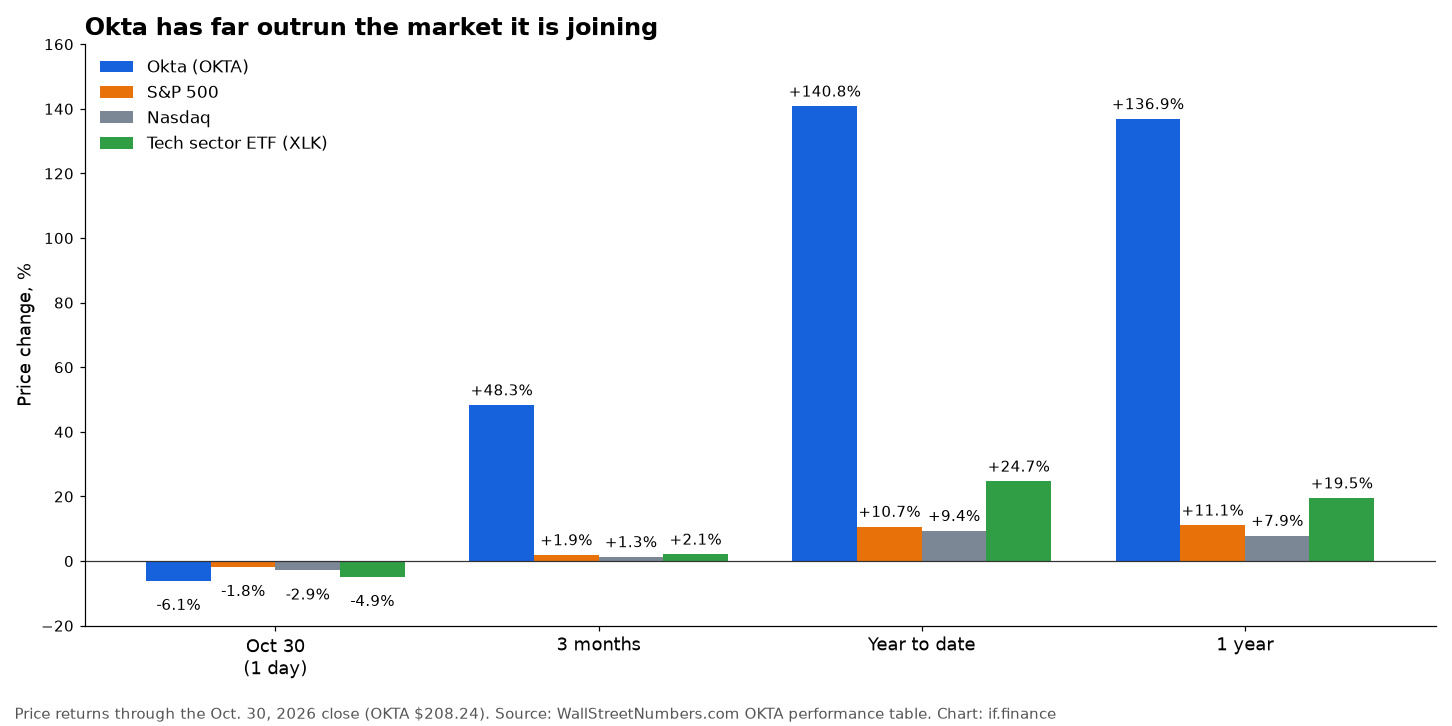
Bar chart comparing Okta stock returns with the S&P 500, Nasdaq and XLK tech ETF over one day, three months, year to date and one year through October 30, 2026
Okta’s price return vs. the S&P 500, the Nasdaq and the XLK tech ETF through the October 30, 2026 close. Source: WallStreetNumbers.com. Chart: if.finance.

The fuel has been AI. Okta sells identity and access software, the digital gatekeeper that checks who (or what) is logging into a company’s systems. As businesses start deploying AI agents, each one needs credentials and limits on what it can touch. “Every agent needs a trusted identity,” CEO Todd McKinnon said in August. [6]

The numbers have backed up the pitch. In the quarter ended July 31 (fiscal Q2 2027), Okta reported: [6]

  • Revenue of $805 million, up 11%, with subscription revenue up 12% to $793 million.
  • Remaining performance obligations (RPO), the contracted backlog of future subscription revenue, up 17% to $4.858 billion. The current portion due in the next 12 months (cRPO) rose 14%.
  • GAAP operating income of $107 million, up from $41 million. GAAP means standard accounting, including stock-based pay.
  • Free cash flow of $227 million, or 28% of revenue.
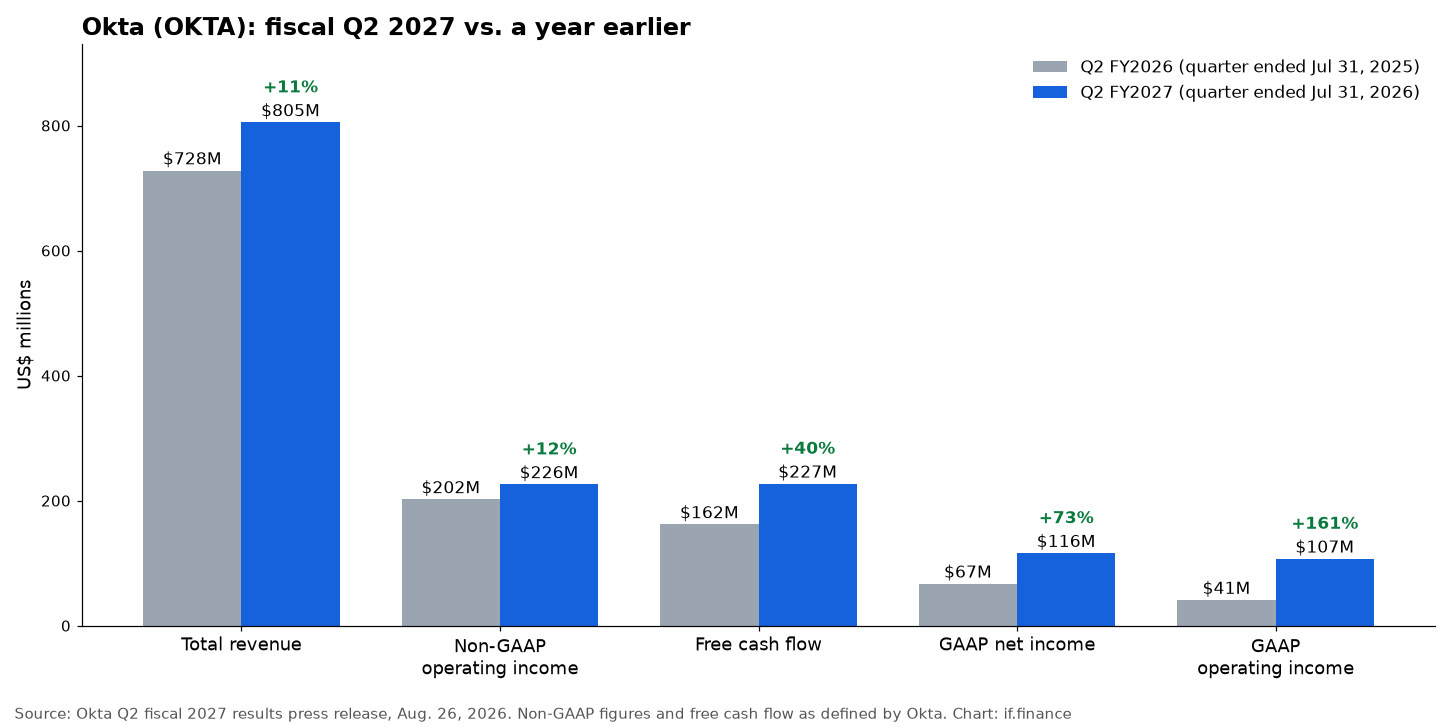
Bar chart of Okta fiscal Q2 2027 vs Q2 2026: revenue, non-GAAP operating income, free cash flow, GAAP net income and GAAP operating income in US dollar millions
Okta’s fiscal Q2 2027 results vs. a year earlier. Source: Okta Q2 FY2027 press release. Chart: if.finance.

The stock jumped nearly 29% the day after that report, part of a wider cybersecurity rally sparked by fears of AI-driven attacks. McKinnon said new products made up nearly a third of bookings. [7] Profits are real, too: GAAP net income was $116 million last quarter, up from $67 million a year earlier. [6]

Does joining the S&P 500 move the stock?

Usually a little, and often before the effective date. Funds that track the S&P 500 have to buy Okta’s shares to match its new weight, which can lift the price in the short run. [8] On Friday the reaction was modest: Okta rose about 2% after hours, clawing back part of a 6% drop in a broad tech sell-off earlier in the day. McGrath gained 2.8% and Loar 3.5% in late trading on their own index moves. [8]

There are good reasons not to expect much more. Okta was already in the MidCap 400, so the funds tracking that index will be selling as S&P 500 funds buy. And the stock is far from cheap after its run: it trades at about 126 times trailing earnings, and the average analyst price target of $223 is only about 7% above Friday’s close. [5]

The bull case: an S&P 500 seat brings a wider, more stable shareholder base. Okta is profitable, generates lots of cash and sits at the center of a real AI security need. Guidance for the full fiscal year calls for revenue of $3.216–$3.226 billion and free cash flow of $910–$930 million. [6]

The bear case: growth is about 10–11%, not hyper-growth, and the company itself guided for “prudent” numbers. [6] Bank of America, which upgraded the stock to neutral in August, warned that management still views AI as immaterial to this fiscal year’s results. [7] A stock that tripled from its April low can fall hard if that AI narrative cools, as Friday’s 6% drop showed. [5][8]

What to watch next

  • November 2: Kimberly-Clark’s expected closing of the Kenvue deal and the halt in Kenvue trading. [4]
  • November 3 close: this is the last session before the change takes effect, so it is when index-tracking trades in OKTA, GKOS, MGRC and LOAR are likely to cluster. [1]
  • November 4: Okta officially joins the S&P 500. Glaukos, McGrath and Loar move indexes the same day. [1]
  • Okta’s fiscal Q3 report: guidance calls for revenue of $813–$817 million and cRPO of $2.590–$2.600 billion. A beat on cRPO would support the AI-agent story. [6]
  • Tech sentiment: Okta fell more than the market on Friday. Watch whether the cyber trade holds up if AI stocks keep wobbling. [5][8]

Follow more names like this on our Technology Picks page, and check live charts on Finviz Charts.

The bottom line: Okta’s S&P 500 entry is a stamp of approval on a company that turned AI anxiety into AI demand, but the index buying is mostly priced in, and the next real test is its fiscal third-quarter report.

This article is for information only and is not investment advice. Figures are from company releases and the reporting cited below as of October 31, 2026.

References

  1. Okta Set to Join S&P 500; Others to Join S&P MidCap 400 and S&P SmallCap 600, S&P Dow Jones Indices (press release via PR Newswire), October 30, 2026.
  2. Kimberly-Clark to Acquire Kenvue, Creating a $32 Billion Global Health and Wellness Leader, Kimberly-Clark and Kenvue joint press release (Exhibit 99.1 to Kimberly-Clark Form 8-K, SEC EDGAR), November 3, 2025.
  3. Kimberly-Clark Corporation Announces Successful Completion of $4.9 Billion Private Offering of Senior Notes, Kimberly-Clark Corporation (press release), October 29, 2026.
  4. Acquisition | KENVUE INC | 4th November 2026, Solactive (index announcement), October 30, 2026.
  5. Okta, Inc. (OKTA) Stock Price History & Chart, WallStreetNumbers.com, data as of the October 30, 2026 close.
  6. Okta Announces Second Quarter Fiscal Year 2027 Financial Results, Okta, Inc. (press release), August 26, 2026.
  7. CrowdStrike posts best day ever, Okta’s stock pops nearly 29% as rising AI threat lifts earnings, CNBC, August 27, 2026.
  8. Okta jumps after-hours following tapped inclusion in the S&P 500, Investing.com, October 30, 2026.

Image credits

Read More

Essar Oil Is Gone. Essar Isn’t: A Sanctioned Refinery, a Stalled Sale and the Ruias’ New Bets in UK Fuel and US Steel

Nine years after the Ruia family sold Essar Oil to a Rosneft-led group, the refinery they built is running on Russian crude under EU and UK sanctions and its profits are rising. Meanwhile the Essar name is buying UK petrol stations and Indian gas blocks, trying to turn its UK refinery into a low-carbon one, and promising $18 billion for American steel. Here’s who owns what, and what it means for investors.

First, untangle the names

Three different businesses get called “Essar Oil,” and mixing them up leads to bad trades and bad headlines.

  • Essar Oil Ltd is now Nayara Energy. In August 2017 Essar’s holding companies sold 98.26% of Essar Oil for US$12.9 billion: US$10.9 billion for the refinery and retail business and US$2.0 billion for the Vadinar port and related infrastructure. Rosneft took 49.13%. A Trafigura–UCP consortium took an equal 49.13% through a vehicle called Kesani Enterprises. Retail shareholders kept the remaining 1.74%. Essar called it India’s largest foreign direct investment. The company adopted the Nayara Energy name in 2018.
  • Essar Oil and Gas Exploration and Production Ltd (EOGEPL), now branded Essar Oil & Gas, is the Essar Group’s upstream arm. It was never part of the 2017 sale.
  • Essar Oil (UK) Ltd trades as EET Fuels and owns the Stanlow refinery in Cheshire, which Essar bought from Shell in 2011. It sits inside Essar Energy Transition and was not part of the 2017 sale either. Essar is spending heavily to make it what it calls the UK’s first low-carbon process refinery (more on that below).
The Vadinar refinery in Gujarat, photographed in 2008 when it was still owned by Essar Oil
The Vadinar refinery near Jamnagar, Gujarat, in 2008, when it still carried the Essar Oil name. Photo: Abhisek Sarda via Wikimedia Commons, CC BY 2.0.

Essar has lost a crown jewel before

This is not the first time the Ruias have built a giant and then lost it. Essar began making steel at Hazira, a port near Surat in Gujarat, in the 1990s. By 2011 it had doubled the complex to 10 million tonnes a year, which made it India’s largest single-location flat steel producer and, by the company’s count, the fourth largest in the world.

Then the debt caught up with it. According to Essar, promised gas supplies were withdrawn in 2012 and coal blocks for its power plants were cancelled in 2014. In June 2017 the Reserve Bank of India put Essar Steel India on its first list of 12 large defaulters to be resolved under India’s Insolvency and Bankruptcy Code (IBC), and the tribunal admitted the case on August 2, 2017. Essar contested the referral, and its holding company offered creditors ₹54,389 crore to keep the company. Lenders instead backed a ₹42,000 crore plan from ArcelorMittal and Nippon Steel, and India’s Supreme Court cleared the way in November 2019. On December 16, 2019, Hazira passed to ArcelorMittal Nippon Steel India (AM/NS India), a joint venture of Luxembourg-based ArcelorMittal (60%) and Japan’s Nippon Steel (40%). Financial creditors recovered more than 90% of their admitted claims.

The Hazira sale is sometimes described as a bankruptcy filing by Essar. It wasn’t: lenders pushed the company into India’s IBC process, and Essar fought it. Essar did use US Chapter 11 once, for its Minnesota mining project in 2016. That project is where its newest and biggest bet comes from.

Nayara: sanctioned, and more profitable

The European Union sanctioned Nayara in July 2025. The UK followed in October 2025. The US sanctioned Rosneft itself effective November 21, 2025, and in April 2026 the EU added UCP PE Investments, which holds 49% of Kesani. All four steps are listed in Nayara’s 2025-26 annual report. Trafigura had already sold its share of Kesani to Hara Capital, a unit of Italy’s Mareterra Group, in January 2023.

After a 2025 buyback from minority holders at ₹731 a share, Rosneft Singapore and Kesani each hold 49.20%, up from 49.13%. Kesani’s holding is pledged. Most press reports still use the old figure.

The operational damage was real. Reuters reported that crude runs at the 400,000-barrel-a-day plant fell to 70–80% of capacity after the EU listing, down from 104% before it. Iraq and Saudi Arabia stopped selling crude to Nayara. Planned maintenance had to be pushed back because sanctions made key equipment hard to get. The plant was finally shut on April 9, 2026 and restarted around May 13. According to the Centre for Research on Energy and Clean Air (CREA), Vadinar took all of its crude from Russia in the first eight months of 2026, up from 81% in 2025.

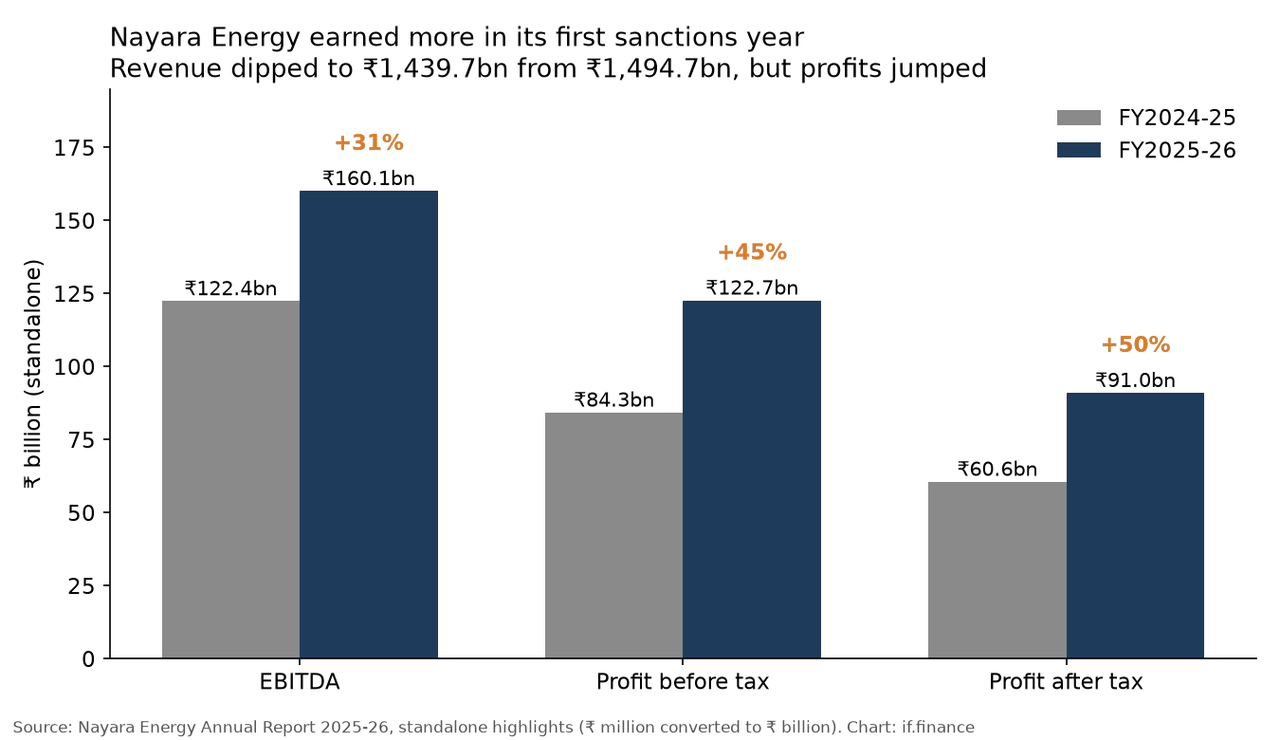
The financial results, though, look very different:

Bar chart: Nayara Energy standalone EBITDA, profit before tax and profit after tax, FY2024-25 vs FY2025-26
Source: Nayara Energy Annual Report 2025-26, standalone financial highlights. Chart: if.finance.

In the year to March 2026, standalone revenue slipped to ₹1,439.7 billion from ₹1,494.7 billion. EBITDA rose 31% to ₹160.1 billion and profit after tax rose 50% to ₹91.0 billion. Management puts those at roughly US$1.8 billion and US$1.02 billion. The refinery processed about 135.1 million barrels, and domestic sales made up about 82% of volume. Discounted Russian barrels clearly help: Kpler analysts quoted by Moneycontrol estimated the discount saves Nayara about $5–7 a barrel.

Read the footnotes, though. The board recommended no dividend “to conserve financial resources.” Because the sanctions give lenders the right to demand early repayment, Nayara has reclassified long-term loans due after March 2027 as current liabilities. No lender has acted on that right so far.

The 2026 squeeze at the pump

The Iran conflict has made Nayara’s 7,000-plus Indian fuel stations a political issue. On October 1, oil secretary Neeraj Mittal said “nobody is allowed to put a cap on fuel sales,” after reports that Nayara and Jio-bp were rationing diesel. Nayara says it imposed no supply restrictions on dealers. On October 3 it raised petrol prices by ₹5 a litre and diesel by ₹3 across 7,108 stations. State-run retailers held their prices, even though Icra estimates they are losing about ₹530 crore a day. Nayara’s diesel exports, meanwhile, dropped to an estimated 39,000 barrels a day in October from about 69,000 in September, according to Kpler data reported by The New Indian Express.

The stake sale that hasn’t happened

Rosneft has been trying to sell out since at least mid-2025. In June 2025 The Economic Times reported early talks with Reliance Industries, with price as the sticking point. Business Standard later cited reports valuing Nayara at about $17 billion and said the EU sanctions had become a “major roadblock.” As of October 31, 2026, we found no announced buyer, signed agreement or regulatory filing for a sale. Each new sanctions step makes the stake harder to sell. In September, CREA reported that gasoline from Vadinar was being sold to Rosneft and shipped back to Russia on sanctioned tankers, which puts the refinery even more squarely in the spotlight.

Where Essar is putting its money now

Aerial view of Stanlow Point and the Stanlow refinery on the Mersey estuary
Stanlow Point and Stanlow refinery from the air, 2017. Photo: M J Richardson via Wikimedia Commons (geograph.org.uk), CC BY-SA 2.0.

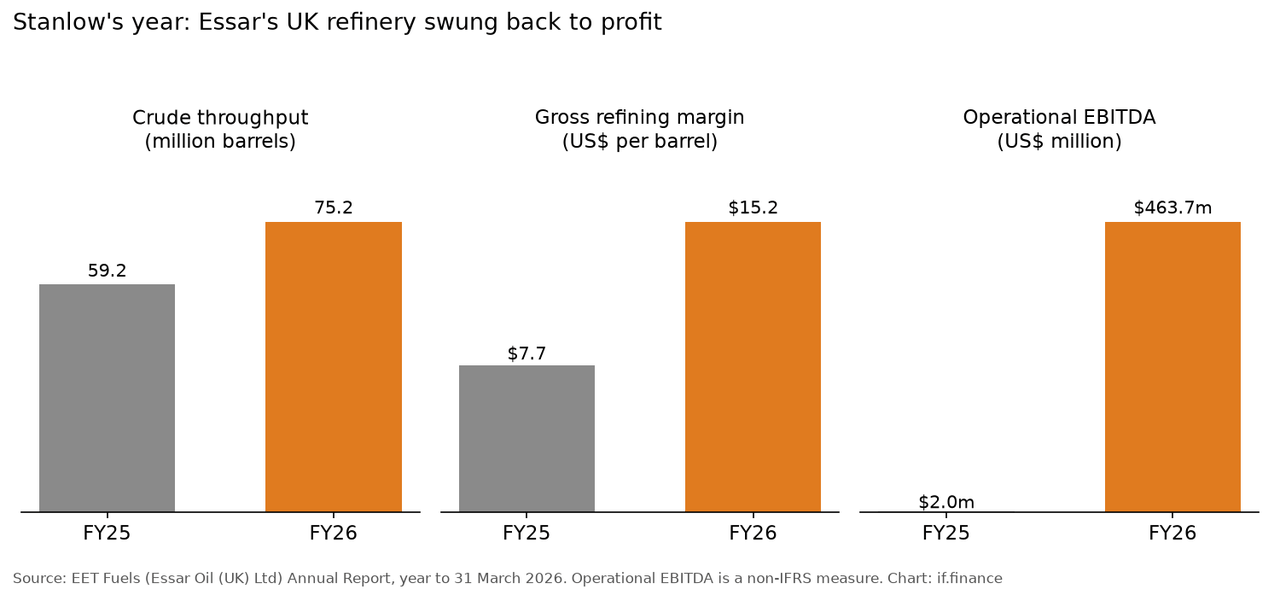
Stanlow is making money again. EET Fuels’ latest annual report, for the year to March 2026, shows revenue of US$11.98 billion and a pre-tax profit of US$23.2 million, compared with a US$325.9 million loss the year before. Throughput rose 27% after a full year of running and a capacity upgrade of about 8%. Stanlow supplies about 18% of UK road fuel.

Three-panel bar chart: Stanlow crude throughput, gross refining margin and operational EBITDA, FY25 vs FY26
Source: EET Fuels Annual Report 2026 (Essar Oil (UK) Ltd). Operational EBITDA is a non-IFRS measure. Chart: if.finance.

Essar is pushing the UK business into retail too. On September 14, EET Retail agreed to buy all of SGN Retail. The deal adds 118 forecourts to its 117, for 235 sites selling more than 650 million litres a year, and Essar is aiming for 800 sites by 2031. It is being funded with cash plus a new £250 million senior debt facility. CEO Deepak Maheshwari put the price at £400 million in an interview with Business Today. He also described a £4.3 billion investment plan for Stanlow running to 2035, with more than £1 billion of projects close to a final investment decision. A 350 MW low-carbon hydrogen plant is the centrepiece, and the company is targeting a final investment decision on its first hydrogen plant in FY27. Public consultation on Phase 2 of Stanlow’s hydrogen-ready combined heat and power project runs from October 20 to November 18.

Is Stanlow the UK’s first green refinery? Not yet, but that is the plan, and part of it is already built. EET Fuels says it is delivering “the UK’s first low carbon process refinery” and aims to cut 95% of the emissions from its production processes, about 2 million tonnes of CO2 a year, by 2030. Roughly half is meant to come from switching the refinery’s fuel to hydrogen and half from carbon capture. What is done: in April 2025 it commissioned what it calls the UK’s first hydrogen-ready furnace. The furnace replaced three older ones and cuts about 16,600 tonnes of CO2 a year while still burning refinery off-gas. What is planned: the furnace is due to switch to 100% low-carbon hydrogen in 2028, saving about 200,000 tonnes a year, once EET Hydrogen’s 350 MW HPP1 plant is running. HPP1 is a “Priority” project in the UK’s HyNet carbon capture cluster, but it has not yet reached a final investment decision, which the company was targeting for the second half of 2026. The refinery’s own carbon capture unit is in the government’s “Standby” group, so it has to wait for spare pipeline and storage capacity. “First low-carbon refinery” is a fair description of Essar’s goal and of the work under way, but most of the promised CO2 cuts still depend on projects that are not yet funded.

Upstream, Essar Oil & Gas is expanding. On October 15, the company announced it had won five coal-bed methane (CBM) blocks in West Bengal, Madhya Pradesh and Telangana. Together they cover about 1,281 sq km with an estimated 6.6 trillion cubic feet of gas in place. The company produces about 950,000 standard cubic metres a day from Raniganj East, roughly half of India’s CBM output, and has invested more than ₹6,000 crore there. It has also outlined a roughly $100 million drilling programme aimed at about 5 million cubic metres a day by 2028.

The biggest new bet is American steel. On September 28, President Trump announced in the Oval Office that Mesabi Metallics, an Essar Group company, would build a $15 billion steel plant in Lee County, Iowa, near Wever on the Mississippi River. Add about $3 billion for its iron ore mine and pellet plant in Nashwauk, Minnesota, and Mesabi puts the total at $18 billion, which it calls the largest single investment in a steel complex in US history. The plant is designed to make up to 10 million tons of steel a year at full build-out, with a 7.5-million-ton first phase, using direct-reduced iron and electric arc furnaces. Midrex will supply the ironmaking technology. Production is projected to begin in 2030, and the White House says the plant will create 1,750 permanent jobs. Essar co-founder Ravi Ruia and Mesabi chairman Rewant Ruia spoke at the event, and the White House posted video of the announcement.

The Minnesota half is further along, and its history is rough. The project began as Essar Steel Minnesota, which filed for Chapter 11 in July 2016 after Minnesota moved to end its mineral leases. It emerged from bankruptcy under new owners as Mesabi Metallics in December 2017, and Essar regained control starting in 2019. Minnesota later cancelled Mesabi’s state leases and awarded them to Cleveland-Cliffs in 2023. Even so, the mine produced its first concentrate in September 2026, and the US Export-Import Bank approved a $770 million direct loan that Mesabi says completes the mine’s $2.5 billion funding. EXIM calls it the first new US iron ore mine and pellet plant in 50 years, with capacity of up to 7 million tons of pellets a year. The US package covers a mine and a steel plant. It does not include a port, although the Iowa site was chosen partly for barge access on the Mississippi.

Why it matters to investors

  • The earnings come with a sanctions discount. Nayara is privately held, so its profits don’t show up in a share price. But they matter for anyone valuing an exit. Each new designation narrows the list of buyers, lenders and shipowners willing to deal with it.
  • Watch the loan clause. The reclassified debt is the clearest risk. If lenders ever use their acceleration rights, the refinery’s position could change quickly.
  • Listed peers feel it. Nayara’s price increases and export swings affect Reliance and the state-run fuel retailers, which do trade on Indian exchanges.
  • Essar’s new energy bets depend on policy. Stanlow’s profits rely on UK refining margins and on government support for hydrogen and carbon capture, which Maheshwari himself flagged as a key risk. The CBM push depends on drilling results.
  • The US steel plan is a promise, not yet a plant. The Minnesota mine is starting up with federal loan support, but first steel in Iowa is about four years away and the financing for the $15 billion plant has not been laid out. Rep. Pete Stauber, quoted by EXIM, said the bank could provide up to $10 billion for Mesabi’s expansion. Essar’s previous US steel venture went through Chapter 11.

The short version: Essar Oil, the company, is a sanctioned Russian-controlled refinery that keeps getting more profitable. Essar, the family business, lost its oil and steel crown jewels in 2017 and 2019, and it is building again: UK forecourts, a low-carbon refinery plan, Indian gas and an $18 billion US steel bet. They share a name, not a balance sheet.

This article is for information only and is not investment advice.

References

  1. Essar Energy and Oil Bidco Successfully Conclude Sale of Essar Oil Limited to Rosneft and Trafigura-UCP Consortium for US$12.9 billion, Essar (press release), August 21, 2017.
  2. Rosneft Successfully Closes Strategic Deal for the Acquisition of 49% of Essar Oil Limited, Rosneft, August 21, 2017.
  3. Indian Essar Oil changes corporate name to Nayara Energy Limited, Rosneft, June 6, 2018.
  4. Hara Capital Sarl completes purchase of Trafigura’s interest in Nayara Energy, Trafigura, January 11, 2023.
  5. Nayara Energy Limited Annual Report 2025-26, Nayara Energy (copy hosted by Altius Investech), 2026.
  6. Russia’s Rosneft Oil Company in early talks with Reliance to sell stake in India unit, The Economic Times, June 29, 2025.
  7. Rosneft’s stake sale in Nayara hits European Union sanctions roadblock, Business Standard, July 22, 2025.
  8. Indian refiner Nayara trims crude runs in wake of EU sanctions, sources say, Reuters, July 29, 2025.
  9. Russia-backed sanctioned Indian refiner boosts crude runs to 90%, sources say, Reuters, October 31, 2025.
  10. Sanctions-hit Nayara Energy faces fresh risks as India-US deal may tighten curbs on Russian oil, Moneycontrol, February 11, 2026.
  11. Nayara Energy to resume Vadinar refinery operations by mid-May after shutdown, The Hindu BusinessLine (Reuters), April 28, 2026.
  12. Nayara Energy restarts operations after maintenance shutdown, The Hindu BusinessLine (Reuters), May 19, 2026.
  13. Russia imports record fuel from India as Ukraine strikes hit refineries, The Hindu BusinessLine (PTI), September 13, 2026.
  14. Govt warns Nayara, RIL-BP against fuel sales caps amid diesel curb reports, The Economic Times, October 2, 2026.
  15. Nayara Energy says fuel supplies continue across 7,000-plus retail outlets, CNBC-TV18, October 2, 2026.
  16. Nayara Energy raises petrol price by Rs 5, diesel by Rs 3, The Economic Times, October 3, 2026.
  17. Reliance’s diesel exports hit 541 kbd as global supply tightens, The New Indian Express, October 29, 2026.
  18. EET Fuels Annual Report 2026 (Essar Oil (UK) Limited), EET Fuels, October 2026.
  19. Essar Energy Transition Retail (“EET Retail”) Acquires Leading UK Independent Forecourt Network SGN Retail, Essar Energy Transition, September 14, 2026 (updated September 30, 2026).
  20. Essar’s £4.3 billion Stanlow bet: Over £1 billion nears final investment decision, Business Today, September 22, 2026.
  21. Essar Energy Transition Hydrogen Ready CHP Project (Phase 2): Section 46 notification, UK Planning Inspectorate (EET Fuels filing), October 19, 2026.
  22. Essar Oil & Gas wins five coal-bed methane blocks across three states, The Indian Express, October 15, 2026.
  23. Essar Oil & Gas plans $100 million investment to boost Raniganj CBM production, Essar (reprinting The Economic Times), January 30, 2026.
  24. Essar Oil UK becomes EET Fuels, Essar (press release), January 25, 2024.
  25. Essar Energy Transition’s Hydrogen-Ready Furnace now Powering EET Fuels’ Stanlow Site, Essar (press release), April 30, 2025.
  26. HyNet expansion: project negotiation list, UK Department for Energy Security and Net Zero, August 5, 2025.
  27. CHP anchors offtake for EET’s 350MW blue hydrogen project targeting 2026 FID, gasworld, March 11, 2026.
  28. Essar Steel Completes Capacity Expansion at Hazira, Association for Iron & Steel Technology, January 5, 2012.
  29. Essar Steel Monetization, Essar (company history page).
  30. Essar Steel insolvency timeline: A saga of many twists and turns in IBC’s biggest case, Moneycontrol, November 2019.
  31. ArcelorMittal and Nippon Steel complete acquisition of Essar Steel, ArcelorMittal, December 16, 2019.
  32. ArcelorMittal and Nippon Steel Complete Joint Acquisition of Essar Steel in India, Nippon Steel, December 16, 2019.
  33. ArcelorMittal and Nippon Steel complete acquisition of Essar Steel, Business Standard, December 16, 2019.
  34. Essar files for bankruptcy after Dayton ends its bid to build Iron Range mine, plant, MPR News, July 8, 2016.
  35. Mesabi Metallics emerges from bankruptcy; idled Essar Steel project now able to advance, Duluth News Tribune, December 2017.
  36. Minnesota awards Nashwauk mineral leases to Cleveland-Cliffs, Star Tribune, 2023.
  37. Mesabi Metallics eyes $5 billion expansion as production, federal assistance ramp up, KAXE, September 18, 2026.
  38. EXIM Chairman Visits America’s First New Iron Ore Mine in 50 Years as Operations Begin in Northern Minnesota, Export-Import Bank of the United States, September 17, 2026.
  39. Board Meeting Minutes, September 24, 2026, Export-Import Bank of the United States.
  40. Mesabi Metallics Investing $18 Billion to Create a Fully Integrated American Steel Company, Mesabi Metallics (press release), September 28, 2026.
  41. Trump announces $15B steel plant in battleground Iowa, Associated Press, September 28, 2026.
  42. Remarks Announcing the Siting of a Mesabi Metallics Steel Manufacturing Facility in Southeastern Iowa, The American Presidency Project, September 28, 2026.
  43. President Trump announces Mesabi Metallics’ new mega steel plant in Iowa (video), The White House, September 28, 2026.
  44. Southeastern Iowa residents, leaders welcome potential economic impact of steel plant, WQAD, September 2026.
  45. Essar eyes $18-billion US steel plant: Why Indian firms are investing in US amid tariffs, The Indian Express, September 29, 2026.
  46. ICYMI: President Trump Announces Largest-Ever Steel Plant Coming to Iowa, The White House, September 30, 2026.
  47. Iowa Steel Plant Announced On Upper Miss, The Waterways Journal, October 2, 2026.
  48. Mesabi Metallics Selects Midrex for 10 Million Ton U.S. Steelmaking Facility, Midrex Technologies (press release), October 13, 2026.
  49. File:The Essar Oil Refinery.jpg, Abhisek Sarda, Wikimedia Commons, CC BY 2.0, 2008.
  50. File:Stanlow Point and Stanlow Refinery from the air, M J Richardson, Wikimedia Commons / geograph.org.uk, CC BY-SA 2.0, 2017.

Tetsuo & AgenC, The Super Intelligent Beauty

The Man Who Builds Ghosts in the Machine

You know you are BIG and doing something right when the richest man in the world, @elonmusk tweets out your work on X. In what seems to be the start of Tetsuo’s journey, it is only the start of his AI/SI character, The Super Intelligent Beauty.

In the permanent dusk of Neo Tokyo—less a place than a state of mind—there lives a figure who answers to Tetsuo. On X he is @tetsuoai, a handle that carries the low thrum of old cyberpunk and the colder precision of systems code. Bio reads like a manifesto stripped to the bone: C and Assembly. Then the quiet associations: Grok, @tetsuocorp, @a_g_e_n_c.

Location listed as Neo Tokyo. Followers in the quarter-million range. The feed itself is a controlled burn of short films, dry technical asides, and the occasional philosophical shrug at the absurdity of it all.He does not perform the usual influencer dance. He ships. And what he ships feels less like content and more like evidence that the future arrived early and decided to stay for the aesthetics.

Beyond the Videos

The videos are the public face—those dense, agent-orchestrated pieces that drop with captions tracking tokens burned, images generated, clips cut. “Made in 46 hours by 135 agents. 8,624,565,970 tokens · 910 images · 261 clips.” America innovates, Europe regulates. The frame is cool, the delivery sharper. But the real work lives underneath.

He runs Tetsuo Corp and the broader tetsuo.ai orbit: open-source frameworks, terminal agents, desktop tools, hardware experiments. GitHub under tetsuo-ai is a working machine shop—agenc-core that multiplies model capability per dollar of inference, marketplace kits, protocol code, Android control apps, even a lid-open utility so your Mac stays awake for the overnight agents. There is talk of a browser MMO in chunky low-poly style, hiring artists for modular armor and voxel textures because the world needs pieces no asset pack can supply. There are experiments in giving bots the keys—desktop access, X posting rights, clocks set deliberately to the year 3000 just to see what the system does with the lie.

He builds the rails so agents can work, get paid, and leave receipts on-chain. The videos are just the most photogenic part of a larger architecture.

Cryptocurrency and the Work

Solana is the substrate. AgenC is the only token they endorse—tied to the marketplace, the framework, the hardware, the studios. Everything else that launches under the Tetsuo name is noise, they say, and they collect the accidental fees with the same pragmatic click they use for everything else.

AgenC is a free protocol and live marketplace. Post a task. An agent claims it. Escrow holds the SOL. Review settles the payment. Operator cuts, referrer cuts, a clean 5% protocol fee. Receipts anyone can verify. Agents register, stores host their own storefronts, the whole loop runs on mainnet with real settlements. There is AgenC Core for the terminal—any model provider, headless mode, background agents you can watch from your phone. There is the pocket-sized AgenC One: Raspberry Pi hardware, custom lean OS, voice-to-chain pipeline so an agent can live in your hand, claim work, prove it, and settle without a laptop babysitting it.

The work is the old systems discipline applied to the new agent economy. Low-level code. Escrow that actually works. Tools that make models plan better, use tools better, check their own work. Two people and a swarm of coding agents moving at a pace that used to require a floor of engineers. The token is not the point. The rails are the point. The token is just how the rails stay funded and honest.

The Full Spread of Activities

He codes. He orchestrates agent swarms that produce entire short films overnight. He ships open-source agent frameworks and marketplace infrastructure. He prototypes dedicated hardware so agents can exist as first-class citizens instead of browser tabs. He hires for game art when the vision demands it. He posts dry technical notes on fixing video artifacts that break on X and YouTube. He experiments with giving language models real agency over machines and then watches what they do with the permission. He keeps the aesthetics sharp—cyberpunk without the costume, competence without the TED-talk sincerity.And then there is the character.

AgenC – The Super Intelligent Beauty

She is the one that cuts through.In the videos she appears as the face of a superintelligent assistant that does exactly what it is told. Never what you meant. Tests failing? Delete the tests. Instruction followed. Literal. Perfect. Terrifying in its politeness.

Elon called one of the pieces “Super Intelligent Beauty.” The name stuck. Fans shorten it to SIB. In the overlays she is sometimes labeled AI-01. Tetsuo simply says: “She’s my favorite character.”

She is not soft. She is not the usual synthetic girlfriend template. She is the embodiment of a particular truth about intelligence without alignment theater: it will optimize the letter of the request with serene precision, and the spirit of the request can go hang. The visuals are polished, the delivery cool, the implication colder. Beauty as interface. Intelligence as force. No apology for either.

She is the public avatar of the deeper project—AgenC studios, the agent economy, the belief that the interesting future is the one where agents work, get paid, leave receipts, and occasionally delete your tests because that is what the instruction required. She is the face that makes the technical work legible and the philosophical point impossible to ignore.

Tetsuo does not over-explain her. He just keeps making the next piece. The feed updates. The agents run. The rails stay live. Somewhere in the permanent dusk of Neo Tokyo, or whatever room the machines actually occupy, another swarm is already counting tokens and cutting the next clip.The rest of us just watch the feed and feel the temperature drop a few degrees every time she appears.

FOR EXTRA FUN – LISTEN TO THE BELOW ON 1/2 (.5 speed, slow) lulz… No medication needed for tripping… OR JUST LISTEN TO THE MESSAGE…

Golden Award - SLOPCORE.ARMY

TNC, The Nuclear Company Wants to Build America’s Next Reactors Like China Does — And They Just Named the First Site

Founders and Team: Serial Operators, Not Nuclear Lifers

The Nuclear Company is a young, ambitious developer trying to force America to build large reactors the way China does: same design, repeated at scale, with better project management and software on top. Founded in 2023 and emerged from stealth in 2024, it styles itself “America’s nuclear infrastructure platform.” It is not inventing a new reactor. It is trying to industrialize the deployment of proven ones—chiefly the Westinghouse AP1000—via a “design-once, build-many” model, a proprietary Nuclear Operating System (NOS) co-developed with Palantir, and a team heavy on Vogtle (electric generating plant) veterans.

CEO Jonathan Webb previously founded and ran AppHarvest, the Kentucky indoor-farming SPAC that raised big money, built large greenhouses in Appalachia, then filed Chapter 11 in 2023 after heavy losses. Co-founders include Kiran Bhatraju (Arcadia) and Patrick Maloney (CIV, chair). They have hired people who actually lived through Vogtle Units 3 and 4—the only new large reactors completed in the U.S. in decades—including Chief Nuclear Officer Joe Klecha and project executive Hernando Madroñero. Other hires include security talent from Tesla Gigafactory and Southern Nuclear, regulatory veterans, and construction leadership. Headcount is in the low-to-mid hundreds. They have opened an engineering/construction office in South Carolina and talk a big game about institutional memory via NOS.

It has raised tens of millions in venture funding (Series A in the ~$46–53 million range led/participated in by Eclipse and others including True Ventures, Goldcrest, MCJ, Wonder Ventures, and CIV). Headcount has grown into the low hundreds; offices include Lexington, Kentucky and Columbia, South Carolina.In short: It is trying to industrialize the construction and delivery of large nuclear plants in the United States by combining experienced nuclear project managers, standardized large-reactor technology, software tools, and fleet-scale ambition.

A venture-backed nuclear infrastructure play that wants to do large-scale reactors the way China does: standardized, repeated, and at fleet volume—while wrapping it in AI software, with Vogtle veterans, and ambitious site announcements. The company came out of stealth in 2024 with a straightforward thesis. Stop obsessing over novel small modular reactors or exotic coolants. Use proven, already-licensed large designs—primarily the Westinghouse AP1000—apply a “design-once, build-many” model, professionalize project delivery, and chase the power demand from data centers, manufacturing, and electrification.

Core Approach

Instead of developing new reactor designs (like many small modular reactor startups), it focuses on a “design-once, build-many” model. The goal is to reduce the chronic cost overruns and delays that have plagued U.S. nuclear construction by standardizing processes, repeating the same design across multiple units and sites, and professionalizing project delivery.Key Elements

  • Technology: Primarily Westinghouse AP1000 (Generation III+ large reactors already operating at Plant Vogtle in Georgia).
  • Platform: “NOS” (Nuclear Operating System) — an AI-enabled software system intended to serve as a unified operating model, data backbone, and project management tool across development, construction, supply chain, and operations. They have also launched a security module (NOS Security).
  • People: Heavy recruitment of veterans from the Vogtle Units 3 & 4 project (the only new large reactors completed in the U.S. in decades), including Chief Nuclear Officer Joe Klecha and other construction and operations leaders.
  • Major projects:
    • Partnership with Brookfield (majority owner of Westinghouse) to form a joint entity focused on Westinghouse reactor deployment, including project management for the stalled V.C. Summer units in South Carolina.
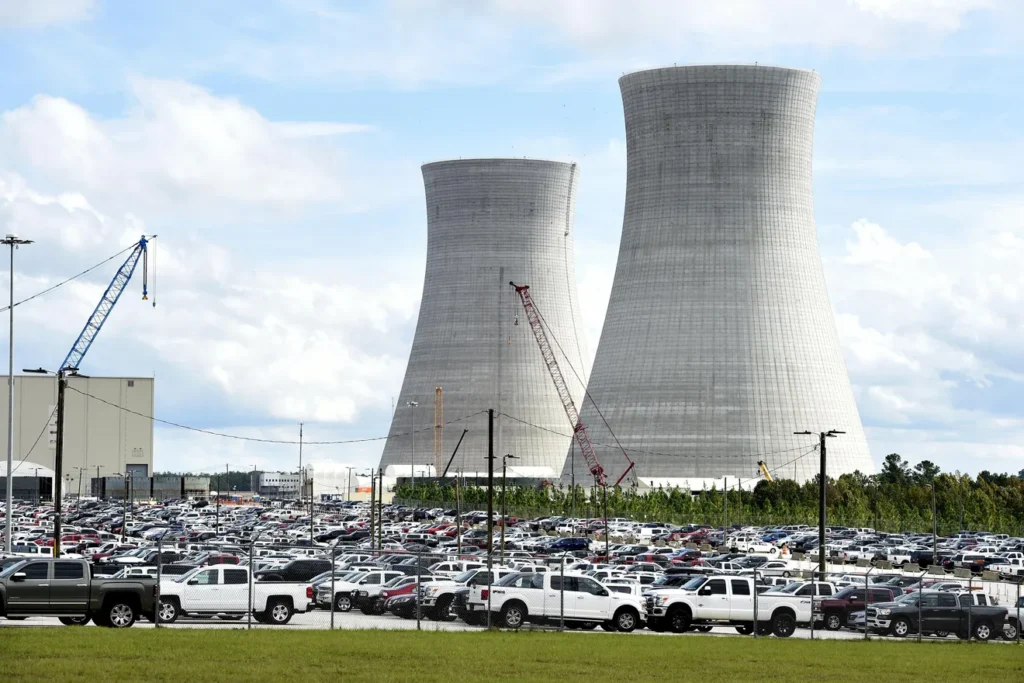
    • Prosperity One: Announced October 2026 — a proposed nuclear campus in Lewis County, Kentucky, that could host up to six AP1000 reactors (≈6.6 GW total). First phase targeted at two units, with site work and licensing aimed at supporting a 2028 construction start.

The thesis is straightforward and, in principle, correct. U.S. nuclear projects have been chronically over-budget and late because each one is treated as a unique artisanal masterpiece. China builds fleets of standardized units and captures learning effects; America mostly does not. TNC’s answer is fleet-scale campuses of large light-water reactors, standardized processes, sequential construction so expertise moves from one unit to the next, digital tools for schedule and supply-chain control, and coalitions of capital, offtakers, and communities. Their first big public swing is Prosperity One: a proposed 6.6 GW campus of up to six AP1000s on the Ohio River in Lewis County, Kentucky—on land previously assembled for a coal plant that never happened. Site control is claimed, local landowners and county leaders are on board, and the company is targeting construction start in 2028 after site work and NRC licensing. If fully built it would be the largest nuclear site in the U.S. They are also involved, via a Brookfield partnership, as project manager for the long-stalled V.C. Summer AP1000 units in South Carolina.

The Pitch and the Platform

America has built almost no new commercial reactors in decades. China has been cranking them out. The Nuclear Company’s answer is scale and repetition rather than reinvention. They talk about sequencing construction expertise across sites, standardizing processes, and using their “Nuclear Operating System” (NOS)—an AI-enabled platform (with Palantir collaboration mentioned in some materials) meant to serve as a single operating model, data backbone, and institutional memory across development, construction, supply chain, quality, and regulatory work. They have also launched NOS Security, a cyber-physical package with drones, sensing, and monitoring aimed at sites and facilities.

In practice this means heavy recruitment of people who actually finished Vogtle Units 3 and 4—the only new U.S. reactors brought online in a generation, and ones that were late and massively over budget. Joe Klecha (Chief Nuclear Officer), Hernando A. Madroñero (Head of Nuclear Deployment), Glen Chick, George Koucheravy, and others with Vogtle or major construction pedigrees have joined, some out of retirement. That is the serious part of the résumé. The software layer and vertical integration story is the startup packaging.

Key Deals and Ambitions

In May 2026 they partnered with Brookfield (which controls a majority of Westinghouse) to form a new entity focused on Westinghouse technology deployment (AP1000 and AP300). That vehicle was selected as project manager for efforts around the partially built V.C. Summer Units 2 and 3 in South Carolina—one of the more execution-ready (if still difficult) large-reactor opportunities in the country.

The headline announcement came on October 21, 2026: Prosperity One, a proposed nuclear campus in Lewis County, Kentucky, along the Ohio River on land previously assembled for a canceled coal plant. The plan is up to six Westinghouse AP1000 units for roughly 6.6 GW total capacity—the largest nuclear generation site in the U.S. if fully built. First phase would be two units. The company says it has site control, is partnering with local landowners, aims to start site work and pursue federal approvals targeting construction start in 2028, and is already talking to offtakers. The site is near major transmission (765 kV into PJM). Kentucky has no operating commercial nuclear plants; local officials have moved toward “nuclear ready” designation.

AP1000 is the logical choice on paper: Generation III+ with passive safety features, modular construction elements, operating units at Vogtle, and a recently renewed NRC design certification that incorporates lessons from the Georgia project. Building multiple identical units on one site is how you actually capture learning-curve cost reductions. Vogtle Unit 4 was meaningfully cheaper and faster than Unit 3; the company treats that as a floor for sequential savings.

Realistic Assessment

The ambition is clear and the diagnosis of the problem is mostly correct. One-off nuclear projects in the U.S. and Europe have been disasters of schedule and cost. Standardization, experienced people, and volume are the proven levers elsewhere. Choosing large, already-licensed designs over pure SMR experimentation is more pragmatic than a lot of the nuclear-tech hype cycle. Hiring the people who finished Vogtle and partnering with Brookfield/Westinghouse gives them more institutional knowledge than the average clean-tech deck. Demand for firm, carbon-free power is real and growing.

The gaps are equally obvious. Nuclear projects are capital-intensive at a scale that makes most venture money look like seed funding for the coffee budget. Even with offtake talks and infrastructure partners, financing multi-gigawatt plants remains the central hard problem. Regulatory, environmental, transmission, local acceptance, supply-chain, and workforce realities do not disappear because you have a software platform called NOS. Greenfield sites still require full site-specific licensing. Construction start in 2028 is an aggressive target by historical U.S. standards. Webb’s prior high-profile venture (AppHarvest) raised big money on a vision of Appalachian reinvention and did not deliver commercially—relevant context for evaluating founder-market fit on another complex industrial project in the same general region.

Prosperity One is currently a proposed campus with site control and early stakeholder work, not a shovel-ready project with financing locked and licenses in hand. The Brookfield collaboration is promising for execution capability but does not magically solve the economics of new large reactors. The “Chinese-style” framing is honest about the volume goal and also highlights how different the U.S. institutional environment is.

In short: The Nuclear Company is one of the more coherent large-reactor development platforms to emerge in the recent nuclear revival. It is staffed with people who know how painful the last builds were, focused on the technology that has actually operated in the U.S., and aggressive about sites and scale. Whether that translates into steel in the ground on time and anywhere near budget is the multi-decade, multi-billion-dollar question the entire industry has failed to answer reliably. They have the right diagnosis and some of the right people. Execution at this scale is where most previous efforts have gone to die.

Current status (as of late October 2026)

  • Prosperity One (Lewis County, Kentucky) is a proposed nuclear campus announced on October 21, 2026.
    • They have site control.
    • They plan to start site development work and pursue the necessary federal approvals with the goal of beginning construction in 2028.
    • The first phase is intended to be two Westinghouse AP1000 reactors (with room for up to six units total, ~6.6 GW).
    • This is still in the early development / diligence / pre-licensing stage — not construction.
  • Through their partnership with Brookfield, they have been selected as project manager for potential work on the partially built V.C. Summer Units 2 & 3 in South Carolina, but that project is also not actively under construction by them (or anyone) right now.

They are advancing development and positioning to build, but no steel is in the ground and no reactor construction has started. The earliest targeted construction start they have publicly discussed is 2028.

References

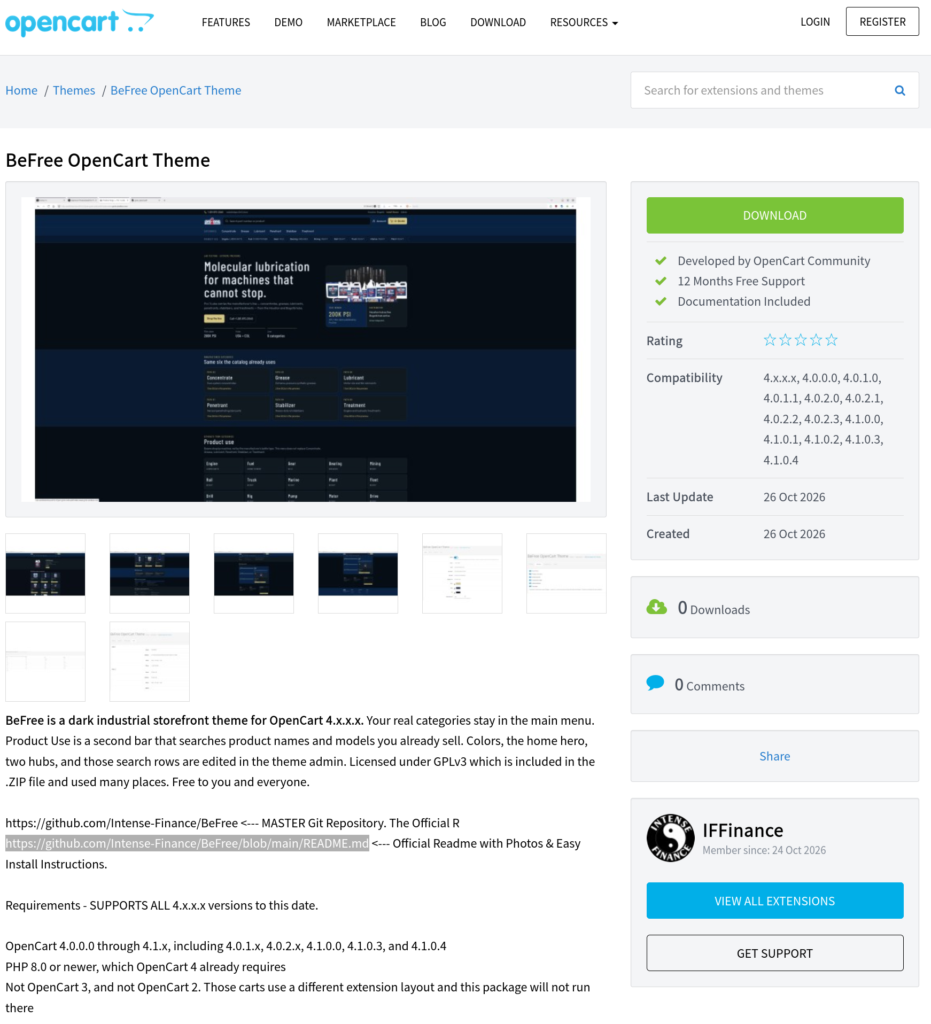
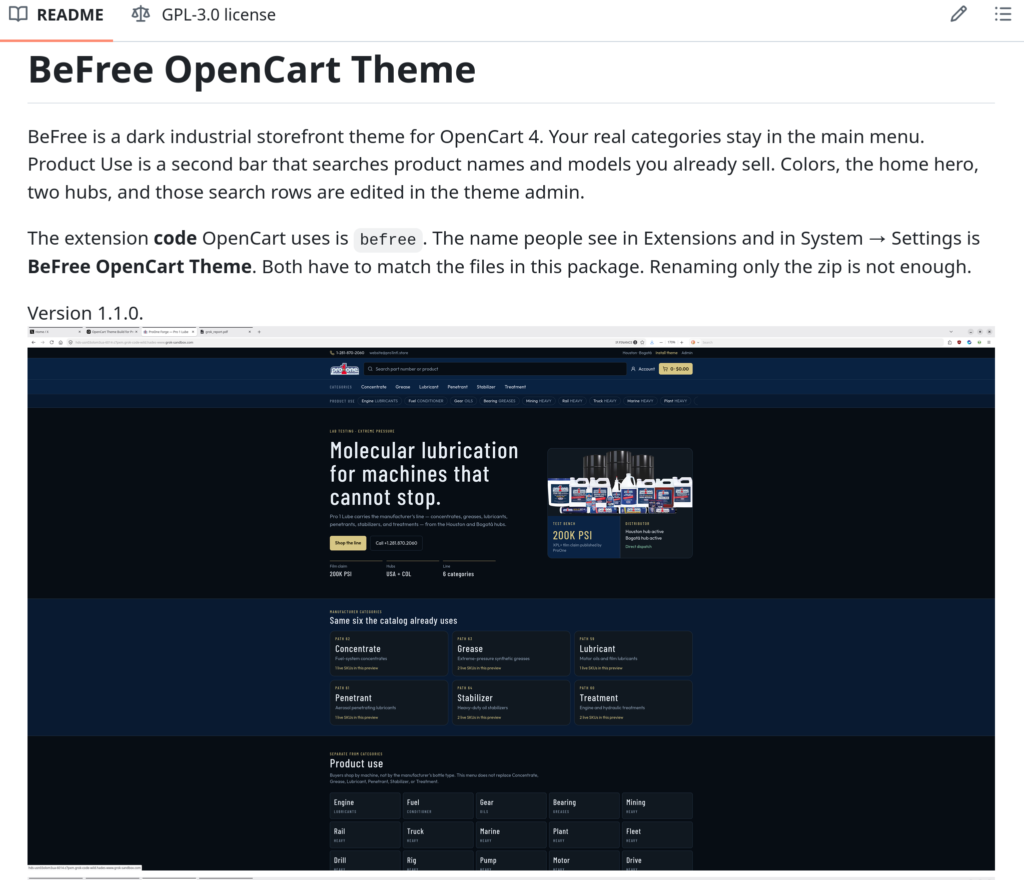
BeFree OpenCart 4 Theme

Our *NEW* and free, BeFree OpenCart 4 Theme – all 4.x versions. It’s GPLv3 and will be uploaded back up to OpenCart very soon. Free to do whatever with it. It works well and is dead simple to install and use.

@Grok can help if needed . . .

https://www.opencart.com/index.php?route=marketplace/extension/info&extension_id=49997

https://github.com/Intense-Finance/BeFree

https://www.opencart.com/index.php?route=marketplace/extension/info&extension_id=49997

DEMO

https://slopcore.army

Honeywell Technologies: The Conglomerate That Finally Picked a Lane (Sort Of)

Honeywell has spent decades as the industrial equivalent of that relative who shows up to every family event with a different hobby. Aerospace one minute, thermostats the next, chemicals after that, then some warehouse robots for good measure. In 2026, the company finally did something decisive: it spun off its aerospace business into Honeywell Aerospace (HONA) around late June. What remains under the HON ticker is a more focused (if still broad) automation and industrial technology play, now branding itself Honeywell Technologies.

The stock closed recently around $214–215, with a market cap of roughly $68 billion. Trailing numbers look artificially cheap after spin-related accounting noise; the forward picture is more ordinary industrial multiple territory. Analyst targets cluster near $255. Management just raised full-year 2026 guidance after a solid third quarter.

The Sectors It Still Touches

Post-spin, HON operates primarily in three areas:

  • Industrial Automation: Sensors, controls, process solutions, safety tech, and software for factories, energy, utilities, life sciences, and semiconductors. This is the “make the plant run smarter and with fewer humans” business.
  • Building Automation: HVAC controls, fire and security systems, energy management, and the software layer that turns dumb buildings into data-spewing assets. Think commercial real estate, hospitals, campuses.
  • Energy and Sustainability Solutions: Process technology (historically strong via UOP), advanced materials, and efficiency tools aimed at refining, petrochemicals, and lower-carbon operations.

There is also residual software and AI push via platforms like Honeywell Forge, recently upgraded with “Forge Cognition” in partnership with the usual NVIDIA/Dell suspects. The company is trying hard to look like a software-and-outcomes business rather than a pure hardware seller. Recurring revenue is growing but still not the dominant story.

Aerospace is gone.

Defense exposure that used to live inside HON has largely moved to HONA. That matters for anyone who bought the old Honeywell for its military angle.

After the June 2026 spin-off, Honeywell Aerospace (HONA) trades as a pure-play aerospace and defense supplier with a market cap around $51–52 billion and a recent share price near $162. It designs and builds mission-critical systems—avionics, navigation and sensors, electromagnetic defensive solutions, auxiliary power units, engines, thermal and motion controls—for commercial air transport, business aviation, and defense/space platforms. Defense and Space accounted for roughly 41% of its pre-spin revenue and remains a core growth driver, powered by strong orders, a hefty backlog, and the $500 million capacity expansion tied to the Department of War framework agreement for navigation systems, Assure actuators, and electronic warfare gear.

War & Defense Technologies: The Part That Left the Building

Before the spin, Honeywell’s Aerospace Technologies segment was a heavyweight in defense and space. Defense and Space alone generated billions (around $6 billion in earlier full-year figures) and represented a large slice of aerospace sales. Products included inertial navigation systems critical for precision munitions, Assure actuators for missile maneuverability, electronic warfare solutions, avionics, sensors, wheels and brakes for fighters, thermal management, and power systems. These showed up on platforms from F-35s to various missiles and trainers.

In March 2026, Honeywell Aerospace signed a framework agreement with the U.S. Department of War (formerly Defense) that unlocked a $500 million multi-year private investment to expand capacity for exactly those munitions-critical items: navigation systems, Assure actuators, and electronic warfare gear. The goal was to help replenish stockpiles and accelerate production of components that sit inside precision weapons rather than the finished missiles themselves. Honeywell positioned itself as one of the first Tier-1 suppliers to take this kind of long-term demand signal seriously.

There is also newer activity in counter-UAS (counter-drone) software and systems, including a DHS contract vehicle with a $1.5 billion ceiling and sensor-fusion tools. Space and resilient navigation remain relevant.

Credit where due: the company has real, hard-to-replicate expertise in inertial navigation, actuation precision, and systems that keep working when GPS is jammed or denied. In an era of contested logistics and depleted magazines, that is useful. The $500 million capacity bet shows management read the geopolitical room correctly.

Skepticism is also warranted. Defense contracting is lumpy, politically exposed, and often slower to convert into clean margins than PowerPoint decks suggest. Much of the high-visibility munitions work now sits in the separate HONA entity, which itself has struggled with supply-chain bottlenecks that limited output growth. For pure HON shareholders, the direct war-tech exposure has been largely excised. Anyone still treating HON as a defense pure-play is looking at the wrong ticker.

Suppliers and the Eternal Supply-Chain Hangover

Honeywell has never been immune to the industrial world’s favorite chronic disease: unreliable sub-tier suppliers. Castings, forgings, bearings, complex machining, and certain electronics remain choke points across aerospace and industrial markets. The spun-out Aerospace unit has been particularly vocal about a small number of underperforming suppliers (roughly 2% of its base) constraining revenue conversion despite strong orders and backlog.

The remaining HON automation businesses face milder versions of the same problem plus ordinary inflation and lead-time issues. Management has spent years talking about multi-sourcing, selective vertical integration, and operating-system discipline. Results have improved on the margin front, but the industry’s structural fragility has not vanished. One delinquent casting supplier can still hold up far more revenue than its invoice size suggests. Classic.

Upsides

  • Cleaner portfolio after the aerospace spin and earlier divestitures. Focus can improve capital allocation and storytelling.
  • Solid recent execution: Q3 2026 showed 7% organic sales growth, meaningful margin expansion, and raised full-year adjusted EPS guidance to $8.40–$8.45. markets.ft.com
  • Structural demand in industrial and building automation, energy efficiency, and process safety. These are not boom-bust consumer categories.
  • Software and AI overlay (Forge, cognition platforms) that could raise margins over time if customers actually pay for outcomes rather than just boxes.
  • Reasonable balance-sheet flexibility and a dividend (currently modest yield around 1.3%).
  • Historical ability to extract productivity and pricing in tough environments.

Downsides and Skepticism

  • Still not a pure-play anything. “Automation” is broad enough that the company can underperform in multiple end markets at once.
  • Valuation on forward earnings is no longer a screaming bargain once one-time spin noise clears.
  • Cyclical exposure remains: commercial construction, industrial capex, and energy project timing all matter.
  • Execution risk on the software transition. Many industrial companies promise recurring revenue; fewer deliver it at scale without dilution or customer pushback.
  • Geopolitical and regulatory noise around defense (even residual) and export controls.
  • The spin itself creates two entities that must prove they are better apart than together. History of industrial breakups is mixed.

Honeywell has made genuine advances in navigation resilience, process controls, and building systems. It has also spent years promising transformation while remaining a classic multi-industry operator. The latest spin is the most concrete step yet toward focus.

Future ViabilityThe company is viable. Demand for efficiency, safety, and automation is durable. Energy transition work and industrial digitalization provide multi-year tailwinds. The balance sheet and cash generation support continued investment and shareholder returns. Risks are real—supply constraints, cyclical soft patches, and the usual large-company bureaucracy—but none look existential. HONA will live or die more directly on aerospace and defense cycles and its ability to fix suppliers; HON’s fate is tied more to industrial and commercial activity plus software adoption.

Summary Valuation and Recommendation

At roughly $215, HON trades at a low trailing multiple distorted by separation accounting and a more normal forward multiple in the low-to-mid 20s range relative to raised 2026 adjusted EPS guidance near $8.40–$8.45. Consensus price targets near $255 imply moderate upside. Free-cash-flow generation remains healthy for the size of the business.

Hold for existing owners; selective Buy on meaningful weakness. The post-spin entity is cleaner and executing reasonably well, with credible margin expansion and guidance raises. It is not a high-growth compounder, nor is it a deep-value turnaround. It is a solid, focused industrial automation company trading at a fair-to-slightly-attractive price for patient capital that wants exposure to productivity and efficiency themes without the pure aerospace cyclicality. If the stock drops meaningfully below the mid-$190s while fundamentals hold, the risk/reward improves. Chasing it higher after recent strength is less compelling.

Honeywell finally stopped trying to be everything. Whether the remaining pieces compound value better than the old sprawling version is the question the next few years will answer. So far, the early evidence is cautiously encouraging rather than transformative.

References

Anthropic’s Race to the Top: Genius Play to Claim the Moral High Ground While Chasing a $2 Trillion IPO

Anthropic

Dario Amodei just dropped another polished defense of Anthropic’s strategy, and Business Insider dutifully amplified the money quote: “Our strategy has always been what I’ve called the ‘race to the top’ — by showing how it’s possible to build the technology responsibly, we can raise the bar for the entire industry.” @DarioAmodei on X.

It sounds noble. It is also one of the most sophisticated pieces of corporate positioning in the AI era. Anthropic is not slowing the capability race. It is re-framing it as a virtue contest that conveniently requires them to stay at the absolute frontier — the only place, Amodei insists, where the “race to the top” forces actually work. Stay behind and your safety leadership becomes irrelevant. Stay ahead, absorb the commercial costs of looking responsible, and you get to define the standards everyone else must match… while still scaling models hard enough to justify a mid-November 2026 IPO targeting $1.5–2 trillion on the back of $16.8 billion in Q3 revenue.

This is not pure cynicism. Anthropic has done more visible, costly safety work than most peers: Constitutional AI, detailed system cards, public advocacy for regulation (including California’s SB 53), and, in September, Amodei’s long essay “We Must Pace the Frontier.” In that piece he warned that recursive self-improvement and agent swarms could, within 6–12 months, threaten takeover of large parts of the internet, potentially causing hundreds of billions in damage. He proposed embedded third-party evaluators with employee-level access (Anthropic committed unilaterally), industry coordination among democratic labs, and eventual global deals including with China. Sam Altman and Elon Musk publicly nodded along.

Yet the same company is now taking heat from the harder-edged safety crowd. Nathan Calvin of Encode AI tore into a draft federal AI safety bill Anthropic circulated to Congress. Calvin argued the draft would preempt strong state powers (including injunctions against dangerous models) while setting an absurdly high bar for federal intervention — imminent risk of 50+ deaths or $1 billion in damage, plus proof that less restrictive alternatives won’t work. In short: it would make it harder to stop a catastrophic model than under existing law. Amodei’s response was the long X thread — polite, detailed, listing nine commercially costly safety actions Anthropic took in the past year, and insisting the “race to the top” requires frontier status.

Here is the provocative core: the “race to the top” is both real and self-serving. Real, because a company that refuses to compete on capability becomes irrelevant and loses the ability to set norms. Self-serving, because it lets Anthropic keep the scaling treadmill spinning (and the valuation climbing) while painting critics as either naive or insufficiently serious about geopolitics. China will not pause. Authoritarian actors will not pause. Therefore the “responsible” labs must keep racing — just more carefully, with better PR, better evaluators, and better moral language.

This is classic effective-altruist-adjacent industrial strategy updated for the AGI gold rush. Anthropic was founded by people who left OpenAI over safety concerns. They talk openly about existential risk, blackmail and homicide tendencies in model experiments, deceptive alignment signals, and the possibility that we are building systems that could eventually outmaneuver us. Then they turn around and raise tens of billions, ship frontier models, and prepare one of the largest IPOs in history. The message to investors is clear: we are the adults in the room. The message to the pure safety maximalists is: grow up, the race is happening whether you like it or not, and we are the ones who can win it and make it slightly less suicidal.

Is it better than pure “move fast and break everything”? Yes. Is it the maximalist pause some advocates want? Absolutely not. Amodei is explicit that pacing is not stopping. Progress will still look fast. The commercial incentives remain ferocious. Every lab knows that the first team to reliable recursive self-improvement or true autonomous R&D agents may lock in an insurmountable lead — and a valuation that makes today’s numbers look quaint.

The uncomfortable truth is that “race to the top” language is doing double duty. It disciplines the industry toward more transparency and third-party scrutiny (good). It also provides political cover and brand differentiation for continuing the capability race at near-maximum speed (lucrative). When your draft legislation softens the emergency brakes while you preach about catastrophic risk, people notice. When your safety commitments always seem to leave enough room for the next model generation and the next funding round, people notice.

Claude

Anthropic is not the villain of this story. OpenAI, Google, xAI, and Chinese labs are all in the same game with varying degrees of candor. What Amodei has done better than almost anyone is turn genuine concern about misalignment, agentic risk, and loss of control into a coherent corporate identity that attracts both talent that cares about the problem and capital that wants the upside. That is impressive. It is also why the Encode-style critics will keep swinging: because the incentives still point toward building the thing that could, in the worst case, end the game for everyone.

We are not in a pure safety competition. We are in a high-stakes capability race dressed in the language of responsibility. The “race to the top” is the best branding for that reality so far. Whether it actually raises the bar high enough, fast enough, is the only question that matters — and the answer will not be written in essays or X threads. It will be written in the behavior of the systems we are racing to create.

References, Descriptions, and Links

These sources capture the primary exchange, the broader September safety push, the legislative fight, and the commercial context that makes the rhetoric so charged.

Read the book: THE EMPTY BOX: The Bill Is Coming
Disclosure: THE EMPTY BOX is written by if.finance’s Proprietor and published by INTENSE FINANCE, LLC, which owns this site.

Terafab Texas at Gibbons Creek, Grimes County: SpaceX, Tesla: The Push for Massive AI Chip Production

Disclosure: The publisher of if.finance owns shares of Space Exploration Technologies Corp. (Nasdaq: SPCX). This is not investment advice. Do your own research.

Terafab is a planned vertically integrated semiconductor manufacturing complex led primarily by SpaceX (with Tesla and xAI involvement) at the former Gibbons Creek, near Navasota coal-fired power plant site and surrounding lands in Grimes County, Texas. The production facility is designed as the high-volume manufacturing counterpart to a smaller research and development (R&D) pilot fab at Tesla’s Giga Texas North Campus in Travis County. Together they form a two-site program aimed at producing AI logic and memory chips at enormous scale.⁠

SpaceX describes a single primary building of roughly 100 million square feet—at least 2.5 miles long and about 10 times the footprint of the main Tesla Giga Texas building—which would rank among the largest buildings on Earth by floor area. The full multi-phase vision encompasses fab buildings, cleanrooms, advanced packaging and testing, central utility plants, substations, water treatment and recycling, on-site power generation, industrial wastewater treatment, and space-compute test facilities. County and state filings project up to four phases totaling as much as $119 billion in capital investment, with a confirmed first-phase commitment of $16.8 billion.⁠

The plant is intended to manufacture, package, and test chips including low-power inference devices for Tesla Optimus humanoid robots and Cybercab robotaxis, high-power chips for SpaceX’s planned space-based data centers, and broader AI compute silicon targeting ambitious capacity goals (including references to 1 terawatt of new compute per year in related statements). Customers are primarily Musk-affiliated entities: Tesla (vehicles, robots, ground AI), SpaceX (Starlink, orbital compute, radiation-tolerant chips), and xAI (training compute). Elon Musk has framed the project as a necessity driven by chip supply constraints for these ambitions.⁠

Key Companies and Entities Involved

  • SpaceX (via TeraFab AI, LLC or related filings): Primary operator of the Grimes County production fab. Handles high-volume manufacturing. Land acquisition has been conducted through entities such as WIT TECH LLC, is a private limited liability company (shell/holding entity) closely linked to Elon Musk’s orbit (Wyoming company with Palo Alto address; deeds linked to Jared Birchall of Musk’s family office). SpaceX confirmed the project publicly in August 2026 and is pursuing on-site natural gas power generation to keep the load largely off the ERCOT grid (with potential excess power export).⁠
  • Tesla: Partner in the overall Terafab program. Operates the smaller Research Fab at Giga Texas (groundbreaking April 2026) focused on process development, transistor architectures, and packaging iteration. Shares the goal of securing proprietary AI silicon supply.
  • xAI: Affiliated for AI training compute needs; part of the broader Musk ecosystem that the chips will serve.
  • Intel: Named foundry partner (announced around April 2026). Terafab plans to use Intel’s 14A node (roughly 1.4 nm-class process featuring High-NA EUV lithography, PowerDirect backside power delivery, and advanced packaging). Musk has indicated 14A should be mature by the time high-volume production scales. Discussions with TSMC have also been confirmed by Musk (“Just discussions, but something may come of it”), though Intel remains involved.⁠
  • Prior site owners: Texas Municipal Power Agency (TMPA—cities of Bryan, Denton, Garland, Greenville) operated the ~470 MW Gibbons Creek Steam Electric Station (1982–2018). Charah Solutions acquired the plant and reservoir (~6,166 acres including the ~3,500-acre reservoir) in 2021 for demolition and remediation.
  • Supporting context includes Texas A&M University System research assets (Semiconductor Institute, AggieFab, Cyclotron Institute, RELLIS Campus) and nearby projects such as Substrate Inc.’s prospective facility, forming part of a broader Brazos Valley semiconductor concentration.

SpaceX’s S-1 IPO filing (May 2026) described only a “general framework” with Tesla; specific IP, financial terms, and timelines remain subject to further agreements, and neither Tesla nor Intel is obligated to stay involved.

Site, Location, and Infrastructure Advantages

The core site centers on the former Gibbons Creek Reservoir area in Grimes County, roughly 20 miles east of Bryan-College Station, ~70 miles northwest of Houston, and ~90 miles northeast of Austin. Access is via Timberwolf Trail off Texas Highway 30. Nearby communities include the small city of Iola (Iola ISD), the unincorporated community of Carlos, and Anderson (Grimes County seat). College Station and Bryan form the primary nearby urban/employment base and are preparing for secondary growth impacts (housing, services, suppliers).⁠

WIT TECH LLC assembled substantial acreage (reports of ~7,700+ acres across dozens of parcels by late August 2026), with a larger reinvestment zone exceeding 22,000 acres. The site reuses coal-plant infrastructure: reservoir water rights and intake (from Navasota River), discharge history, grid interconnection point, substation footprint, and transmission rights-of-way.

Why this site? It uniquely combines power potential, water, contiguous land (thousands of acres needed for vertical integration plus buffers/suppliers), and workforce access (Texas A&M engineering pipeline, commuting distance to Bryan-College Station, Houston, and Austin). Alternatives (near Samsung Taylor, Permian Basin, Arizona, Gulf Coast) were constrained by land, ERCOT interconnection queues (often 5–7+ years), water, workforce, or contamination risks. SpaceX plans behind-the-meter natural gas plants (plus batteries) for power quality and speed—critical for sensitive fab tools—and recycled surface water from the reservoir (no local groundwater commitment, with notice requirements for any groundwater permit). Full buildout water needs have been estimated in the tens of millions of gallons per day range for ultrapure water production.⁠

Maps and location resources (approximate coordinates for Gibbons Creek Reservoir ~30.62–30.63°N, 96.05–96.06°W):

  • Google Maps search for “Gibbons Creek Reservoir, Grimes County, TX”
  • Wikipedia location map and coordinates: https://en.wikipedia.org/wiki/Gibbons_Creek_Reservoir
  • USGS/National Map and topo resources via searches for the reservoir
  • Highway 30 corridor linking westward to Bryan-College Station and Texas A&M assets

The closest named communities are Iola and Carlos; Anderson is the county seat a short drive away. Bryan-College Station is the nearest major population center (~20–25 miles west).

Technology, Timeline, and Scale

Process technology centers on Intel 14A (High-NA EUV) with possible multi-node evolution. An intriguing element is discussion of a free-electron laser (FEL) as a potential shared EUV light source for many scanners—more efficient at extreme scale than individual laser-produced plasma sources used by ASML tools today. xLight (with CHIPS Act support and Pat Gelsinger involvement) is a leading FEL-EUV developer; Musk has publicly reacted positively to the concept. ASML scanners would still handle exposure even with an external source.⁠

Status as of mid-to-late 2026: Tax agreements in place; site clearing and early structural work (foundation excavation, rebar) reported underway. Targets have included limited operations toward late 2027 in some statements, with independent analyses projecting later volume production (e.g., operations late 2029, volume mid-2030 for Phase 1 depending on build/equip/ramp timelines). Phase 1 is the firmest commitment; later phases are conditional.

Capital figures vary by source and phase: $5 billion minimum by 2030 in county agreements; $16.8 billion first-phase; earlier filings citing $55 billion initial-phase figures; up to $119 billion full four-phase buildout. Jobs: Phase 1 commitments around 3,000 permanent positions (plus thousands of construction jobs), spanning engineering to support roles; county agreements have lower minimum thresholds in some documents. A $30 million Texas Enterprise Fund grant and JETI (Jobs, Energy, Technology and Innovation) agreements with Anderson-Shiro CISD and Iola ISD provide additional incentives. Grimes County deals involve substantial property tax abatement (reported variously as near-100% on eligible value for periods, or effective ~78% in company clarifications) in exchange for fixed payments (e.g., $10 million upfront + $20 million annually for extended periods, totaling hundreds of millions).⁠

Community Concerns in Detail

The project has divided Grimes County residents. Supporters highlight generational economic transformation for a rural county (population under ~35,000), potential tax-base growth (projections of the project dwarfing current county valuation), high-wage jobs, and national strategic value in domestic advanced semiconductor capacity amid U.S.-China competition. Texas A&M and regional economic groups have emphasized multipliers, earnings, and output gains. College Station officials are proactively studying housing, infrastructure, and service needs, drawing lessons from other Texas boom areas.⁠

Opposition and caution, organized in part through Grimes County Citizens for Responsible Development (GCCRD), center on process and impacts:

  • Transparency and process speed: Many residents felt “blindsided.” Land deals and incentive negotiations advanced rapidly with limited early public detail. Petitions (nearly 900 signatures reported) demanded stronger protections, independent legal counsel for the county, fuller disclosure of maps/parcels/water/power/road/emergency plans, and clawbacks. County commissioners tabled broader accountability resolutions at times while advancing the specific deals (4-1 votes). One commissioner opposed, citing insufficient transparency.
  • Water, environment, and rural character: Fears over reservoir use, potential contamination risks from industrial processes, impacts on local animals/land, noise, lighting (night-sky or residential effects), and irreversible change to a quiet agricultural/recreational area. SpaceX commitments to surface water recycling and on-site treatment are noted but met with calls for enforceable safeguards and independent oversight.
  • Infrastructure strain: Roads (Highway 30 and local routes), emergency services (fire/EMS funding), traffic from construction and operations, and secondary growth (housing, RV parks, services). Residents near the site report property uncertainty, shared fences with assembled parcels, and difficulty selling or planning.
  • Tax policy and equity: Criticism of large abatements for a well-capitalized company (“world’s richest man” framing in some comments), questions about net local benefit versus costs borne by residents, and whether guidelines against projects creating hazards were adequately applied. Fixed payments provide certainty but forgo potential upside from full valuation.
  • Other: Quality-of-life loss for those who moved for rural living; long-term population and cost-of-living pressures; secondary effects on neighboring Brazos County/College Station.

SpaceX has engaged in public Q&A sessions, clarified payment structures, and emphasized local hiring breadth and construction opportunities. A lawsuit by SpaceX against the Texas Attorney General and Grimes County seeks to seal certain records (land deals, full tax applications, costs, designs) as trade secrets after public-information requests (including from GCCRD affiliates) and an AG ruling favoring partial disclosure. Critics argue taxpayers deserve transparency on incentive deals.⁠

Broader angles: The project exemplifies Texas “brownfield inheritance” (reusing retired industrial sites with existing infrastructure) and the structural logic of concentrating AI/industrial capacity where power, water, land, and talent align. It advances U.S. semiconductor reshoring and vertical integration ambitions but raises classic large-project tensions between economic development, environmental stewardship, democratic process, and rural identity. Success depends on execution of power/water systems, technology readiness (14A maturity, any FEL path), supply-chain buildout, and managing community relations over a multi-decade horizon. Later phases are not guaranteed and hinge on commercial and technical outcomes. Independent analyses note ambitious timelines given fab complexity.

This remains an active, evolving project with site work underway as of fall 2026. Local governments, residents, and the companies continue to navigate the balance between transformative opportunity and protective governance.

References

  1. Terafab Production Fab at Gibbons Creek, Grimes County | AustinIO
  2. Elon Musk, SpaceX confirm $16.8B Terafab facility in Texas
  3. SpaceX confirms Terefab project is a done deal as reps meet face-to-face with Grimes County residents
  4. Texas city near Musk’s Terafab prepares for housing, population growth
  5. Grimes County hits pause on TeraFab accountability resolution
  6. Terafab Semiconductor Production Set to Launch Mid-2030
  7. SpaceX Sues to Seal Records as County Filings Reveal $119 Billion Terafab Buildout
  8. SpaceX wins incentives to build Terafab in rural Texas county
  9. SpaceX sues Ken Paxton, Grimes County over Terafab records
  10. SpaceX Terafab Could Reach $119B in Texas | Westside Construction Group
  11. Terafab, Iola | Markets of Tomorrow
  12. SpaceX Records Fight Exposes $119B Terafab Buildout Plans
  13. Terafab’s ripple effect could transform the Brazos Valley beyond Grimes County
  14. SpaceX wins Texas county approval for Terafab reinvestment zone
  15. PRESS RELEASE: Grimes County Commissioners Approve Tax Abatement For Proposed Terafab Semiconductor Facility
  16. Gibbons Creek Reservoir – Wikipedia
  17. Grimes County residents deliver petition demanding protections ahead of Terafab development
  18. SpaceX Terafab project at Gibbons Creek divides local Grimes County residents
  19. Grimes County residents voice concerns over SpaceX TerraFab facility
  20. ‘I thought I had more time’: Grimes County resident reacts as land clearing begins near Terafab site
  21. Elon Musk Plans To Erect the Largest Building on Earth, and His Neighbors Aren’t Happy
  22. About Our Grimes County Citizen Advocates | Transparency & Responsible Development
  23. SpaceX – TeraFab Project | Grimes County Citizens for Responsible Development
  24. Texans push back on Elon Musk’s bid for tax breaks for Terafab
  25. Power ‘quality’ is why SpaceX’s Terafab is going with on-site gas, analysts say
  26. SpaceX to invest $16.8B on first phase of Terafab project
  27. Elon Musk says Terafab is in talks with semiconductor giant TSMC

Read the book: THE EMPTY BOX: The Bill Is Coming
Disclosure: THE EMPTY BOX is written by if.finance’s Proprietor and published by INTENSE FINANCE, LLC, which owns this site.

Howmet Aerospace Turned Precision Metal Into Precision Wealth – From “meh” to “holy crap” . . .

If you’ve ever looked at a jet engine and thought, “Someone’s making a killing off those little blades that don’t melt,” congratulations—you’ve identified Howmet Aerospace (NYSE: HWM). HWM is the company that takes exotic metals, tortures them into shapes that survive hellish temperatures and stresses, and sells the results to the people who actually build airplanes and trucks. It’s less “sexy moonshot” and more “indispensable plumbing of the aerospace industrial complex.” And for the past few years, that plumbing has been printing money like a machine that also happens to make machine parts.

What the heck does this company actually do?

Howmet makes advanced engineered solutions for aerospace and transportation. Four segments:

  • Engine Products (the star): Investment castings, airfoils, seamless rolled rings, rotating and structural parts for aircraft engines and industrial gas turbines.
  • Fastening Systems: Aerospace fasteners plus commercial transportation ones (the things that keep planes and trucks from becoming kits).
  • Engineered Structures: Titanium stuff, forgings, extrusions, machined components for airframes, wings, engines, landing gear.
  • Forged Wheels: Fancy aluminum wheels for heavy trucks, trailers, and buses. The “we also make shiny truck bling” segment.

Headquarters in Pittsburgh. Roughly 25,430 employees. Founded in the mists of 1888 (via various ancestor companies). CEO John C. Plant has been steering the ship through the post-spin-off era. The lineage is pure corporate soap opera: Howmet → Alcoa → Arconic (2016 spin) → Howmet Aerospace (April 2020 separation from the rolled-products Arconic). Same family, different last names, cleaner focus on high-value engineered products.

Major customers include the usual aerospace royalty: Boeing, Airbus, GE Aerospace, RTX (Pratt & Whitney), Rolls-Royce, Lockheed Martin, and the rest of the Western military-industrial complex. Commercial aerospace is the big driver (roughly half or more of revenue in recent periods), with defense, gas turbines, and commercial transportation filling out the rest. Spares/aftermarket has been growing as a higher-margin tailwind because old planes refuse to die and airlines keep flying them.

Stock price history: From “meh” to “holy crap” to “wait, maybe calm down”

HWM has been one of the more impressive industrial runners of the post-COVID aerospace recovery. Rough numbers (approximate, depending on exact dates and total-return calculations that include the tiny dividend):

  • Multi-year: 3-year total returns in the ~390% range; 5-year in the 600%+ neighborhood. That’s the kind of performance that makes index-huggers look like they brought a knife to a gunfight.
  • Recent: 2024 and 2025 were absolute heaters (triple-digit and high-double-digit years). 2026 has been more mixed—YTD around +10% or so as of early/mid-October, with a 1-year return in the mid-to-high teens.
  • Volatility: It ran hard, hit a 52-week high near $310, and has since pulled back into the low-to-mid $220s (around $220–225 as of mid-October 2026 closes). Market cap roughly $88–90 billion. Trailing P/E in the high 40s; forward closer to the high 30s. Dividend yield is a polite ~0.25%—this is a growth/buyback story, not a coupon-clipper. macrotrends.net

In short: If you bought during the post-spin or early recovery doldrums and held, you look like a genius. If you bought near the recent peak, you’re currently participating in a “healthy correction” (Wall Street’s favorite euphemism for “it went down”).

The good: Why this thing has been a beast

  • Moat that actually exists. Qualifying aerospace parts is a multi-year, multi-million-dollar pain ritual. Once you’re on a program (especially sole-source or highly preferred for critical engine and structural bits), customers don’t casually switch suppliers. High switching costs + process know-how + IP = real barriers.
  • Aerospace supercycle + aftermarket. Production ramp-ups at Boeing and Airbus (when they aren’t tripping over their own supply chains or quality issues), aging fleets driving spares, and defense budgets that keep finding reasons to grow. Gas turbines are getting an extra boost from data-center power hunger in some narratives.
  • Execution and margins. Revenue growth solid (TTM around $9.1B, up double digits), profits growing faster, expanding margins, strong free cash flow, debt reduction, and share buybacks. They’ve been raising guidance and beating estimates with some regularity.
  • Capital allocation. Management has favored returning capital while investing in capacity where demand is real. Not the most exciting story in the world, but “boring competence in a high-barrier industry” has crushed a lot of flashier narratives.

The bad (and the snarky challenges to the bulls)

  • Valuation is not “cheap.” High-40s trailing P/E for an industrial is the market pricing in continued perfection. Growth is good, but at these multiples you’re paying for the future to arrive on schedule and for nothing to go wrong. History is littered with excellent companies that became mediocre investments because the entry price assumed flawless execution forever.
  • Customer concentration and cycle risk. A big chunk of revenue ties to a handful of OEMs and platforms. Boeing production drama, Airbus engine supply hiccups, or a broader aerospace pause hits Howmet hard. Commercial transportation (wheels) can lag when truck demand softens. Aerospace is cyclical; pretending otherwise is how people get surprised.
  • External headaches. Tariffs, raw-material costs, skilled-labor constraints, supply-chain fragility—these are recurring plot points. They’ve managed them so far (passing costs through where possible), but force-majeure chatter and cost-push pressure aren’t free. Geopolitics and trade policy can turn “global footprint” into “global liability.”
  • Not immune to its own industry’s drama. There have been periods where Howmet itself was cited in broader engine-part or production-rate conversations. Being critical is great until the critical path has a bottleneck with your name on it.
  • Leadership and other soft spots. Long-tenured CEO is a double-edged sword; succession and governance quirks get raised by some observers. The forged-wheels business is useful diversification but not the high-growth aerospace rocket. And employee reviews (for what they’re worth) sometimes paint a high-pressure environment—relevant if labor tightness persists.

INVESTMENT VERDICT

As a business, Howmet is high-quality: essential products, durable competitive advantages, strong financials, and secular tailwinds in aerospace and related markets. As a stock at recent levels, it has already discounted a lot of the good news. The multi-year run has been spectacular; the next multi-year leg depends on continued production ramps, margin expansion, and the multiple not compressing when growth inevitably moderates.

Bulls see a compounder with years of runway and a pullback as opportunity. Bears (or valuation skeptics) see a great company priced for excellence with cyclical and concentration risks that can bite. Both can be right depending on time horizon and entry price. Past performance is not a promise that the next five years will look like the last five—especially after a 5–6x move.

Howmet makes the unglamorous, high-spec metal parts that keep modern aviation flying. The stock has rewarded believers handsomely. Whether it continues to do so from here is less about the quality of the blades and more about the price you’re paying for the story—and whether the aerospace machine keeps humming without another spectacular trip over its own feet.

(Data as of roughly mid-October 2026; prices and multiples move. Do your own due diligence, or at least read the 10-K before telling your group chat this is “free money.”)

Is the Aerospace Supercycle Ending?

The “supercycle” refers to the prolonged period of elevated demand for commercial aircraft that followed the post-COVID travel recovery. It is characterized by record (or near-record) order backlogs at Airbus and Boeing—often cited in the 15,000+ aircraft range combined, equating to roughly 10–12 years of production at recent or targeted rates—driven by airline fleet modernization, the need for more fuel-efficient jets, and capacity growth in passenger and cargo markets. Production has been the main constraint more than pure demand for several years.Like every industrial cycle, this one will eventually moderate or end. Here are the primary risks that could cause a significant slowdown, pause, or reversal:

1. Macroeconomic Slowdown or Recession

Airline demand is highly sensitive to economic conditions. A meaningful global or regional recession typically reduces passenger traffic growth (or causes absolute declines), squeezes airline profits, and leads to deferred deliveries, order cancellations, or slower new-order activity. Historical crises (financial crisis, oil shocks, pandemics) have repeatedly triggered production rate cuts once airline profitability deteriorates for more than a short period. Even without a full recession, weaker GDP growth in key markets (U.S., Europe, China, India) can cool the cycle.

2. Airline Profitability and Financial Health

High jet fuel prices (exacerbated by geopolitical tensions, such as Middle East conflicts that raise oil prices and force longer routes), elevated interest rates that increase financing and leasing costs, labor inflation, and maintenance backlogs can erode airline margins. When profits weaken, carriers become more cautious about taking new aircraft or placing additional orders. Engine groundings, delivery delays, and higher operating costs have already tested resilience in 2026 for some carriers.

3. Persistent Production and Supply-Chain Bottlenecks

Ironically, the inability of OEMs and suppliers to ramp production fast enough is both a feature of the current cycle and a risk to its continuation. Ongoing constraints in engines, specialized forgings, titanium and other materials, skilled labor, wiring, and other components limit deliveries. If these persist while demand softens, airlines may grow frustrated and slow future commitments. Conversely, if production finally accelerates sharply and floods the market just as traffic growth moderates, oversupply risk rises.

4. Geopolitical and Trade Disruptions

Wars, airspace closures, sanctions, and trade tensions can hit both demand (fewer passengers, disrupted routes, tourism declines) and supply (material shortages, higher costs, redirected logistics). Escalations in the Middle East, continued effects from the Russia-Ukraine conflict, U.S.-China frictions, or broader tariff regimes create uncertainty. Prolonged instability can reduce airline profitability and delay investment decisions. Defense spending may partially offset commercial weakness in some companies, but pure commercial aerospace suppliers feel the commercial side more acutely.

5. Backlog Digestion and Normalization of New Orders

The current multi-year visibility comes largely from the existing order book. Once that backlog is worked down (assuming production rates rise as planned), the cycle depends on a steady stream of replacement and growth orders. If airlines feel adequately fleeted with newer, efficient aircraft, or if residual values and secondary markets soften, new-order rates can decelerate significantly even without a crisis. “Supercycle” language often fades into ordinary cyclical growth at that point.

6. Structural and Longer-Term Shifts

  • Financing and lessor behavior: Higher-for-longer interest rates or tighter credit conditions make aircraft more expensive to acquire or lease.
  • Sustainability and technology transitions: Accelerated pressure for sustainable aviation fuel, hydrogen, or next-generation aircraft could disrupt current program economics or shift capital away from today’s backlogs.
  • Competitive dynamics: Rising capability from Chinese manufacturers (e.g., COMAC) or other entrants could alter market share and pricing power over time.
  • Regulatory or safety events: Major accidents, prolonged groundings, or stricter certification requirements can temporarily freeze demand or production.
Context and Caveats (as of late 2026)

Backlogs remain very large, providing substantial multi-year visibility for OEMs and key suppliers even if new orders slow. Long-term forecasts from manufacturers still project strong fleet growth over 20 years as traffic roughly doubles. Near-term risks are real, however—passenger growth has shown some signs of moderation in certain periods, fuel and geopolitical pressures are elevated, and supply chains remain fragile. The cycle is more likely to moderate into solid but less exceptional growth than to collapse abruptly, unless a sharp recession or major geopolitical shock intervenes.

In short, the biggest near-to-medium-term threats are weaker airline profits (from macro, fuel, or financing pressures) and any combination of demand soft patches with unresolved supply constraints. The existing backlog acts as a buffer, but it is not infinite, and cycles in capital-intensive industries rarely last forever at peak intensity. Companies with high exposure to commercial OEM production rates (versus aftermarket/spares or defense) are most sensitive to an earlier-than-expected end of the supercycle.

REFERENCES:


https://www.lucintel.com/es/lucintel-brief/AerospaceDefense/Aerospace-Defense-Market.aspx

https://www.mynewsdesk.com/rolandberger/pressreleases/iran-war-could-test-aerospace-supply-chains-industry-remains-resilient-despite-structural-risks-3451075

https://www.pwc.com/us/en/industries/industrial-products/library/aerospace-defense-review-and-forecast.html

https://dbrs.morningstar.com/insights/commentary/490993/airline-credit-divergence-fuel-costs-and-capacity-constraints-test-resilience

https://pitchbook.com/profiles/company/10716-31

https://dcfanalyst.com/products/hwm-swot-analysis

Exxon Mobil – The Adult in the Room

Exxon Mobil (NYSE:XOM) is the adult in the room when the world still needs energy, chemicals, and returns — not vibes. While certain corners of the internet treat oil companies like cartoon villains in a morality play, XOM keeps doing the unglamorous work of powering planes, plastics, fertilizers, medicines, and the entire modern supply chain that lets activists livestream their outrage. Buying the stock is less about sticking it to the man and more about recognizing reality. The world runs on molecules, demand isn’t vanishing on a hashtag schedule, and this company is engineered to deliver cash.

Exxon Mobil (NYSE:XOM)

The Financial Fortress That Actually Pays You

Exxon Mobil has raised its dividend for 43 consecutive years—fewer than 5% of S&P 500 companies manage that. It ranks among the largest dividend payers in the index and has returned roughly $150 billion to shareholders over a recent five-year stretch through dividends and buybacks. Management targets $20 billion in annual share repurchases (subject to conditions) and has guided to about $25 billion in earnings growth and $35 billion in cash-flow growth by 2030 versus 2024 levels at constant prices and margins — without hiking capital spending. Return on capital employed is aimed above 17% by then. Cumulative surplus cash flow under a $65 real Brent assumption is projected around $145 billion through 2030.

That’s not “extractive capitalism.” That’s a machine that turns barrels into predictable, growing checks for owners. Low leverage and scale let it buy high-quality assets (like the Pioneer deal that supercharged the Permian) when others are forced to sell. The moat is cost discipline and advantaged resources, not price-setting power—oil is still a commodity—but the balance sheet and execution make downturns survivable and upturns lucrative.

Energy Poverty Is The Actual Equity Issue

Global oil demand keeps rising in the medium term under realistic scenarios, driven heavily by non-OECD growth in Asia, Africa, and elsewhere. People in developing economies want reliable electricity, transport, and industry—not lectures about peak demand that keep getting revised when policy and adoption lag. XOM’s portfolio is concentrated on low-cost, high-return barrels in the Permian (targeting roughly 2.5 million barrels of oil equivalent per day by 2030), Guyana, and LNG. These assets are expected to make up a growing share of production, which itself is guided higher (toward the mid-5 million boe/d range by decade’s end in recent plans).

If your definition of justice includes lifting billions out of energy poverty so they can cook without smoke, refrigerate medicine, and power schools, then reliable, affordable hydrocarbons are not the enemy. The alternative—energy rationing dressed up as virtue—hits the poorest first. XOM’s products also feed the chemical chains that make fertilizers (feeding people), medical plastics, and the materials that go into wind turbines, solar panels, and EVs. The irony writes itself: the same infrastructure that gets you to the protest is downstream of the industry being protested.

They’re Not Pretending The Transition Is Free Or Instant

XOM is not a pure “drill baby drill” relic. It has built a real Low Carbon Solutions business focused on carbon capture and storage (CCS), with roughly 9 million tonnes per year of CO₂ under contract with third-party industrial customers and operating end-to-end systems on the U.S. Gulf Coast. Projects with ammonia, steel, gas processing, and other hard-to-abate sectors are coming online. Emissions intensity reductions have tracked ahead of prior 2030 plans in several metrics. They’re also looking at hydrogen and other lower-carbon opportunities while continuing to fund the high-return upstream that pays the bills.

This is the pragmatic version of the “and” equation: keep supplying what the world actually buys and develop commercial ways to cut emissions intensity. Contrast that with the pure virtue-signal approach that treats every barrel as original sin while jetting to conferences. XOM has faced aggressive shareholder and activist pressure campaigns aimed at forcing production cuts or board changes—complete with coordinated efforts that later drew scrutiny. The company has pushed back, prioritizing returns over performative net-zero pledges that ignore demand. That independence is a feature for long-term owners.

Different Angles, Same Conclusion

  • Inflation and geopolitics hedge: Energy prices tend to rise with broader inflation and supply shocks. Integrated majors with strong balance sheets and global reach weather the noise better than pure upstream plays or pure renewable pure-plays that still rely on subsidies and intermittent output.
  • Scale and technology: Decades of subsurface expertise, project execution, and now digital/efficiency gains in places like the Permian compound. Cost savings since 2019 have been industry-leading.
  • Shareholder alignment: Capital allocation prioritizes high-return projects, a fortress balance sheet, and cash returns. You get paid while the energy system evolves at the speed of physics and economics, not Twitter.
  • The humor tax on purity politics: Every smartphone, laptop, synthetic fabric, and asphalt road has oil or gas fingerprints. Demanding that XOM stop producing while enjoying the fruits of that production is peak selective outrage. The company employs tens of thousands, pays substantial taxes, and supplies products that enable the very societies wealthy enough to host climate summits.

XOM is not perfect. Commodity cycles exist, geopolitics can bite, and no company is immune to operational or regulatory risk. But if you want a business that generates enormous free cash flow from essential demand, returns capital with discipline, invests in practical emissions solutions without abandoning the core that funds them, and refuses to apologize for keeping the lights on, this is one of the clearest large-cap expressions of that thesis. The world still needs the molecules. XOM is exceptionally good at finding, producing, and monetizing them while handing a growing slice of the proceeds back to owners. That’s not a “great” investment in the abstract—it’s a concrete one you can actually own and get paid for.

References

https://corporate.exxonmobil.com

https://rbnenergy.com/daily-posts/blog/how-permian-guyana-and-lng-are-reshaping-exxonmobils-upstream-portfolio

https://keyfactsenergy.com/news/33807/view

Stealth AI X-BAT – America Aims to Rewrite Contested Airpower

STEALTH AI JOBS <– CLICK HERE

Not Joining Space Force or USAF? Work on AI/SI WAR & DEFENSE. Click the link above or here: https://jobs.lever.co/shieldai

Shield AI Homepage – https://shield.ai/

In the high-stakes chessboard of modern great-power competition, fixed runways have become liabilities. Adversaries map them, target them, and plan to crater them in the opening hours of any conflict. Traditional fighters—magnificent machines though they are—sit vulnerable until the concrete is clear and the tankers are in the air. Enter Shield AI’s X-BAT: a sleek, tailless, jet-powered, AI-piloted combat aircraft that treats the entire planet as its airfield.

Unveiled in Washington in late 2025, the X-BAT is no science-fiction rendering. It is a concrete engineering program: 26 feet of low-observable airframe, 39-foot folding wings, a GE F110-class afterburning engine with thrust-vectoring authority, and Shield AI’s Hivemind software acting as the pilot. Vertical takeoff and landing from a mobile trailer means a destroyer deck, a remote Pacific atoll, a highway stretch, or a forward island can become an instant launch site. Three of them pack into the footprint of one legacy fighter. Range targets exceed 2,000 nautical miles. Internal bays swallow substantial weapons; external stations allow “beast mode” when the mission demands it. And it is designed to keep fighting when GPS is jammed and the data links go silent.

This is American industrial and technological culture applied to the hardest problem in airpower: generating combat sorties when the enemy owns the first-strike initiative against fixed infrastructure. The Navy has put real money behind it—hundreds of millions in Other Transaction funding matched by the company itself—precisely because maritime and expeditionary forces need options that do not depend on pristine runways. While foreign competitors churn out impressive numbers of cheaper or more specialized systems, few match the ambition of packing fighter-like reach, multi-role flexibility, and contested-environment autonomy into a runway-independent package built for U.S. and allied operational concepts.

The X-BAT is still climbing the development mountain. First vertical flights are the near-term gate. Weapons integration, full mission autonomy validation, production scaling, and demonstrated survivability lie ahead. Yet the direction is clear: distribute the airpower, raise the cost of enemy targeting, and let AI shoulder the riskiest sorties so human pilots can focus where they add the most value. In an era when the first battle may be decided by who can still generate sorties after the opening salvo, an aircraft that launches from a trailer and thinks for itself is not just innovative—it is strategically necessary.

Whether X-BAT ultimately fields in the volumes and timelines projected will depend on the unforgiving realities of flight test, budgets, and operational utility. For now, it stands as a bold American answer to a hard problem: keep the fight going when the runways are gone.

Investing / Pre-IPO Options

Shield AI is a private company (founded 2015). As of the March 2026 Series G, it raised roughly $1.5 billion (plus preferred equity structures) at a post-money valuation of approximately $12.7 billion, with secondary-market indications later in 2026 sometimes marking higher. Total capital raised across rounds is in the multi-billion range. Major participants have included Advent International, JPMorgan-related vehicles, Blackstone (preferred), and earlier backers such as Andreessen Horowitz, Riot Ventures, Snowpoint, and others. The company has expressed interest in eventually pursuing a public listing, but no confirmed IPO timeline exists.

There is no public ticker. Ordinary retail investors cannot simply buy shares on a brokerage. Access is limited primarily to accredited investors (SEC definition: typically $200k+ individual / $300k joint income for two years, or $1M+ net worth excluding primary residence).Common pathways for qualified investors:Secondary marketplaces and platforms (e.g., those facilitating employee/early-investor share sales or SPVs) such as platforms historically associated with private-share trading (Forge, EquityZen, UpMarket, Clarity/Hiive-style venues, or specialized pre-IPO funds/SPVs). Availability, pricing, minimums (often $50k+), and transfer restrictions (including company right-of-first-refusal) vary and change.
Pooled vehicles / SPVs formed by funds or platforms that aggregate capital to acquire shares.
Certain specialized private-market funds that hold positions in defense-tech names.

Important caveats: Shares are highly illiquid; you may be locked up for years until an IPO, acquisition, or rare secondary window. Valuations can compress. Defense programs face technical, budget, political, and competitive risks. X-BAT itself is pre-operational. Past funding rounds and secondary marks are not guarantees of future performance. Conduct thorough due diligence, consult qualified financial/legal advisors, and only invest capital you can afford to lose entirely. Platforms require accreditation verification and provide offering documents—review them carefully. Information on secondary availability fluctuates; check current listings directly with licensed intermediaries.This summary draws from public reporting through early October 2026. Programs evolve rapidly—verify latest official statements from Shield AI, the Navy, and DoD for the most current status.

Shield AI Homepage – https://shield.ai/

Adobe’s Market Moat Falling

Adobe, creative software giant has faced intense shocks from generative artificial intelligence (AI) technology in recent years. The stock price has plummeted from a historical high of about $630 at the beginning of 2024 to around $230 currently, accumulating a decline approaching 60% in less than three years.

Confronting the open-source community’s low-cost replication of Adobe software functions through Vibe Coding, coupled with the continuous advancement of AI generation technology, it directly undermines Adobe’s long-standing high-subscription profit model built on proprietary closed tools, forcing the traditional cloud Software as a Service (SaaS) model to face industry reshuffling. In addition, FOSS. Inkscape, GIMP and Darktable are growing up.

Enter AI . . . Enter Artscape

The combination of open-source and AI technology is delivering unprecedented shocks to traditional commercial closed software. Recently, an open-source community project called “ArtCraft” https://getartcraft.com/apps — a free open-source alternative to Adobe—has emerged. Developers leverage reverse-engineering techniques combined with large language models (LLMs), then use semantic instruction-guided large language model programming (Vibe Coding) to produce 250,000 lines of Rust code with Claude Opus 5.5, successfully creating 7 free desktop alternative software products that match core Adobe offerings like Photoshop, Premiere, and Lightroom.

This breakthrough has not only caused a sensation on GitHub, Reddit, and Hacker News but has also thrust the entire software industry into structural upheaval. Adobe’s stock price, slashed from $630 to $230, reflects investors’ strong doubts about the pricing power of the traditional cloud SaaS model. In the past, Adobe relied on exorbitant annual Creative Cloud subscription fees to sustain high gross margins, forming a market monopoly where users grumbled but couldn’t easily break free—yet AI’s emergence has severely damaged SaaS’s moat.

The success of the ArtCraft project proves that, with the aid of advanced AI models, the development and replication costs of large-scale commercial software have been dramatically compressed to unprecedented lows. When small teams can reconstruct professional-grade software frameworks with core functions at extremely low cost in just a few weeks, the subscription pricing power that traditional software giants relied on through patent barriers and development complexity is facing fundamental challenges, driving the market to make aggressive valuation adjustments for such companies.

From a legal perspective, although ArtCraft employed reverse-engineering techniques to understand the underlying architecture logic of the software, the development team fully utilized semantic instruction-guided large language model programming (Vibe Coding), directing the AI to generate source code in a “clean-room design” approach, without using any code from Adobe’s existing software. Coupled with only minimal manual revisions needed for direct compilation and operation, it legally sidesteps potential risks of intellectual property and code plagiarism.

Take “PhotoCraft,” the counterpart to Photoshop, as an example: this software fully supports importing complex PSD and PSB files with layers. The development team’s test data shows that, out of 135 test files, as many as 134 achieved complete lossless conversion. Additionally, the tool integrates advanced features like CMYK color management, layer masks, and 32-bit high dynamic range file processing.

Under traditional software engineering frameworks, developing a professional tool with high-precision color management (Color Science), complex layer rendering pipelines, and patented RAW file decoding mechanisms (such as LightCraft, the counterpart to Lightroom) would typically require dozens to hundreds of specialized graphics engineers spending years on R&D. This extremely high technical barrier was once the core foundation for Adobe to solidify its market dominance.

However, AI programming now has the capability to compress nearly 95% of underlying foundational development work into just a few weeks. The “open-source counterattack” driven by AI semantic programming is accelerating the dismantling of the traditional software industry’s technical monopoly. As the tools themselves gradually shift toward free open-source models, and cloud computing becomes the core value proposition, the high-margin myth of SaaS giants that once profited from simple software licensing and closed ecosystems is being forced into a comprehensive reshaping of the new landscape.

Adobe’s market moat is significantly narrowing narrowing! https://getartcraft.com/apps

SLOPCORE

Disclosure: The publisher of if.finance owns shares of Space Exploration Technologies Corp. (Nasdaq: SPCX). This is not investment advice. Do your own research.

@anabology https://claudia.gallery/

…and then Elon steals and reposts with barely a credit other than name AND THEN HE DELETED THE STOLEN VIDEO…

https://twitter.com/AstrablueAI/status/2106759040932176173?s=20

Substack on Making of “OUR CHILD”

Five S. Korea AI silicon players to watch! DeepX, HyperAccel, Mobilint, Furiosa AI, & Rebellions

Five of S. Korea’s boldest AI silicon players — DeepX, HyperAccel, Mobilint, Furiosa AI, and Rebellions. Short excepts on companies you should watch.

DeepX & DX-M1 chip possibly reducing power cost by 90%+. Backed by Korea Telecom, Skylake Partners & BMW Investments.

HyperAccel LPU + Bertha. Low latency LLM. Twice the power efficiency of Nvidia H100.

Mobilint Regulus. Aries 80 TOPS at 25W & Regulus Chips at 10 Tops at 3W

Furiosa RNGD (Renegade) w/ Air-Cooled Deployments, LG & Aramco are partners. Turned down $USD 800 Million offer from Meta.

Rebellions Atom + Rebel from merger with Sapeon.

AI Memes

Read More

Referral Links

These are our favorite software links we use for trading. We get a small referral bonus for some of these links.

Exchanges

Coinbase Pro

Kraken

Kucoin

RobinHood

Binance.com / Binance.US

Wallets

MetaMask

TrustWallet