Essar Oil Is Gone. Essar Isn’t: A Sanctioned Refinery, a Stalled Sale and the Ruias’ New Bets in UK Fuel and US Steel
Nine years after the Ruia family sold Essar Oil to a Rosneft-led group, the refinery they built is running on Russian crude under EU and UK sanctions and its profits are rising. Meanwhile the Essar name is buying UK petrol stations and Indian gas blocks, trying to turn its UK refinery into a low-carbon one, and promising $18 billion for American steel. Here’s who owns what, and what it means for investors.
First, untangle the names
Three different businesses get called “Essar Oil,” and mixing them up leads to bad trades and bad headlines.
- Essar Oil Ltd is now Nayara Energy. In August 2017 Essar’s holding companies sold 98.26% of Essar Oil for US$12.9 billion: US$10.9 billion for the refinery and retail business and US$2.0 billion for the Vadinar port and related infrastructure. Rosneft took 49.13%. A Trafigura–UCP consortium took an equal 49.13% through a vehicle called Kesani Enterprises. Retail shareholders kept the remaining 1.74%. Essar called it India’s largest foreign direct investment. The company adopted the Nayara Energy name in 2018.
- Essar Oil and Gas Exploration and Production Ltd (EOGEPL), now branded Essar Oil & Gas, is the Essar Group’s upstream arm. It was never part of the 2017 sale.
- Essar Oil (UK) Ltd trades as EET Fuels and owns the Stanlow refinery in Cheshire, which Essar bought from Shell in 2011. It sits inside Essar Energy Transition and was not part of the 2017 sale either. Essar is spending heavily to make it what it calls the UK’s first low-carbon process refinery (more on that below).

Essar has lost a crown jewel before
This is not the first time the Ruias have built a giant and then lost it. Essar began making steel at Hazira, a port near Surat in Gujarat, in the 1990s. By 2011 it had doubled the complex to 10 million tonnes a year, which made it India’s largest single-location flat steel producer and, by the company’s count, the fourth largest in the world.
Then the debt caught up with it. According to Essar, promised gas supplies were withdrawn in 2012 and coal blocks for its power plants were cancelled in 2014. In June 2017 the Reserve Bank of India put Essar Steel India on its first list of 12 large defaulters to be resolved under India’s Insolvency and Bankruptcy Code (IBC), and the tribunal admitted the case on August 2, 2017. Essar contested the referral, and its holding company offered creditors ₹54,389 crore to keep the company. Lenders instead backed a ₹42,000 crore plan from ArcelorMittal and Nippon Steel, and India’s Supreme Court cleared the way in November 2019. On December 16, 2019, Hazira passed to ArcelorMittal Nippon Steel India (AM/NS India), a joint venture of Luxembourg-based ArcelorMittal (60%) and Japan’s Nippon Steel (40%). Financial creditors recovered more than 90% of their admitted claims.
The Hazira sale is sometimes described as a bankruptcy filing by Essar. It wasn’t: lenders pushed the company into India’s IBC process, and Essar fought it. Essar did use US Chapter 11 once, for its Minnesota mining project in 2016. That project is where its newest and biggest bet comes from.
Nayara: sanctioned, and more profitable
The European Union sanctioned Nayara in July 2025. The UK followed in October 2025. The US sanctioned Rosneft itself effective November 21, 2025, and in April 2026 the EU added UCP PE Investments, which holds 49% of Kesani. All four steps are listed in Nayara’s 2025-26 annual report. Trafigura had already sold its share of Kesani to Hara Capital, a unit of Italy’s Mareterra Group, in January 2023.
After a 2025 buyback from minority holders at ₹731 a share, Rosneft Singapore and Kesani each hold 49.20%, up from 49.13%. Kesani’s holding is pledged. Most press reports still use the old figure.
The operational damage was real. Reuters reported that crude runs at the 400,000-barrel-a-day plant fell to 70–80% of capacity after the EU listing, down from 104% before it. Iraq and Saudi Arabia stopped selling crude to Nayara. Planned maintenance had to be pushed back because sanctions made key equipment hard to get. The plant was finally shut on April 9, 2026 and restarted around May 13. According to the Centre for Research on Energy and Clean Air (CREA), Vadinar took all of its crude from Russia in the first eight months of 2026, up from 81% in 2025.
The financial results, though, look very different:
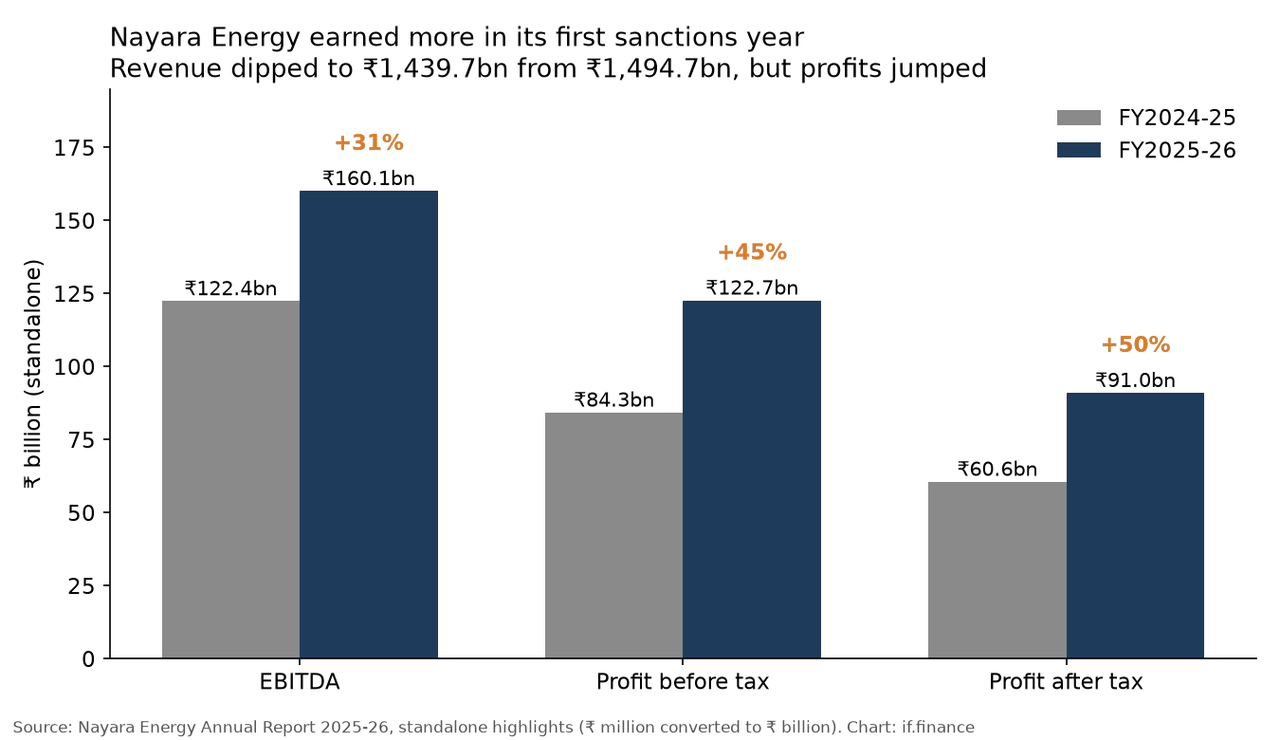
In the year to March 2026, standalone revenue slipped to ₹1,439.7 billion from ₹1,494.7 billion. EBITDA rose 31% to ₹160.1 billion and profit after tax rose 50% to ₹91.0 billion. Management puts those at roughly US$1.8 billion and US$1.02 billion. The refinery processed about 135.1 million barrels, and domestic sales made up about 82% of volume. Discounted Russian barrels clearly help: Kpler analysts quoted by Moneycontrol estimated the discount saves Nayara about $5–7 a barrel.
Read the footnotes, though. The board recommended no dividend “to conserve financial resources.” Because the sanctions give lenders the right to demand early repayment, Nayara has reclassified long-term loans due after March 2027 as current liabilities. No lender has acted on that right so far.
The 2026 squeeze at the pump
The Iran conflict has made Nayara’s 7,000-plus Indian fuel stations a political issue. On October 1, oil secretary Neeraj Mittal said “nobody is allowed to put a cap on fuel sales,” after reports that Nayara and Jio-bp were rationing diesel. Nayara says it imposed no supply restrictions on dealers. On October 3 it raised petrol prices by ₹5 a litre and diesel by ₹3 across 7,108 stations. State-run retailers held their prices, even though Icra estimates they are losing about ₹530 crore a day. Nayara’s diesel exports, meanwhile, dropped to an estimated 39,000 barrels a day in October from about 69,000 in September, according to Kpler data reported by The New Indian Express.
The stake sale that hasn’t happened
Rosneft has been trying to sell out since at least mid-2025. In June 2025 The Economic Times reported early talks with Reliance Industries, with price as the sticking point. Business Standard later cited reports valuing Nayara at about $17 billion and said the EU sanctions had become a “major roadblock.” As of October 31, 2026, we found no announced buyer, signed agreement or regulatory filing for a sale. Each new sanctions step makes the stake harder to sell. In September, CREA reported that gasoline from Vadinar was being sold to Rosneft and shipped back to Russia on sanctioned tankers, which puts the refinery even more squarely in the spotlight.
Where Essar is putting its money now

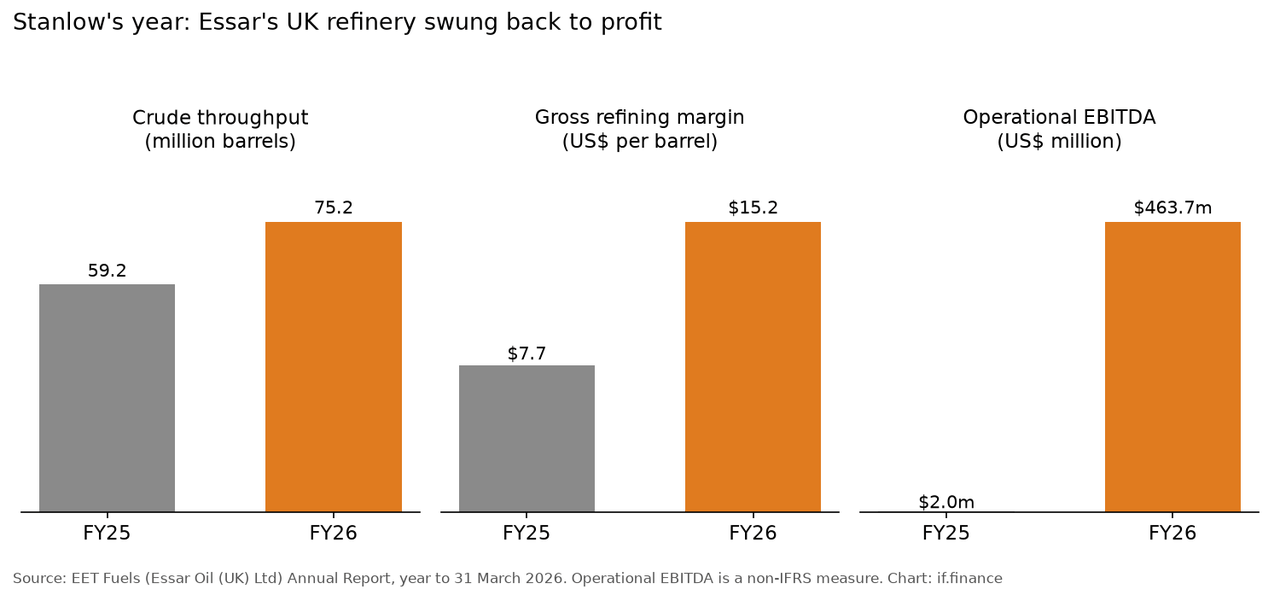
Stanlow is making money again. EET Fuels’ latest annual report, for the year to March 2026, shows revenue of US$11.98 billion and a pre-tax profit of US$23.2 million, compared with a US$325.9 million loss the year before. Throughput rose 27% after a full year of running and a capacity upgrade of about 8%. Stanlow supplies about 18% of UK road fuel.
Essar is pushing the UK business into retail too. On September 14, EET Retail agreed to buy all of SGN Retail. The deal adds 118 forecourts to its 117, for 235 sites selling more than 650 million litres a year, and Essar is aiming for 800 sites by 2031. It is being funded with cash plus a new £250 million senior debt facility. CEO Deepak Maheshwari put the price at £400 million in an interview with Business Today. He also described a £4.3 billion investment plan for Stanlow running to 2035, with more than £1 billion of projects close to a final investment decision. A 350 MW low-carbon hydrogen plant is the centrepiece, and the company is targeting a final investment decision on its first hydrogen plant in FY27. Public consultation on Phase 2 of Stanlow’s hydrogen-ready combined heat and power project runs from October 20 to November 18.
Is Stanlow the UK’s first green refinery? Not yet, but that is the plan, and part of it is already built. EET Fuels says it is delivering “the UK’s first low carbon process refinery” and aims to cut 95% of the emissions from its production processes, about 2 million tonnes of CO2 a year, by 2030. Roughly half is meant to come from switching the refinery’s fuel to hydrogen and half from carbon capture. What is done: in April 2025 it commissioned what it calls the UK’s first hydrogen-ready furnace. The furnace replaced three older ones and cuts about 16,600 tonnes of CO2 a year while still burning refinery off-gas. What is planned: the furnace is due to switch to 100% low-carbon hydrogen in 2028, saving about 200,000 tonnes a year, once EET Hydrogen’s 350 MW HPP1 plant is running. HPP1 is a “Priority” project in the UK’s HyNet carbon capture cluster, but it has not yet reached a final investment decision, which the company was targeting for the second half of 2026. The refinery’s own carbon capture unit is in the government’s “Standby” group, so it has to wait for spare pipeline and storage capacity. “First low-carbon refinery” is a fair description of Essar’s goal and of the work under way, but most of the promised CO2 cuts still depend on projects that are not yet funded.
Upstream, Essar Oil & Gas is expanding. On October 15, the company announced it had won five coal-bed methane (CBM) blocks in West Bengal, Madhya Pradesh and Telangana. Together they cover about 1,281 sq km with an estimated 6.6 trillion cubic feet of gas in place. The company produces about 950,000 standard cubic metres a day from Raniganj East, roughly half of India’s CBM output, and has invested more than ₹6,000 crore there. It has also outlined a roughly $100 million drilling programme aimed at about 5 million cubic metres a day by 2028.
The biggest new bet is American steel. On September 28, President Trump announced in the Oval Office that Mesabi Metallics, an Essar Group company, would build a $15 billion steel plant in Lee County, Iowa, near Wever on the Mississippi River. Add about $3 billion for its iron ore mine and pellet plant in Nashwauk, Minnesota, and Mesabi puts the total at $18 billion, which it calls the largest single investment in a steel complex in US history. The plant is designed to make up to 10 million tons of steel a year at full build-out, with a 7.5-million-ton first phase, using direct-reduced iron and electric arc furnaces. Midrex will supply the ironmaking technology. Production is projected to begin in 2030, and the White House says the plant will create 1,750 permanent jobs. Essar co-founder Ravi Ruia and Mesabi chairman Rewant Ruia spoke at the event, and the White House posted video of the announcement.
The Minnesota half is further along, and its history is rough. The project began as Essar Steel Minnesota, which filed for Chapter 11 in July 2016 after Minnesota moved to end its mineral leases. It emerged from bankruptcy under new owners as Mesabi Metallics in December 2017, and Essar regained control starting in 2019. Minnesota later cancelled Mesabi’s state leases and awarded them to Cleveland-Cliffs in 2023. Even so, the mine produced its first concentrate in September 2026, and the US Export-Import Bank approved a $770 million direct loan that Mesabi says completes the mine’s $2.5 billion funding. EXIM calls it the first new US iron ore mine and pellet plant in 50 years, with capacity of up to 7 million tons of pellets a year. The US package covers a mine and a steel plant. It does not include a port, although the Iowa site was chosen partly for barge access on the Mississippi.
Why it matters to investors
- The earnings come with a sanctions discount. Nayara is privately held, so its profits don’t show up in a share price. But they matter for anyone valuing an exit. Each new designation narrows the list of buyers, lenders and shipowners willing to deal with it.
- Watch the loan clause. The reclassified debt is the clearest risk. If lenders ever use their acceleration rights, the refinery’s position could change quickly.
- Listed peers feel it. Nayara’s price increases and export swings affect Reliance and the state-run fuel retailers, which do trade on Indian exchanges.
- Essar’s new energy bets depend on policy. Stanlow’s profits rely on UK refining margins and on government support for hydrogen and carbon capture, which Maheshwari himself flagged as a key risk. The CBM push depends on drilling results.
- The US steel plan is a promise, not yet a plant. The Minnesota mine is starting up with federal loan support, but first steel in Iowa is about four years away and the financing for the $15 billion plant has not been laid out. Rep. Pete Stauber, quoted by EXIM, said the bank could provide up to $10 billion for Mesabi’s expansion. Essar’s previous US steel venture went through Chapter 11.
The short version: Essar Oil, the company, is a sanctioned Russian-controlled refinery that keeps getting more profitable. Essar, the family business, lost its oil and steel crown jewels in 2017 and 2019, and it is building again: UK forecourts, a low-carbon refinery plan, Indian gas and an $18 billion US steel bet. They share a name, not a balance sheet.
This article is for information only and is not investment advice.
References
- Essar Energy and Oil Bidco Successfully Conclude Sale of Essar Oil Limited to Rosneft and Trafigura-UCP Consortium for US$12.9 billion, Essar (press release), August 21, 2017.
- Rosneft Successfully Closes Strategic Deal for the Acquisition of 49% of Essar Oil Limited, Rosneft, August 21, 2017.
- Indian Essar Oil changes corporate name to Nayara Energy Limited, Rosneft, June 6, 2018.
- Hara Capital Sarl completes purchase of Trafigura’s interest in Nayara Energy, Trafigura, January 11, 2023.
- Nayara Energy Limited Annual Report 2025-26, Nayara Energy (copy hosted by Altius Investech), 2026.
- Russia’s Rosneft Oil Company in early talks with Reliance to sell stake in India unit, The Economic Times, June 29, 2025.
- Rosneft’s stake sale in Nayara hits European Union sanctions roadblock, Business Standard, July 22, 2025.
- Indian refiner Nayara trims crude runs in wake of EU sanctions, sources say, Reuters, July 29, 2025.
- Russia-backed sanctioned Indian refiner boosts crude runs to 90%, sources say, Reuters, October 31, 2025.
- Sanctions-hit Nayara Energy faces fresh risks as India-US deal may tighten curbs on Russian oil, Moneycontrol, February 11, 2026.
- Nayara Energy to resume Vadinar refinery operations by mid-May after shutdown, The Hindu BusinessLine (Reuters), April 28, 2026.
- Nayara Energy restarts operations after maintenance shutdown, The Hindu BusinessLine (Reuters), May 19, 2026.
- Russia imports record fuel from India as Ukraine strikes hit refineries, The Hindu BusinessLine (PTI), September 13, 2026.
- Govt warns Nayara, RIL-BP against fuel sales caps amid diesel curb reports, The Economic Times, October 2, 2026.
- Nayara Energy says fuel supplies continue across 7,000-plus retail outlets, CNBC-TV18, October 2, 2026.
- Nayara Energy raises petrol price by Rs 5, diesel by Rs 3, The Economic Times, October 3, 2026.
- Reliance’s diesel exports hit 541 kbd as global supply tightens, The New Indian Express, October 29, 2026.
- EET Fuels Annual Report 2026 (Essar Oil (UK) Limited), EET Fuels, October 2026.
- Essar Energy Transition Retail (“EET Retail”) Acquires Leading UK Independent Forecourt Network SGN Retail, Essar Energy Transition, September 14, 2026 (updated September 30, 2026).
- Essar’s £4.3 billion Stanlow bet: Over £1 billion nears final investment decision, Business Today, September 22, 2026.
- Essar Energy Transition Hydrogen Ready CHP Project (Phase 2): Section 46 notification, UK Planning Inspectorate (EET Fuels filing), October 19, 2026.
- Essar Oil & Gas wins five coal-bed methane blocks across three states, The Indian Express, October 15, 2026.
- Essar Oil & Gas plans $100 million investment to boost Raniganj CBM production, Essar (reprinting The Economic Times), January 30, 2026.
- Essar Oil UK becomes EET Fuels, Essar (press release), January 25, 2024.
- Essar Energy Transition’s Hydrogen-Ready Furnace now Powering EET Fuels’ Stanlow Site, Essar (press release), April 30, 2025.
- HyNet expansion: project negotiation list, UK Department for Energy Security and Net Zero, August 5, 2025.
- CHP anchors offtake for EET’s 350MW blue hydrogen project targeting 2026 FID, gasworld, March 11, 2026.
- Essar Steel Completes Capacity Expansion at Hazira, Association for Iron & Steel Technology, January 5, 2012.
- Essar Steel Monetization, Essar (company history page).
- Essar Steel insolvency timeline: A saga of many twists and turns in IBC’s biggest case, Moneycontrol, November 2019.
- ArcelorMittal and Nippon Steel complete acquisition of Essar Steel, ArcelorMittal, December 16, 2019.
- ArcelorMittal and Nippon Steel Complete Joint Acquisition of Essar Steel in India, Nippon Steel, December 16, 2019.
- ArcelorMittal and Nippon Steel complete acquisition of Essar Steel, Business Standard, December 16, 2019.
- Essar files for bankruptcy after Dayton ends its bid to build Iron Range mine, plant, MPR News, July 8, 2016.
- Mesabi Metallics emerges from bankruptcy; idled Essar Steel project now able to advance, Duluth News Tribune, December 2017.
- Minnesota awards Nashwauk mineral leases to Cleveland-Cliffs, Star Tribune, 2023.
- Mesabi Metallics eyes $5 billion expansion as production, federal assistance ramp up, KAXE, September 18, 2026.
- EXIM Chairman Visits America’s First New Iron Ore Mine in 50 Years as Operations Begin in Northern Minnesota, Export-Import Bank of the United States, September 17, 2026.
- Board Meeting Minutes, September 24, 2026, Export-Import Bank of the United States.
- Mesabi Metallics Investing $18 Billion to Create a Fully Integrated American Steel Company, Mesabi Metallics (press release), September 28, 2026.
- Trump announces $15B steel plant in battleground Iowa, Associated Press, September 28, 2026.
- Remarks Announcing the Siting of a Mesabi Metallics Steel Manufacturing Facility in Southeastern Iowa, The American Presidency Project, September 28, 2026.
- President Trump announces Mesabi Metallics’ new mega steel plant in Iowa (video), The White House, September 28, 2026.
- Southeastern Iowa residents, leaders welcome potential economic impact of steel plant, WQAD, September 2026.
- Essar eyes $18-billion US steel plant: Why Indian firms are investing in US amid tariffs, The Indian Express, September 29, 2026.
- ICYMI: President Trump Announces Largest-Ever Steel Plant Coming to Iowa, The White House, September 30, 2026.
- Iowa Steel Plant Announced On Upper Miss, The Waterways Journal, October 2, 2026.
- Mesabi Metallics Selects Midrex for 10 Million Ton U.S. Steelmaking Facility, Midrex Technologies (press release), October 13, 2026.
- File:The Essar Oil Refinery.jpg, Abhisek Sarda, Wikimedia Commons, CC BY 2.0, 2008.
- File:Stanlow Point and Stanlow Refinery from the air, M J Richardson, Wikimedia Commons / geograph.org.uk, CC BY-SA 2.0, 2017.